
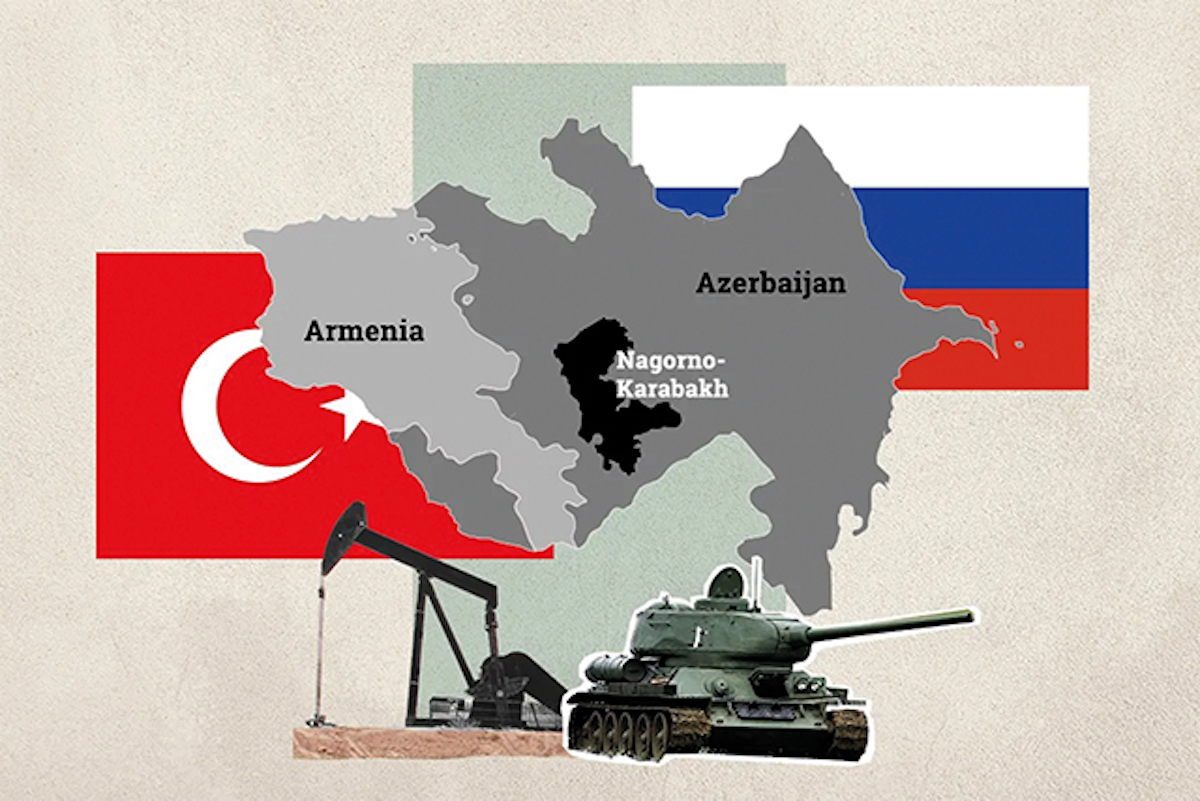
When Armenia regained independence in 1991, its security depended in part on relations between two historic rivals, Russia and Turkey. Armenia looked to Russia for protection, while Turkey drew closer to Azerbaijan, Armenia’s eastern neighbor and rival. The alliance gave Moscow a military foothold near the Turkish border. Turkey had been a member of NATO since 1952, and I thought Moscow valued its position in Armenia too highly to risk it for the sake of an agreement with Ankara. In my 2005 study of the South Caucasus, I called the relationship between Russia and Turkey a “geostrategic armistice.” They still competed for influence, but both showed restraint. As late as 2016, this writer argued that closer economic ties between them were unlikely on their own to change the balance of power in Nagorno-Karabakh. The region, then predominantly Armenian, was internationally recognized as part of Azerbaijan. The authorities of the self-proclaimed Nagorno-Karabakh Republic governed most of it with Armenia’s support. Today, the relationship between Russia and Turkey is best seen as pragmatic cooperation between rivals. And the balance between them has shifted in Turkey’s favor. How Turkey gained influence Turkey’s relations with Azerbaijan have shaped its policy towards Armenia since the early 1990s, as I discussed in a 2021 study of Turkish geostrategy. In 1993, during the first war over Nagorno-Karabakh, Turkey closed its land border with Armenia in support of Azerbaijan. In the years that followed, Turkey and Azerbaijan built close commercial ties. The Baku–Tbilisi–Ceyhan pipeline carried Azerbaijani oil through Georgia to a Turkish port on the Mediterranean. Armenian exporters, meanwhile, still had no direct land route to the Turkish market. In the second war over Nagorno-Karabakh in 2020, Turkey’s military and political support helped Azerbaijan win. Russia brokered the ceasefire, but its response fell short of what many Armenians expected of their ally. Moscow also agreed that Turkish officers would serve alongside Russian officers at a ceasefire monitoring center in Azerbaijan. Russia’s peacekeepers left Nagorno-Karabakh in 2024. Turkey retained its influence through its alliance with Azerbaijan. After the outbreak of full-scale war in Ukraine in 2022, Turkey maintained relations with Kyiv but declined to join Western sanctions against Moscow. As access to Western markets narrowed, trade through Turkey became more important to Russian firms. When I wrote about the Russian alliance 20 years ago, I gave considerable weight to Moscow’s military interests in Armenia. Today, I would also ask what a dispute with Turkey over Armenia might cost Russia. I believe Armenia should preserve friendly relations with Russia while relying less on Moscow for its security. In 2023, at Armenia’s invitation, European Union civilian observers began monitoring the Armenian side of the border with Azerbaijan. What it would take to open the border In an interview with Radar Armenia, I recalled Armenia’s longstanding offer to establish diplomatic relations with Turkey and open the border without preconditions. In 2009, the two governments signed the Zurich Protocols, which provided for both steps. However, the agreements never entered into force. Turkey and Azerbaijan formalized their alliance in the Shusha Declaration of 2021. I argued in Eurasia Review that Turkish backing also gave Azerbaijan greater freedom to pursue its own interests. In a recent interview with Noyan Tapan, I discussed Turkish President Recep Tayyip Erdogan’s insistence on an Armenian–Azerbaijani peace agreement before Turkey fully normalizes relations with Armenia. That condition gives Baku, the Azerbaijani capital, a say in when the Armenian-Turkish border opens. The two sides have continued to discuss a connecting railway even while the border remains closed. In April 2026, Armenian and Turkish officials met in eastern Turkey to discuss restoring the line to Gyumri in northwestern Armenia. If freight trains ran again, a producer in Gyumri could ship goods directly to customers across the border or send them on to a Turkish port on the Mediterranean. What Armenia can negotiate for itself In southern Armenia, it is Azerbaijan that needs a route across its neighbor’s territory. The Armenian province of Syunik separates the main part of Azerbaijan from Nakhchivan, an Azerbaijani territory bordering Turkey. The proposed US-backed Trump Route for International Peace and Prosperity (TRIPP) would link the two across Syunik. Turkey would gain a more direct route east to Azerbaijan and Central Asia. Significantly, Russia has expressed interest in participating. It already has a role in Armenia’s railways, which a subsidiary of Russian Railways operates under a concession agreement. Yerevan has its own railway proposal. It wants Armenian trains to run from Yeraskh through Nakhchivan to Meghri. Both towns are in Armenia, but the line between them passes through Azerbaijani territory. The Washington Declaration spells out the connection Azerbaijan seeks. It promises Armenia reciprocal benefits but leaves the Armenian route unspecified. An agreement on Syunik, in part, would determine whether an Armenian train from the capital, Yerevan, could once again reach Meghri through Nakhchivan. Ruben Safrastyan is a historian of Turkey, a professor and a full member of the National Academy of Sciences of Armenia. He directed the Academy’s Institute of Oriental Studies from 2006 to 2020 and is now an adviser to its director. He also worked in Armenia’s presidential administration and served as a diplomat.
Armenia between Russia and Turkey in a shifting South Caucasus
Full Article
Original Source
Read the full article at Asiatimes →KhanList aggregates and links to publicly available news content. We do not host full articles from third-party sources. Always verify important information with original sources.