
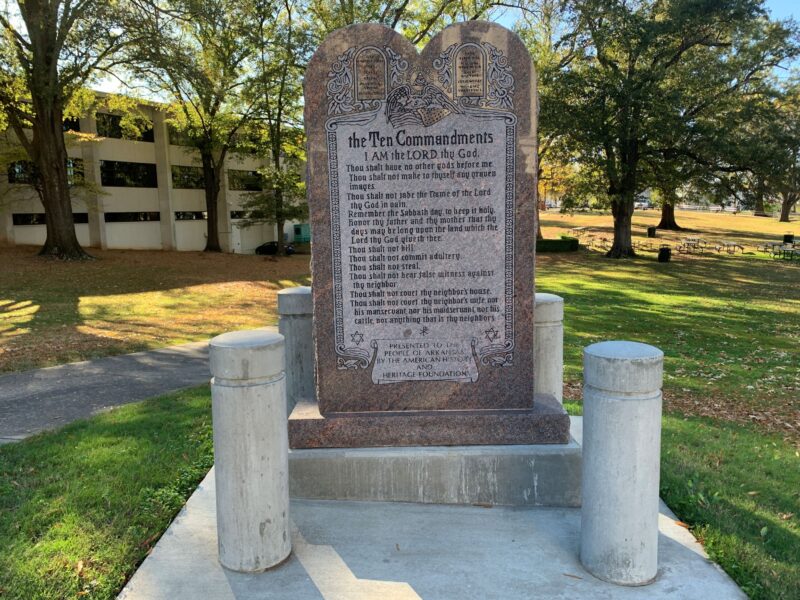
A group of parents claim the law violates students' constitutional rights, but the state argues there's nothing coercive about a poster.ST. LOUIS (CN) — The State of Arkansas asked the Eighth Circuit on Tuesday to reinstate a law requiring the Ten Commandments to be posted in public school classrooms.“Act 573’s requirement that schools put a historical Ten Commandments poster on classroom walls does not constitute a religious establishment or burden free-exercise rights,” Arkansas Solicitor General Autumn Hamit Patterson told the three-judge panel.The 2025 state law provides for “a historical representation of the Ten Commandments” to be posted in public school classrooms and libraries if a poster or funds are donated for that purpose.It requires the poster be at least 16x20 inches with text “legible to a person with average vision,” and that it be “in a conspicuous place.”U.S. Circuit Judge David Stras, a Trump appointee, pushed both sides about neutrality.“One thing that I think is very difficult, which is most of the time it’s limiting religious activity with free exercise, but here you actually have religious activity coming into the classroom,” Stras said. “So, I’m really struggling. I couldn’t find a lot of cases where we have that scenario, and I’m trying to figure out how neutral works here.”Patterson said a passive poster on the wall doesn’t coerce or require students to do anything.Attorney Jonathan K. Youngwood, representing a group of parents and students opposed to the law, views it differently.“There’s nothing neutral about it, your honor,” Youngwood, of Simpson Thacher & Bartlett LLP of New York, NY, said. “‘I am the Lord thy God. Thou shalt have no other gods before me.’ That is completely inconsistent to an atheist family. It is inconsistent to any tradition that has multiple gods.”U.S. Circuit Judge Bobby E. Shepherd, a George W. Bush appointee, asked Youngwood what was objectionable about the message.“Is it that there’s the three words ‘The Ten Commandments’ followed by text, and so it really doesn’t make any difference what the text is?” Shepherd asked. “You just see it on the wall, and you see the word ‘Ten Commandments,’ and so that’s religious? Is that the idea, or is it the content here of this mandated text?”U.S. Circuit Judge L. Steven Grasz, a Trump appointee, asked how this differed from teaching evolution, since it contradicts Christian, Judaic and Islamic traditions.Youngwood said the teaching belongs in a World Religions class, just like evolution belongs in a science class.“Schools use their limited classroom walls to teach,” Youngwood said. “This is instruction. These are, after all, commandments, and they are directly religious.”Patterson pushed back on that argument.“The act does not require the Ten Commandments to be incorporated into the public school curriculum at all, and there’s no requirement for teachers, school officials or students to interact with, bring attention to or even acknowledge the posters in any way,” Patterson said.Before Act 573 went into effect, parents sued four school districts on behalf of 14 students, claiming the law violates the establishment and free exercise clauses of the U.S. Constitution.On March 16, U.S. District Judge Timothy L. Brooks found in favor of the parents, saying Ten Commandments posters usurp parents’ ability to direct their children’s religious upbringing. In the 26-page opinion, the Barack Obama appointee wrote, “The law serves no educational purpose, as the state admits, and consequently deprives plaintiffs of their rights.”Brooks’ decision prompted the state’s appeal to the Eighth Circuit.In its brief, Arkansas claims Brooks misapplied the 1980 Supreme Court ruling in Stone v. Graham, which found a Kentucky statute requiring the Ten Commandments in public school classrooms violated the First Amendment’s establishment clause.“The district court wrongly applied Stonebroadly to mean that displaying a historical representation of the Ten Commandments in classrooms can only have a religious purpose — ‘to proselytize’ — which it concluded was buttressed by cherrypicked statements of legislators and an invented admission,” Arkansas wrote. “But the district court wrongly ignored the cases post-dating Stonethat clarified that posting the Ten Commandments could have a secular purpose too and that even prayers and nativity scenes can serve a secular purpose.”The parents, in their brief, claim they would be irreparably harmed by the law.“Absent an injunction, pursuant to Act 573, scripture would adorn the walls of plaintiffs’ schools, pressuring the child-plaintiffs to observe, read, meditate on and even obey the commandments’ religious directives and usurping the parent-plaintiffs’ right to guide their children’s upbringing on matters of faith,” the parents wrote.The court took the arguments under advisement. There is no timetable for a ruling.Subscribe to our free newslettersOur weekly newsletter Closing Arguments offers the latest about ongoing trials, major litigation and rulings in courthouses around the U.S. and the world, while the monthly Under the Lights dishes the legal dirt from Hollywood, sports, Big Tech and the arts.Additional Reads
Arkansas pushes Eighth Circuit to revive Ten Commandments requirement in schools
Full Article
Original Source
Read the full article at Courthousenews →KhanList aggregates and links to publicly available news content. We do not host full articles from third-party sources. Always verify important information with original sources.