
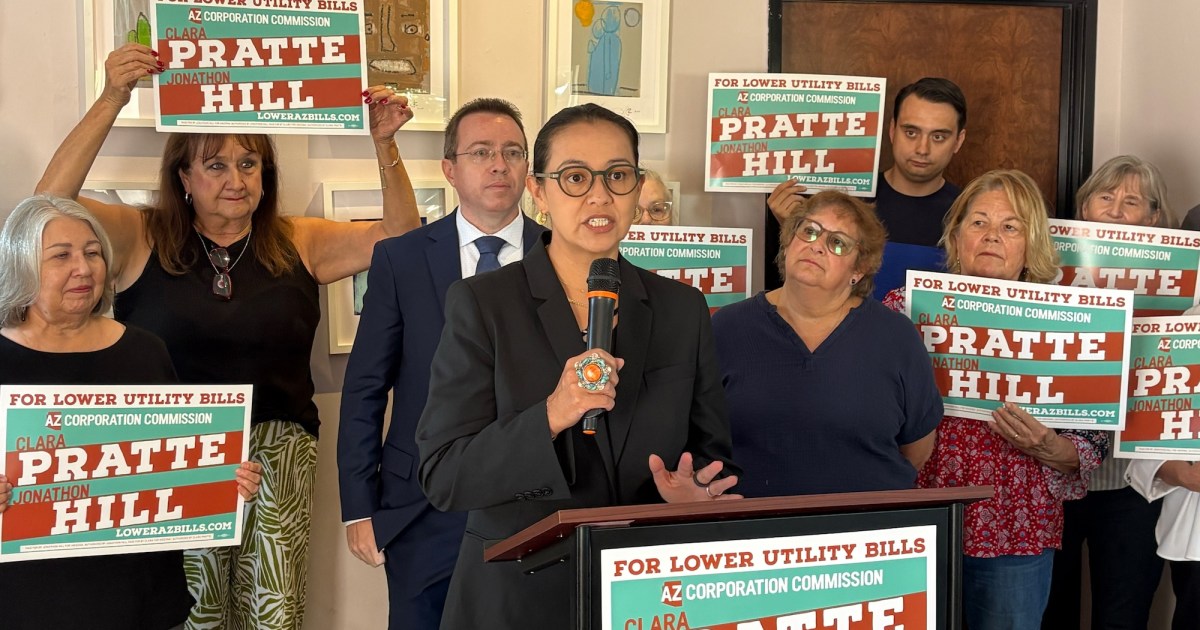
Democrat Clara Pratte, a candidate for the Arizona Corporation Commission, speaks at a press conference.Wyatt Myskow/Inside Climate News Get your news from a source that’s not owned and controlled by oligarchs. Sign up for the free Mother Jones Daily. This story was originally published by Inside Climate News and is reproduced here as part of the Climate Desk collaboration. Koral Casillas’ American Dream was simple: Leave her corporate job to start a local business serving her community. Five years ago, she did just that. She’s now the co-owner of two local Phoenix businesses—Monsoon Market, a purveyor of local goods, and Strip Mall, a coffee and wine shop. But this summer, Casillas said, she was rudely awakened from her dream when her August utility bill came in at $1,500—far higher than any bill she had received before; the next month, it rose again, to $1,700. Casillas’ story quickly made the rounds on social media, and she’s using the recent attention to highlight a little-known elected office in Arizona tasked with regulating the state’s utilities, the Arizona Corporation Commission. The ACC is currently considering approving another 14 percent rate increase from Arizona Power Service—its third price hike from the utility in four years. “It’s already pretty hard to operate a small business here in Arizona, and the risk of utility bills continuing to rise [is] probably [the] greatest one facing us today,” Casillas said at a press conference at Strip Mall featuring Clara Pratte and Jonathon Hill, Democratic candidates for the ACC. They are running against Republicans Kevin Thompson, a current commissioner, and Ralph Heap, a state lawmaker facing a campaign finance investigation, neither of whom responded to requests for comment. “Arizonans are paying attention to these issues like they never have before, because it’s affecting them so much.” “While I can shop around for cheaper costs for coffee beans and paper goods, I am sadly stuck with my utility provider, APS,” Casillas said. “This story isn’t unique, and I know that I’m not alone here. Our members on the ACC are supposed to negotiate and regulate companies like APS to ensure that they are providing safe and reliable power to all of us Arizona residents and small business owners. They have failed us.” Created in 1912 under the state’s constitution, the ACC regulates the state’s water and power utilities, determining how much customers can be charged, how much profit utilities can make and how Arizona’s power grid is built and operated, among other responsibilities. The state is one of 10 where the commissioners are elected and are separate from the state’s other branches of government, meaning only elections and lawsuits can hold them accountable. In the 2024 election, Republicans took control of all five seats on the commission. In the two years since, the commission has repealed the state’s energy efficiency standards and renewable energy standards. It also approved the first formula rate plans, which allow utilities to adjust their rates annually based on a pre-established formula, rather than go through a rate hearing process that involves more oversight and transparency about the need for the increase. “Each of these decisions dealt a blow to consumers. Combined, it’s like a knockout punch,” said Diane Brown, executive director of the nonprofit Arizona Public Interest Research Group Education Fund. “In the upcoming year, the next commission will have major consequential decisions to make related to rate cases, data centers and energy resources, and the decisions of the next commission are extremely likely to impact ratepayer bills for years to come.” Recent polling from The Nature Conservancy in Arizona and the Arizona PIRG Education Fund found about 80 percent of Arizonans said their electricity bills rose in the last two years. Over 60 percent said their summer bills are difficult to afford, and another roughly 60 percent said they keep their thermostat set above comfortable temperatures to save money in the hot summer months. “The polling signifies a disconnect between what Arizonans want when it comes to energy efficiency programs provided by their utility, and what the Arizona Corporation Commission has done by repealing Arizona’s very successful energy efficiency standard,” which saved Arizonans over $1.7 billion dollars and over 2,000 megawatts in cumulative peak demand energy savings, Brown said. Pratte and Hill have campaigned on bringing transparency and accountability to the commission, limiting excessive rate increases for ratepayers, requiring large energy users to pay their fair share and developing more renewable energy in the state. “Arizonans are sick and tired of commissioners who will not fight for them,” said Pratte at the press conference. Pratte is a member of the Navajo Nation and co-founded Navajo Power, which partners with tribal communities to build renewable energy projects. Pratte and Hill cite a recent analysis that shows between 2023 and 2025, homeowners and businesses paid $587 million for costs associated with the “large load” sector, such as data centers. In a statement, APS said the analysis “reaches false conclusions” and “oversimplifies a complex issue.” But Pratte and Hill are calling on the ACC to require APS to open its books and launch an investigation into the claims. “Arizona ratepayers deserve an answer to this very important question” of whether ratepayers are helping pay for the surge of electricity costs driven by data centers in the state, Hill said. “If small businesses, families, seniors are paying for billions of dollars of data center costs, we will demand an immediate reimbursement for those customers,” Hill said. “Arizonans are paying attention to these issues like they never have before, because it’s affecting them so much. Arizonans are realizing that something needs to change, because they’re seeing their utility bills every month, and the problem is only getting worse.”
Arizona Dems Aim to Win a Voice in Energy Policy on Tuesday
Full Article
Original Source
Read the full article at Motherjones →KhanList aggregates and links to publicly available news content. We do not host full articles from third-party sources. Always verify important information with original sources.