
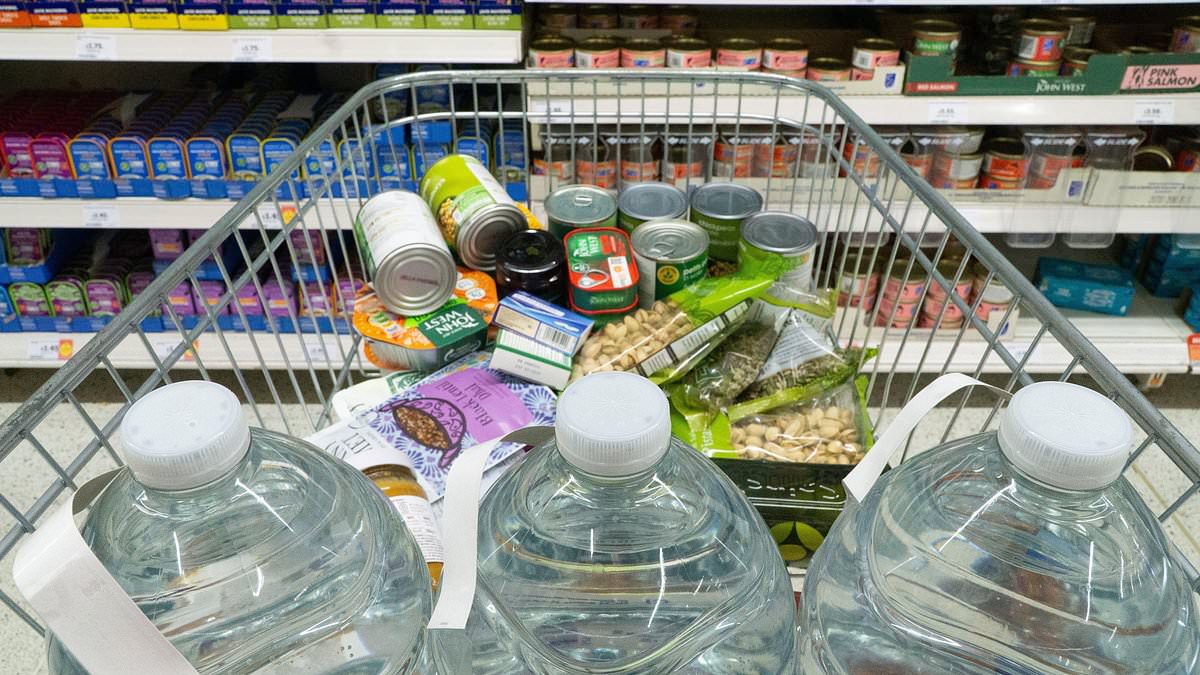
With stockpiling the hot topic of the moment, you might be tempted to rush out and panic-buy everything you could possibly need in an emergency. But experts warn that filling your disaster cupboard in a flurry could actually make shortages worse.Instead, they recommend building up emergency supplies gradually over several weeks.The approach not only spreads the cost for households, but also reduces the risk of panic buying, which can leave supermarket shelves bare.'Build up supplies over a month, adding two or three items to each shop,' Dr Sayed Elhoushy, senior lecturer in Marketing at Queen Mary University of London and Shaheen Hosany, an Associate Professor of Marketing at Hult International Business School, wrote on The Conversation.'Start with water and tinned food, then add medicines and batteries. This spreads demand for retailers, spreads the cost for households, and gives people a clear plan to follow.' Experts say filling a disaster cupboard all at once could make supermarket shortages worse - and encouraged people to gradually build up their supplies Last month, the Government launched a campaign encouraging people to stockpile three days of food and water in case of emergency, prompting 'Prepper Panic' among shoppers A shopper captured the 'chaotic' moment preppers descended on a Costco store and piled their trolleys high with essentials - after the government urged Britons to prep a 'survival kit'The researchers said recent events, such as the Covid pandemic, have shown how quickly fears over shortages can spread.During this time supermarket aisles were stripped of toilet paper, pasta and household essentials.'Shoppers can still strip a shelf, even if they all buy little amounts, at once,' they warned.'The anticipation of empty shelves can then raise urgency and fear. That urgency and fear change how people shop. When people feel unsafe, they buy more, and shortages follow, real or imagined.'Scarcity makes products more desirable and pushes people to seek more, within short notice. In the pandemic, the risk of store closures created panic. People rushed for staples, driven by fear of missing out, social conformity or herd mentality.'Last month, the Government launched a campaign encouraging people to stockpile three days of food and water in case of emergency.The checklist of measures – which people were urged to print out and keep handy – also included having a power pack to charge devices if the power goes off.Defence Secretary Wes Streeting said the guidance would help people brace for events such as wildfires, flooding and cyber attacks.However, senior officials and military figures had also been highlighting the risk of sabotage or even a strike by Russia.It triggered so-called 'Prepper Panic', with some supermarkets seeing shelves emptied of baked beans and bottled water. Experts say Government warnings about the need to be prepared helped drive sales volumes up 0.7 per cent in OctoberThe experts explained that a calmer and more organised approach may be the best way to prepare for the unexpected.The problem is not necessarily a lack of supplies but the psychology of scarcity.'Uncertainty can also fuel people's anxiety, making panic buying more likely,' they said.'When many households act on the same advice in the same week, they can create the very empty shelves that unsettle others. A clear plan gives that control back.'Rather than making a single large purchase, they recommend gradually assembling emergency supplies over the course of around a month.Their preferred strategy involves adding a handful of extra items during routine shopping trips.The researchers argue that this approach benefits both consumers and supermarkets by avoiding sudden spikes in demand. It also makes it easier for households to prepare without facing a large upfront bill.Social media can also play a major role in shaping people's perceptions of shortages, the experts added.'A study of UK shoppers during COVID found that photos of empty shelves on social media increased uncertainty about stock - many responded by buying more,' they said.'Those photos can signal fear and lead to panic.'They said retailers can help prevent runs on products by introducing measures such as temporary purchase limits when demand begins to surge. During COVID, supermarket aisles were stripped of toilet paper, pasta and household essentials. Pictured: Trolleys piled high for delivery are seen as shoppers queue at the checkout of a supermarket in London on March 14, 2020While the UK Government advises households to keep three days' worth of supplies on hand, some specialists warn that is nowhere near enough.Instead, they recommend stockpiling enough food, water and other essentials to last for up to two weeks.Doing so could help families through anything from extreme storms and widespread power outages to terrorist attacks and even a nuclear emergency.'Stockpiling at least two weeks of supplies, for those who can afford it, is much better than three days in order to get through many more types of crises, including helping those around us,' Professor Ilan Kelman, a disaster and climate expert at University College London, told the Daily Mail.'Many scenarios exist with electricity, water and transport routes unavailable for longer than 72 hours.'A resilient society includes households being able to afford and having at least two weeks of emergency supplies.'
Are you stockpiling? Scientists reveal the best tactic to build up a disaster-proof store - and why panic buying is the worst thing you can do
Full Article
Original Source
Read the full article at Dailymail →KhanList aggregates and links to publicly available news content. We do not host full articles from third-party sources. Always verify important information with original sources.