
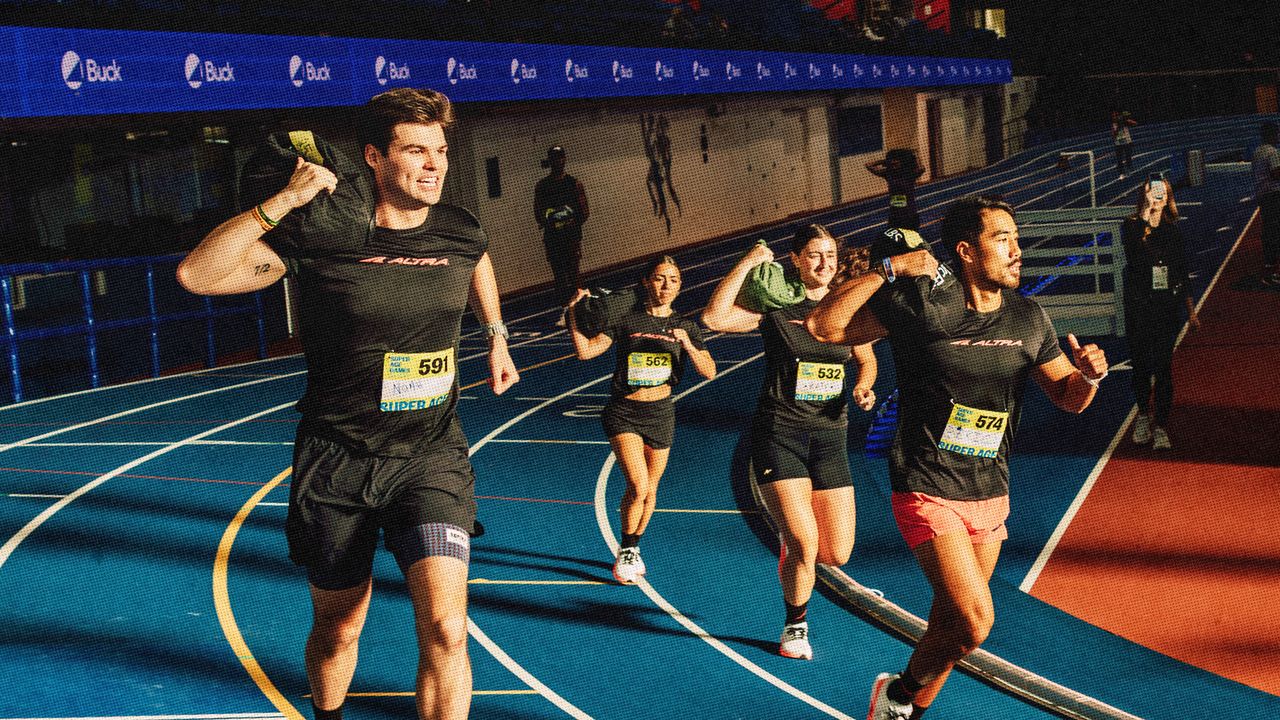
Balance beams, obstacle courses, and brain games. Inside the Super Age Games that are testing what it means to have longevity.Marianna JamadiAlan Krepack stands with his hands on his hips and takes a deep breath as he sizes up the Over Under: an obstacle with a high wooden box and low wooden beam spread 10 meters apart. Music booms over the speakers and other competitors shuffle around the cavernous room of the Armory Track in Washington Heights, New York, but Krepack stays laser-focused, thanks to years of meditation practice.As soon as the volunteer says “go” he sprints to the box, plants his hands, and hoists his feet up and over. As he lands on the other side, he sprints to the beam, dropping down into an army crawl. “Take your time, take your time,” his son yells from the sidelines. Krepack reaches the far end, rushes back, and repeats the sequence again before crossing the line in 51 seconds. To cool down, he paces back and forth with his hands on his head. “I think I’m a sprinter, I’m a jumper, but then it’s like, fuck, no, I’m 73 years old,” he says, catching his breath.The challenge is just the first of eight trials Krepeck will tackle throughout the day alongside his sons, Harrison and Aaron, at the Super Age Games, a fitness and mental competition designed to assess abilities associated with healthy aging. On November 7th, the inaugural day-long event drew 530 athletes from 42 states and 15 countries, and about 70% of participants were between the ages of 40 and 64. Krepeck agreed to let me shadow him to understand this new event through the lens of someone who is, in fact, aging, and would like to do so gracefully.The name of the Games comes from a buzzword that originated in the longevity world: super ager. The term was originally coined by Northwestern University researchers to describe adults over 80 whose memories rival those of people 30 years younger. These days it’s thrown around on podcasts and in books to describe anyone who defies both the typical trajectory of both cognitive and physical aging.The inaugural Super Age Games drew 530 athletes from 42 states and 15 countries. Marianna JamadiFrom crawling across a cargo net to reading microexpressions, the challenges in the competition measure longevity markers like functional strength, aerobic capacity, balance, and cognitive skill. At the end, athletes see where they rank among their age group and receive their “Super Age,” learning how their body’s physical fitness stacks up against the general U.S. population’s.In an era where your average middle-aged midwestern dad is training for Hyrox, and a new, outlandishly extreme challenge is being invented every few months, the Super Age games are a low-key counterpoint to raw, stunty, athleticism, born from the metric-obsessed fitness subcultures who prize longevity above all. And now that fitness trackers like Whoop or Apple Watch can track VO2max, heart rate variability, and resting heart rates, that group continues to grow. Along the way, these stats have become status symbols on par with owning a Lamborghini. And now that overall health is quantifiable, fitness values have become less about just how fast you run or how much you lift, but how slowly aging.It follows that, despite its name, Super Age Games isn’t just for aging athletes. The crowd there leaned middle-aged, and the youngest person at the competition was 21. As we stood by the dead hang station, Krepak pointed across the room at a brolic young man who looked like he could be an NFL prospect: “That dude’s a serious athlete,” he says, as we watched him run around the track cradling a sandbag on his shoulder.Unlike competitions like Hyrox, where athletes race through a sequence of workouts against the clock, the Super Age Games allows competitors to rest as long as they need between trials. In fact, Junior Kennedy, the fitness program director for the Games, encourages it. “There's no rush,” he says. “The goal is to get through each event as intentionally as you can. We need to understand what it means to recover.”Each trial was developed with a certain longevity marker in mind, and developed with input from researchers at the Buck Institute for Research on Aging, a leading nonprofit research center based in Novato, California dedicated to understanding aging. The Over Under, for example, tests agility by judging how fast you can change levels and switch directions. Meanwhile, the Synapse, a challenge where participants track moving balls on a screen and identify them after they've been shuffled around, is meant to measure cognitive processing.Krepack, a psychologist and lifelong athlete from Mill Valley, California, first heard about the event through its founder, David Stewart. Stewart is a media founder behind two niche longevity platforms, AGEIST and Super Age, where he writes about longevity, wellness, and redefining aging (one of his website testimonial’s says he has made aging “cool and aspirational.”). Krepack’s generally a skeptic of the profit-driven modern wellness industry—“I've always had a jaded view of all of that stuff,” he says—but he has followed both Stewart and the Buck Institutes’ work for years.The competition appealed to Krepack, in part because he’s spent decades cultivating a consistent exercise routine he’s proud of. He played baseball in college and has spent much of his life skiing, cycling, and playing other sports. These days, his schedule revolves around a handful of rituals: bike rides on Mondays and Fridays, a Saturday hike with a friend, gardening, yoga, and Zen meditation most days. When he signed up for the Games in June, he altered his exercise routine, lifted more weights, practiced hanging from a bar, and experimented with the Neurotracker cognitive test online.Yet all that training didn’t prepare Krepack for the biggest surprise of his day. After scoring well on both the Inferno (the assault bike VO2max test) and Synapse, next came the fourth trial: the “Tightrope,” a balance challenge that requires competitors to walk along a low beam while carrying a water-filled bag, taking as many consecutive steps as they can in two minutes without falling. He had expected to excel, thanks to years of skiing and yoga. Instead, he struggled to keep steady as the water shifted inside the bag. As his foot slipped off the bar, his eyes got wide. “I can’t believe my balance,” he says. “That’s my one disappointment in life now.”Alan Krepack's sons Harrison and Aaron during the “tightrope” challenge. Krepack was still hard on himself as we walked over to the dead hang trial. But after beating both his sons’ times, he seemed to get his competitive spirit back. He pushed through the remaining challenge determined to finish strong. And he did: By the end of the Games, he had placed second overall, with scores adjusted for age.A few days after the competition, I checked in with Krepack to ask him how he’d processed the event. He responded with screenshots of his scores. His highest score came from the cargo net, which he credited to sheer determination rather than any particular finesse: “due to my will and overcoming an unconventional and desperate style!” he texted me, “Plus my sons were great support and focus partners.”But the Games were also a reality check about aging: “I left there feeling both young and old,” he tells me on a phone call. As he watched his sons rocket through the obstacles, he was forced to confront how much of his athleticism he’d lost. “They just flew over it. They were so fluid, and so fast,” he says. “I’m not 30 or 40 or 50 or 60 anymore.”Krepack with his sons. Photo courtesy of Hannah SingletonDespite all the longevity industry's promises of maintaining youth, Krepack sees little value in denying the inevitable. Aging well, he says, is about “accepting, improving, and doing your best. It’s not a denial of who you are at this point in life.” The goal, he says, is to make the most of what you’re still capable of.Not a subscriber? Join GQ to receive full access to GQ.com.Hannah Singleton is a freelance journalist who writes about fitness, health, wellness, and the environment. Her work has been featured in publications such as the New York Times, Wall Street Journal, GQ, Vox, Wired, National Geographic, Forbes, and Fast Company. She earned a master's degree in environmental studies from Prescott ... Read More
Are You a Super Ager? This Competition Will Be the Judge of That
Full Article
Original Source
Read the full article at Gq →KhanList aggregates and links to publicly available news content. We do not host full articles from third-party sources. Always verify important information with original sources.