
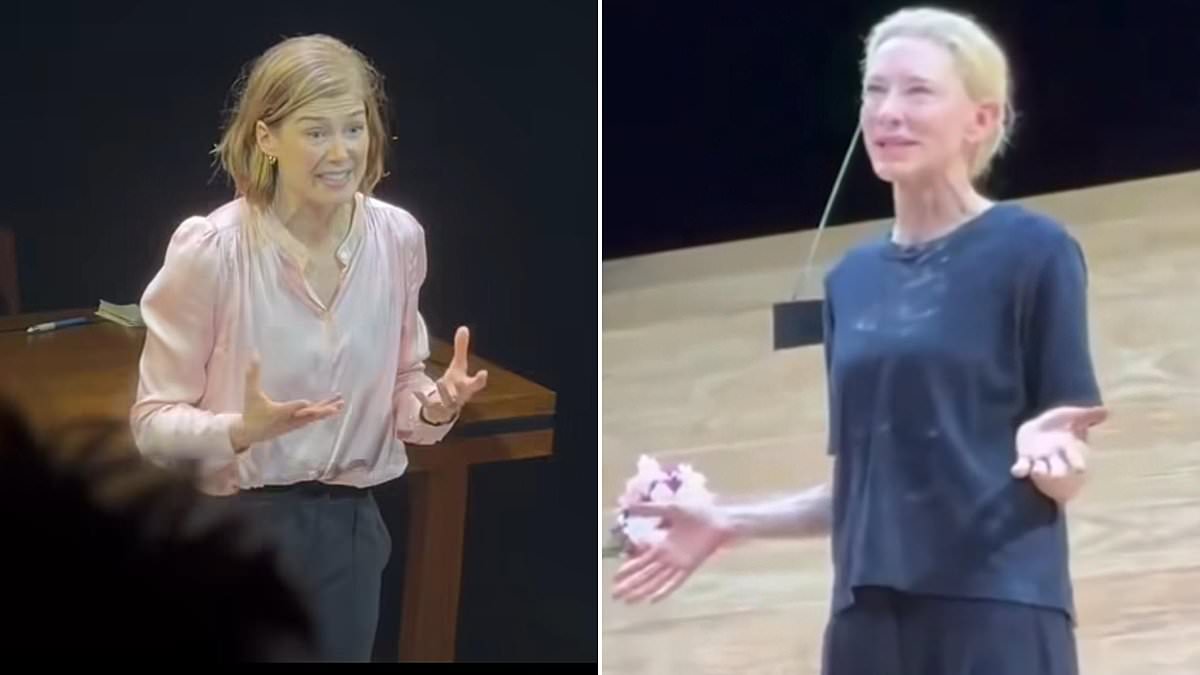
An evening at the theatre often offers a chance to switch off and leave reality behind – apart from when audience members breach the unwritten rules that ensure the atmosphere, fellow theatregoers and actors are respected.From tardiness and loud noises to obstructive headwear and phones screens, there is a tranche of fatal errors that could leave you falling out of favour.And last week actress Cate Blanchett became the latest star to express her disdain at fans filming theatre performances without permission.During the curtain call of a performance of Electra/Persona on Friday, Cate was filmed urging theatregoers at London's Lyttelton Theatre not to film her on stage mid-performance as it 'spoils it for the next group' – and pleaded with the audience to 'be together and be present'.She said: 'I understand you like filming the curtain call – and it is kind of flattering in a way – but for anyone who is filming the show, please don't, because it spoils it for the next group of people who come in and are present with us. So thank you very much.'Fellow actors Rosamund Pike and Cynthia Erivo have also recently chastised audience members for using their phones during their West End productions.According to Laura Windsor, dubbed the Queen of Etiquette, who advised Netflix on Regency-era social graces for Bridgerton, a considerate theatregoer should be mindful that 'everyone enjoys the experience together'.Laura told the Daily Mail: 'When you go to the theatre, you are sharing space with other people.'They have paid to immerse themselves in a performance, not to listen to you rustling through a packet of crisps, humming along to the music or conducting a private conversation with someone in front of you.'No one is asking you to behave as though you have stepped out of a nineteenth-century etiquette manual. But you should have enough awareness to understand that shared experiences require shared consideration.'From respecting the queue to mobile phones, read on for the ultimate guide to navigating theatre etiquette – and the key mistakes to avoid at all costs... Cate, 57, was seen last week urging theatregoers at London's Lyttelton Theatre not to film her on stage1. Turn off your phone. Yes, off... completely offLaura: Do not wait for the announcement reminding you to switch off your phone. Do it before you enter the theatre. If your phone rings during the most important moment of the performance, you may well miss the climax of the plot – and so might everyone around you.And, please, do not assume that putting it on vibrate is considerate. The vibration can still be heard, and the illuminated screen will surely distract those sitting around you.Your phone is not an extension of your hand. You can survive a couple of hours without it.2. Never whisper, let alone talk, during the performanceLaura: Whispering is not magically an acceptable behaviour simply because you have lowered the volume. It is still noise, and noise interferes with other people’s enjoyment.People have come to listen to the actors, the musicians and the performers – not a running commentary from you.If you have something important to say, may I suggest you save it for the interval? Or, better still, wait until tomorrow!3. Don't hum along with songs – this is not the time to audition from your seatLaura: I can understand someone adoring the music. I really can. But the audience has come to listen to professional singers, not to discover whether you should be on Britain’s Got Talent.Humming, singing along even tapping your feet enthusiastically may be great in your living room. In a theatre, it’s only a distraction for everyone around you.Let the professionals have their moment and save yours for the privacy of your shower.4. Ditch the picnic – and finish your interval ice cream before the play restarts Laura: There is a time and a place for snacks, and a theatre performance is not one of them. Avoid noisy foods, rustling packaging and anything with a powerful aroma.Perhaps eat beforehand, enjoy your interval refreshments, and remember: you are not a grazing animal. You do not need to be continuously feeding yourself throughout the performance. It may mean you are bored, so why not just skip the performance and go down the pub.Don’t bring outside food or drinks into the theatre, particularly if they’re noisy. Do I really need to comment on that? Earlier this year, Rosamund Pike berated an audience member for texting during the finale of her West End performance 5. Respect the queue. This is Britain, after allLaura: The British have elevated queuing to an art form. We form a line, we wait our turn, and we respect the people who arrived before us.So, do not push in, and do not invite someone to join you in front of those who have been patiently waiting. Unless, of course, there is a genuine reason, such as helping an elderly person or someone with a disability.If you do need to let someone through or make an exception, be considerate of those around you, apologise and make sure that queue-jumping does not become a feature of your personality.6. If you’re ill, perhaps stay homeLaura: A little cough is one thing. A prolonged coughing fit, constant sneezing or persistent sniffing or, worse, snorting throughout a performance is another.If you are genuinely unwell, is it really sensible to be seen in public, confined in a smallish space spreading your germs around for all to share? Of course it’s not just for the people around you, it’s for your own comfort too.And if you find yourself having a coughing fit during the performance, step outside; there is nothing wrong in leaving for a moment. In fact, it’s probably the most considerate thing you can do.7. If someone has to stand to let you through, please acknowledge themLaura: If you need to pass someone who is seated, offer a simple 'Excuse me, thank you' unless the performance has already begun. Then mimic the above with hand gestures and facial expressions, perhaps a nod and a smile, moving quietly with as little disruption as possible.8. Be considerate if you are late – and avoid applauding the actors' entrances and exitsLaura: Of course, sometimes life happens and traffic, transport disruptions and unexpected delays can make it difficult to be on time. But punctuality is a form of consideration towards others. If you do arrive late, a polite nod or smile to those you are disturbing is sufficient, without engaging in a series of whispered thank-yous.And please, do not applaud the actors’ entrances and exits as though you are personally welcoming them into your home, unless of course it’s part of the production.9. Dress with pride, but not in all your finery Laura: While going to the theatre may not have a particular dress code, I do believe in making an effort.Going to the theatre is an occasion, and dressing with a little effort shows respect for the performers, the setting and, indeed, yourself!In the past, audiences attended in white tie, top hats and long gowns. I am not suggesting we should return to the full evening dress code but there is something special about treating a theatrical performance as an occasion worth dressing for.It is always better to be slightly overdressed than to look as though you’ve just wandered in after a workout. In April, Cynthia Erivo brought her latest West End performance in Dracula to a dramatic halt after an audience member was seen filming the production on their mobile phone10. Children? Only if they are ready for the experienceLaura: Although introducing children to the arts can be a wonderful experience, they should be at an age where they can sit quietly, remain pretty still and understand that there is a distinction between how they behave in their own house and out in public spaces. If a child is constantly talking, fidgeting, complaining or disrupting those around them, it may be worth waiting until they are more prepared.Historically, children were expected to develop the ability to sit upright, behave appropriately and dine elegantly before joining adults at the table. While we needn’t take on every custom of the past, the principle remains the same: teach children how to participate respectfully in shared experiences.11. Take off the enormous hat or any headgearLaura: A beautiful hat is a beautiful hat. But if your headwear is blocking the view of the person behind you, it is no longer a fashion statement – it has become a public nuisance.A hat that is perfectly acceptable at an outdoor event may be entirely unsuitable in a theatre.And yes, this applies to everyone. Men, women, celebrities, royalty and anyone who believes their hat deserves its own space.Your hat should not have a better view than the person behind you.12. Do not ask someone to swap seats because you are tallLaura: If you are tall and want an aisle seat, book one. If you prefer extra legroom, choose a seat that offers it, where available.What you should not do is arrive at the theatre and expect someone else to give up the seat they deliberately selected because you have suddenly realised that your legs are longer than most people’s.Next time, think about it beforehand and respect other people’s choice. Pay a little more for the seat you actually want.13. No arguing – a simple stare will doLaura: If something goes wrong, do not immediately turn it into a public confrontation.Seek the assistance of an usher or member of staff. Let someone who works there deal with your problem.Adopting a little self-control may prevent a small incident from becoming a full-scale production. You are already there for one of those.14. No filming or photographs, even at the curtain call – live in the moment Laura: The theatre is not your personal content studio.Do not film the performance or take photographs when it is prohibited. You are there to experience something live, in the present, with other people.You do not need to document every moment to prove that you were there.Put the phone away. Live in the moment.15. Don't reach for Instagram, even if you are bored, and never leave to take a call Laura: If you are bored with the performance, that is unfortunate. But the answer is not to pull out your phone and start scrolling through Instagram.The light from your screen can distract the people around you, and it shows a lack of consideration for the performance and the audience.Leave discreetly or, adopt a bit of self control and sit quietly.You are going to be in the theatre for a couple of hours. Unless it is a genuine emergency, most calls can wait.16. Your handbag does not require its own seatLaura: Be mindful of the size of your bag and the space available around you.Do not bring an enormous handbag, shopping bags or other large belongings that will take up another person’s legroom or seat. If the theatre has a cloakroom, use it. Otherwise, bring a smaller bag that can fit comfortably beneath your seat or beside you without disturbing others.You are attending the theatre, not a shopping mall.17. Keep your shoes on at all times Laura: Avoid taking your shoes off or putting your feet on the chairs. You’re not at home. Would you really put your shoes – even if you were wearing them – on your mother’s sofa? Have some respect for those who are coming after you.And if you take your shoes off, no one wants to smell your feet. This is public etiquette. You shouldn’t behave the same way you behave at home in public places.18. Remember it is not a pantomime – and be mindful of alcohol intake Laura: Don't boo the villain. This isn’t a pantomime. It’s a theatre performance, and it deserves proper theatre behaviour and, above all, respect for the performers and the people around you.Alcohol can make you considerably more boisterous than you would normally be, and that is the last thing people need during a performance. You’re there to be discreet and considerate, so perhaps cut down on the alcohol.19. Be careful about what you say during the interval Laura: Don’t start loudly criticising the actors or actresses. You never know who might be standing next to you. You could very well find yourself beside a family member of one of the performers.This is their night too. They’re there because they’re proud of their child, and you’ve just ruined it for them.Nobody has paid for a ticket to listen to you talking, eating, singing, answering your phone or repeatedly getting up to visit the loo. YOU are not the star of the show.
Are you a nightmare at the theatre? As Cate Blanchett scolds audience for filming her play, Etiquette Queen LAURA WINDSOR reveals the 19 most annoying habits during performances
Full Article
Original Source
Read the full article at Dailymail →KhanList aggregates and links to publicly available news content. We do not host full articles from third-party sources. Always verify important information with original sources.