
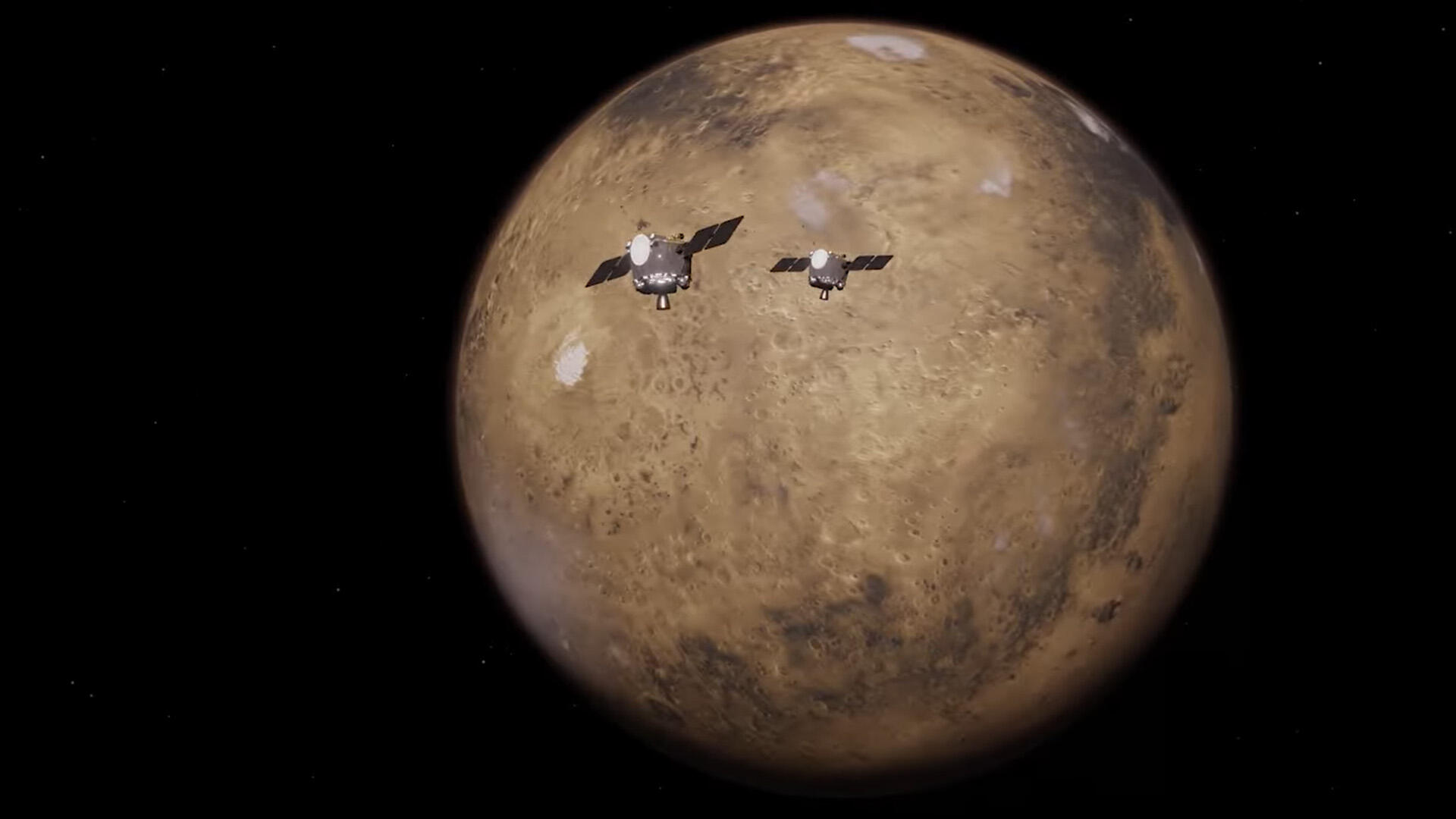
NASA launched its Escapade mission just over a year ago to send two spacecraft, nicknamed Blue and Gold, to Mars. After spending a year looping near Earth, the twin probes completed a gravity-assist maneuver this month and are now en route to the red planet. It’s an exciting time for NASA. Blue and Gold, named for the school colors of UC Berkeley where they were built, completed the agency’s first powered Earth flyby. Typically, spacecraft use a planet or the sun’s natural gravity to get close to the planet before slingshotting off into the distance. A notable example is Voyager 1, which used unpowered gravity-assisted flybys to reach the speeds needed to cross the light-day threshold earlier this week. Escapade did this with Earth’s gravity but also used thrusters to generate even more speed. Since there are two of them, NASA personnel had to perform this maneuver twice. The other big win for NASA is that Mars will soon have two additional satellites in orbit to measure the planet’s magnetosphere, which is believed to have been stripped by the solar wind eons ago, when the planet likely had liquid water. Another 10 months flying through space The Hohmann Transfer uses gravity and orbits to get spacecraft to Mars without using massive amounts of fuel.NASA Escapade still has a long way to go. Blue and Gold are now spending the next 10 months flying into outer space. Their new trajectory is set to take them into Mars’ orbital path, timed in such a way that the twin satellites will arrive at the same time that Mars naturally shows up, allowing the red planet to capture the twins in its orbit as it flies by. NASA says that both are set to arrive at Mars by early September next year. By the time the twins get there, they will have been in space for 22 months. Flights to Mars require months of deep space travel, impeccable timing and loads of fuel. However, if missions hit specific launch windows, they require far less fuel. This is a well-documented maneuver known as the Hohmann Transfer, and NASA’s JPL has a neat math exercise to show how it’s calculated. NASA intentionally launched Escapade a year early so that the satellites could hang out in a gravitational sweet spot called the L2 Earth-Sun Lagrange point. This is a point in space on the side of the Earth opposite the sun, and the idea was to have the spacecraft already in orbit and ready for the next Mars launch window. Once it opened, the satellites engaged their thrusters, performed a gravity-assisted flyby of Earth to gain speed, and launched themselves into outer space. The Mars launch window The tactic of sending Escapade to the L2 Lagrange point to wait for a Mars window to open is arguably NASA’s biggest win, as no space agency has ever attempted it. The benefit is that it allows agencies to launch payloads into orbit bound for Mars whenever they have the time, then use Earth gravity assists to slingshot them out to Mars when it’s most efficient. “With this loiter orbit and Earth flyby, Escapade is pioneering a new strategy for getting to Mars,” Jeff Parker, CTO of Advanced Space and lead mission designer, said in a statement. “This method provides the flexibility to launch almost anytime and then use Earth’s gravity to get a boost to Mars, rather than waiting every two years to launch there directly when the planets are aligned.” The maneuver paid dividends. JAXA, Japan’s national space agency, launched its MMX spacecraft on Oct. 20, which is within the current Mars launch window and employs the same Hohmann Transfer method to get to Mars. The spacecraft is headed to Phobos and Deimos, Mars’s moons. Despite using the more traditional method of waiting for the window to open to launch, JAXA’s MMX is slated to reach its destination in August next year, just a couple of weeks ahead of Escapade. When you factor in that Escapade performed its gravity-assist slingshot on Nov. 9, roughly two weeks before MMX launched, the spacecraft will reach their respective destinations in approximately the same amount of time, validating NASA’s trajectory strategy.
Are We There Yet? NASA’s Escapade Is Officially Heading to Mars
Full Article
Original Source
Read the full article at Cnet →KhanList aggregates and links to publicly available news content. We do not host full articles from third-party sources. Always verify important information with original sources.