
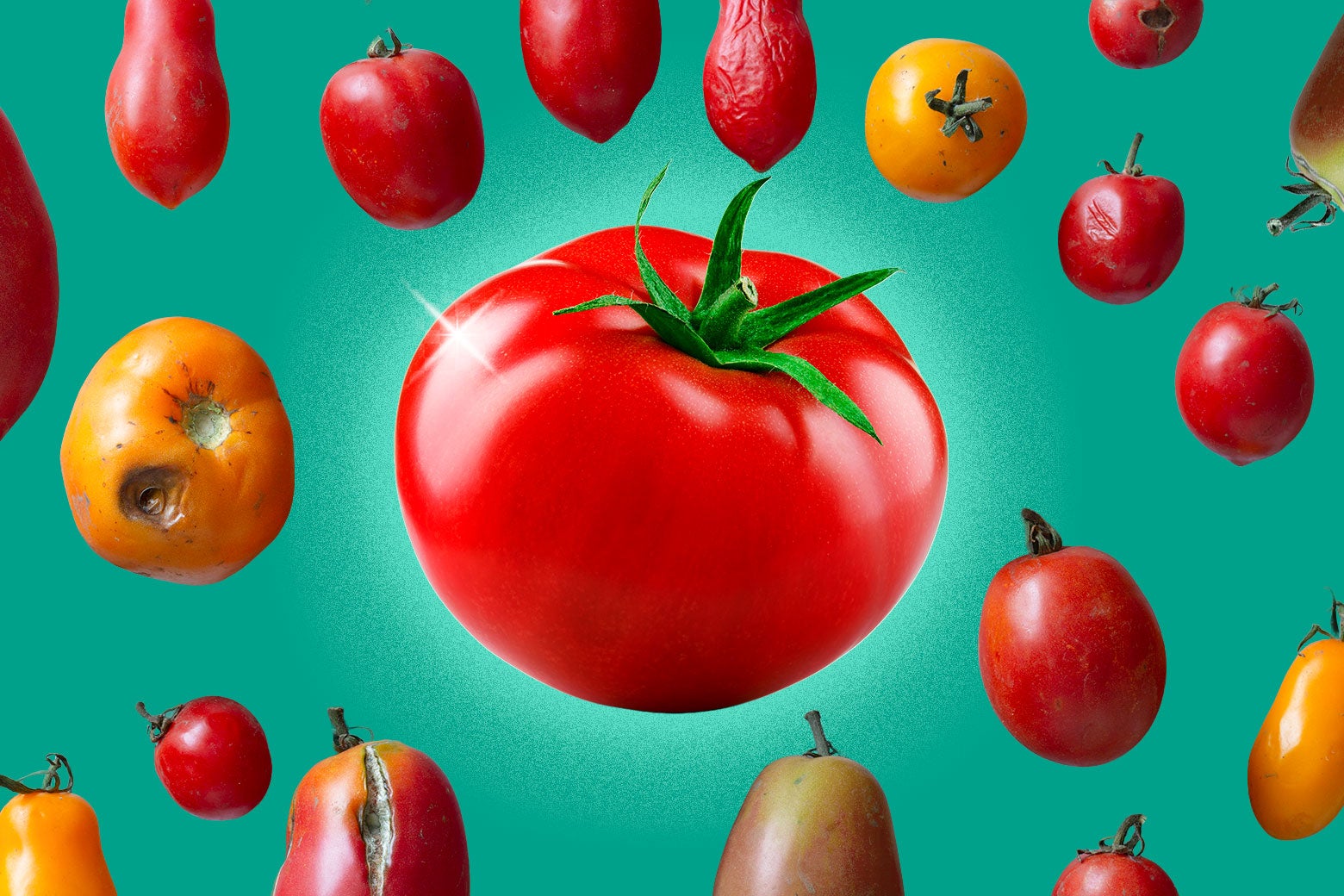
Food The rise of Sugar Cube cantaloupes, honeynut squash, and other produce bred for uniformity and ease may cost us more than we realize. Photo illustration by Slate. Photos by MarcoFood/Getty Images Plus and GannaMartySheva/Getty Images Plus. Sign up for the Slatest to get the most insightful analysis, criticism, and advice out there, delivered to your inbox daily. For as long as brunch has existed, there’s always been a cutthroat rivalry between honeydew and cantaloupe. Honeydew’s a little sweeter and firmer, and cantaloupe—with its bright orange flesh and netted rind—looks like a sofa from the 1970s, and when bad, can kind of smell like one, too. (You can see where my allegiances lie.) But the produce scales may be tipping, because Cantaloupe 2.0 is upon us. Meet the Sugar Cube cantaloupe, a relative newcomer gradually making the rounds in produce aisles and farmers markets across the country. Developed by plant breeders Walt Whitwood of Seneca Vegetable Research in New York and Brent Loy of the New Hampshire Agricultural Experiment Station, it’s a personal-size hybrid muskmelon purposely bred for intense sweetness, a smaller cavity of totally avoidable seeds, and a longer shelf life than your average cantaloupe. It may look like that traditional cantaloupe is rotting by comparison, but those are probably tears. It knows it’s being replaced. Not that the Sugar Cube can rest on its laurels. It’s just one of many fruit replicants out there. A new age of fruit breeding is revolutionizing the industry like a chase scene where a car slams into a fruit cart. Freshly created specimens abound. The Tasti-Lee tomato promises a perfect balance of sweet and tangy and a “deep red, tantalizing look to every slice.” We’ve bred easier-to-peel mandarins for those who somehow found earlier versions to be a Rubik’s Cube. And since misery loves company, that old-fashioned cantaloupe might find a friendly shoulder in the butternut squash, as it watches the smaller, sweeter, and cuter honeynut steal all the roles it used to get. Think of this all like the movie Gattaca, but with produce. They say when life hands you lemons, you make lemonade. But with fruit breeding, we may one day get lemons that already taste like lemonade. And then that phrase will mean nothing. How else will we give clichéd, disingenuous advice to people? How else will we teach kids character? There’s an art to identifying the perfect cantaloupe. You look for one that feels heavy for its size and emits a sweet aroma at the blossom end, or maybe you just turn to an old woman and ask, “Does this look good?” And even then, you can’t be sure until you slice into the rind. It may be a good one or it may be a lemon (I’m mixing metaphors here). But in any case, you learn to make the most of what you’re given, or to try and try again. It all raises the question: Are we losing something in this apparent drive toward perfection? One imagines a brave new world of the produce section in which every peach and plum and mutant pleach is perfectly sweet and crisp, where picking the right one merely involves extending your arm without even looking. That doesn’t sound too appealing, no matter how good those peels look. At its core, fruit breeding—which simply involves developing new fruit with better traits—is nothing new and has existed for almost as long as a piece of fruit has tasted a little off.“Traditional fruit breeding involves taking the pollen from one parent and pollinizing the flowers of the other parent, waiting for the fruit to grow, taking the seeds out, germinating the seeds, and then doing evaluating and selection of the receiving population,” says Kate Evans, a professor of horticulture at Washington State University. This differs from the genetic engineering of fruit in a lab, “but it’s all got the same aim of producing something that’s new, improved, and unique.” Fruit wizards play matchmaker and breed for optimal traits like sweeter taste, crispness, tartness, disease resistance, larger size, better seed/flesh ratio, longer shelf life, and higher yield. Controlled, purposeful cross-pollination in fruit breeding began around the 19th century, but for thousands of years, humans have been haphazardly cutting out seeds from fruits that looked and tasted better in the hopes of making more of them. Many of the fruits we know and love today are the way they are as a result. For instance, there are innumerable reasons to travel back in time, but one of them would not be to grab a slice of watermelon. Hundreds of years ago they were small and filled with a bland, pale yellowish-white flesh, as a 17th-century painting by Italian artist Giovanni Stanchi makes clear. Fancy a banana from the year 2,300 B.C.? You’d likely find one rife with large, spiny black seeds that rendered the banana more seed than banana. And while telling someone they’re “sweet as a peach” in the 21st century might be construed as a compliment, hundreds of years ago they might’ve taken offense, as peaches were almost half pit, earthy and tart, with a tough and often waxy flesh. That is, until selective breeding got ahold of them and gradually edited those hiccups out. We have this sometimes mistaken idea that when fruit is prancing wild in nature, it tastes at its best as well. “People all the time tell me: ‘Oh, but bred blackberries are just not as good as wild ones.’ That’s a lie,” says Margaret Worthington, associate professor of horticulture at the University of Arkansas, whose primary research interest is the development of improved blackberries and grapes, among other fruits. “I ate some wild blackberries this summer and they’re awful.” “The main problem with blackberries is that they don’t last long, the shipability is terrible, and they don’t taste very good. They’re often really sour,” Worthington says. “There’s a lot of room for making a product that is more consistently tasty without having to do anything to it. We’re not trying to breed a blackberry for making cobbler. You can make cobbler plenty good already; just add sugar. We want to make one that is tasty to eat fresh every time you buy it.” Fruit can certainly be a pain in the ass. And some fruits need help more than others. Yet one wonders if we’re pushing things too far these days. That by breeding out every inconvenient trait and irregularity, we’re losing the magical fog of testing and guessing that makes trying fruit a bit fun, even when it goes wrong. We gain something by learning to select the right one, knowing when to let it ripen at home, or that lunch tomorrow will be the ideal time to take a bite, and how to adapt when the fruit goes awry—say, for example, making that cobbler instead of berries and cream. It’s a home kitchen, not a restaurant. A subpar pear sends us off hungry to try to find a good one, and there’s a great pleasure in opening a mango that looks like it was in a car accident only for it to be the best you’ve ever tasted. Granted, from the producer’s side of things, trying to perfect fruit is understandable. Look at what it’s having to compete with: the rest of the grocery store, with fields of processed food that’s always perfectly sweet, crispy, ready, and everything we tired-after-work consumers need it to be. Fruit is peeking over those aisle walls in fear and knows that if it’s going to play, it’s got to breed away the guesswork and ape the convenience of processed food. It’s why we have Cotton Candy grapes, berries that are now available year-round, and seedless everything, and why some fruit geneticists are actually trying to create a pitless cherry. Of course, fruit should be a bit of an escape from life’s constant parade of struggles. We don’t want a watermelon to let us down in the same way our marriage did. But should cherries be that easy? And if one day every fruit in the produce section meets our every expectation, will this not degrade our ability to deal with difficulties and challenges outside the store itself? I can barely handle them as it is. Fruits are not merely dating their own kind to breed the most desirable traits (as in the apple-varietal boom we’re seeing at the moment), they’re sleeping with other fruit as well. In not quite the same way that Coke combined forces with Oreo to make weird cookies, and horses with donkeys to make mules, breeders will cross-pollinate fruit varieties in order to bring another fruit’s desirable traits onto the team. Peaches asked out plums to make plumcots, mandarins made the moves on kumquats for the mandarinquat, and even cantaloupe got some love from watermelon to bring the world the Waterloupe, in which the watermelon is clearly doing the heavy lifting. Anyone traipsing through the produce section can’t help but notice all sorts of fruit hybrids announcing their courtships: NectaPlums, Tangelos, Tayberries, limequats, and others who clearly get around. These forms of interspecific hybrids only tend to work out when the parent plants come from the same genus, like plums and apricots belonging to Prunus. The practice was pioneered in part more than a century ago when American botanist Luther Burbank crossed a plum and an apricot to create the plumcot, and further evolved when fruit breeder Floyd Zaiger crossed apricots and plums and created the Pluot (which is more plum than apricot), doing it again with the Aprium (which is the reverse). Superteams are a problem in the NBA, but fruit breeders are using ringers en masse, and fruit is likely to keep improving until all other aspects of life grossly disappoint in comparison. Not that it’s a perfect art. Fruit breeders can only control so many factors, and shipping, commercial agriculture, and the timing of a harvest can always hurt the quality of a well-bred fruit. Moreover, they have to contend with the perhaps mistaken impression that fruit breeding is only concerned with sweetness and appearance, at the expense of more nuanced flavors. “Fruit breeders get a bad rap. A lot of people think about that story where tomatoes were bred to last forever on your shelf and now fruit breeders are breeding things so that they’re Styrofoam,” says Worthington. “That’s not at all the case. We are really working hard—and I think this is true for most people working across the fruit sector—to make fruit something that people want to enjoy more. I have to eat them, too.” The fruit market may be working to eliminate the difficulty and elbow grease fresh produce sometimes requires, but if they reach that perfect fruit singularity, I foresee a chain reaction rippling through every other facet of life. Humans will start having panic attacks as soon as they leave the produce aisle, unable to cope with a life that hasn’t been cross-pollinated for their benefit, until one day they’re stumbling alone in nature and find a subpar grapefruit, remembering that fruit once had flaws, and they can, too. Or maybe it won’t be quite that bad. Even if fruit becomes impossibly awesome, you know vegetables will always be there letting us down and keeping us grounded. That and Red Delicious apples. Clearly there’s no hope for them. Cooking Food Science
Are We Making Fruit Too Delicious?
Full Article
Original Source
Read the full article at Slate →KhanList aggregates and links to publicly available news content. We do not host full articles from third-party sources. Always verify important information with original sources.