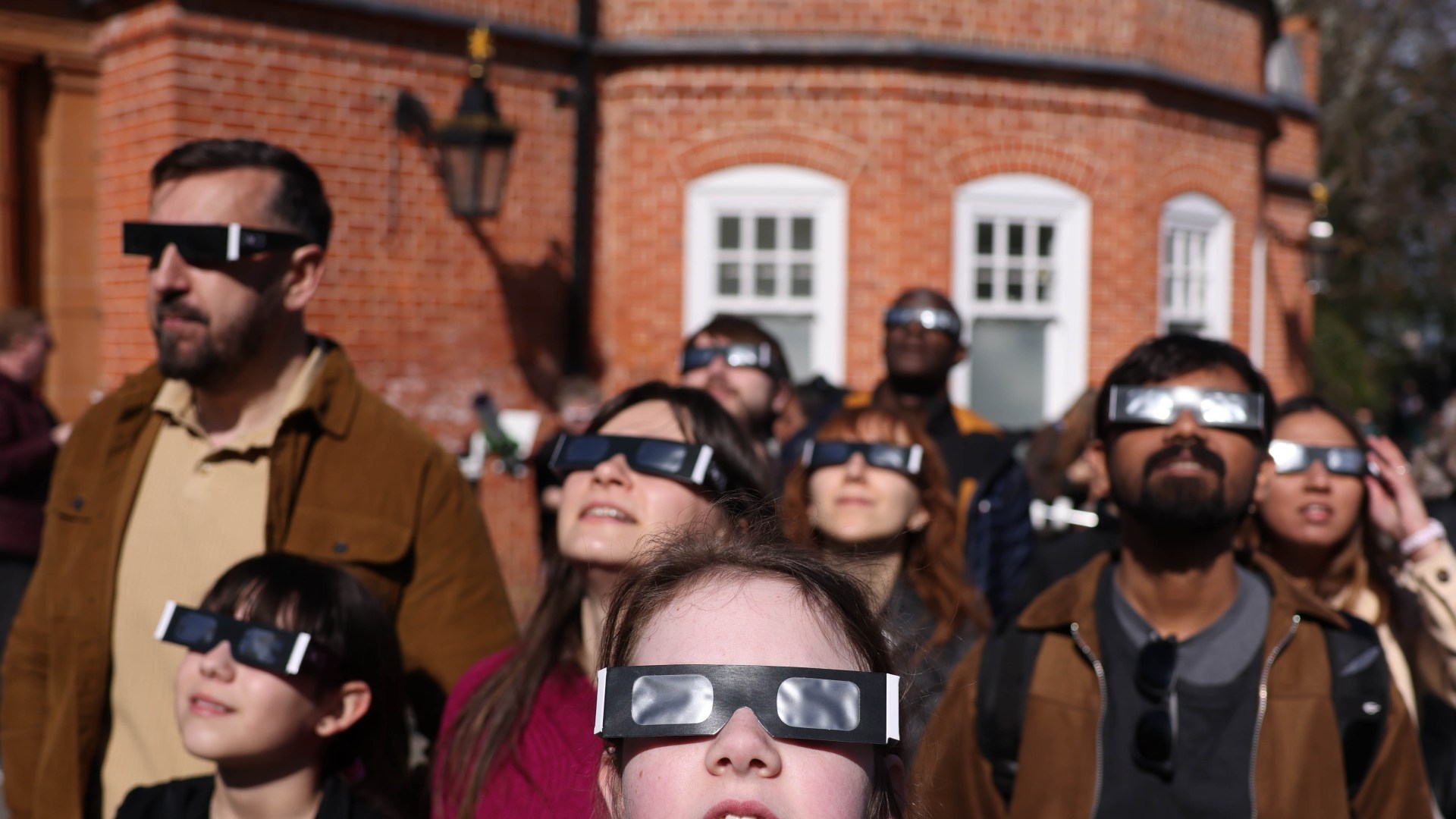
BRITS are in for a stunning celestial treat as a dramatic solar eclipse crosses our skies this month. While the rare event promises incredible views in the early evening of August 12, staring straight at the Sun can cause permanent eye damage – or even blindness. This graphic shows where the eclipse will be visible, and how much of the Sun’s disc will be obscured by the moon in various locations Credit: Getty Solar eclipse glasses are completely safe, provided they meet official international safety standards Credit: EPA Knowing how to protect your eyes is essential before looking up. Here is everything you need to know to watch the 2026 spectacle safely. When is the August solar eclipse? The solar eclipse will take place on Wednesday, 12 August 2026. Sign up for The Sun newsletter Thank you! It will be visible right across the UK as a deep partial eclipse, the biggest solar event seen from British soil since 1999. While the path of totality (where the Moon completely blocks the Sun) passes over Greenland, Iceland, and Spain, the UK will still experience a huge blackout effect. Across Great Britain, between 90% and 96% of the Sun will be covered by the Moon: London & South East: ~91% coverage Manchester & Midlands: ~91%–92% coverage Scotland & Northern Ireland: ~90% to 93% coverage Cornwall & Isles of Scilly: Up to 96% coverage The event happens in the early evening. In the UK, the eclipse begins shortly after 6.15pm, peaks at maximum coverage around 7.13pm, and finishes around 8.05pm, just before sunset. Because the Sun is never 100% covered in the UK, there is no moment when it is safe to look at it with the naked eye. Most read in The Sun Are solar eclipse glasses safe? Yes, solar eclipse glasses are completely safe, provided they meet official international safety standards. Regular sunglasses, no matter how dark or expensive they are, do not offer enough protection. Viewing the Sun through regular sunglasses or unapproved filters can cause solar retinopathy, severe retinal damage that is often painless but irreversible. To make sure your eclipse glasses are safe, check the following: Look for ISO 12312-2 certification: Safe eclipse glasses must feature the official ISO 12312-2 code printed on the inside of the frame. This standard guarantees the lenses filter out 99.999% of intense visible light, along with harmful ultraviolet (UV) and infrared radiation. Buy from reputable sellers: Only purchase glasses from recognised astronomy suppliers, science centres, or reputable opticians. Avoid unbranded, ultra-cheap pairs on online marketplaces, as counterfeit safety labels are common. Inspect for damage: Check your glasses before use. If the lenses are scratched, creased, punctured, or coming away from the cardboard frame, throw them away immediately. Keep them on continuously: Because the UK only sees a partial eclipse, your eclipse glasses must stay firmly over your eyes for every second you look directly at the Sun. What other techniques can you use? If you do not have certified eclipse glasses, you can still watch the event safely using indirect viewing techniques. These methods allow you to view a projected image of the Sun rather than looking at it directly. 1. The pinhole projection method Take two pieces of white card. Poke a smooth, tiny hole in the centre of one card using a pin or paperclip. Stand with the Sun behind you, hold the poked card up to let sunlight pass through the hole, and project the image onto the second card held in your shadow. You will see a clear, inverted crescent image of the eclipsed Sun. The kitchen colander trick will project a brilliant pattern of mini-eclipses Credit: Getty 2. The kitchen colander trick Use an everyday colander from your kitchen cupboard! Hold it out with your back to the Sun so the sunlight shines through the holes onto the pavement or a sheet of paper. Each small hole will project an individual crescent Sun, creating a brilliant pattern of mini-eclipses. 3. Solar filters for cameras and telescopes If you plan to use binoculars, a telescope, or a camera, never look through them while wearing ordinary eclipse glasses. The concentrated sunlight passed through lenses will melt the filter paper and cause instant eye damage. You must buy purpose-built ISO-certified solar filters designed specifically to fit over the front objective lenses of your optical device. Comment now
Are solar eclipse glasses safe? How to watch the eclipse in August 2026 without damaging your eyes
Full Article
Original Source
Read the full article at Thesun →KhanList aggregates and links to publicly available news content. We do not host full articles from third-party sources. Always verify important information with original sources.