
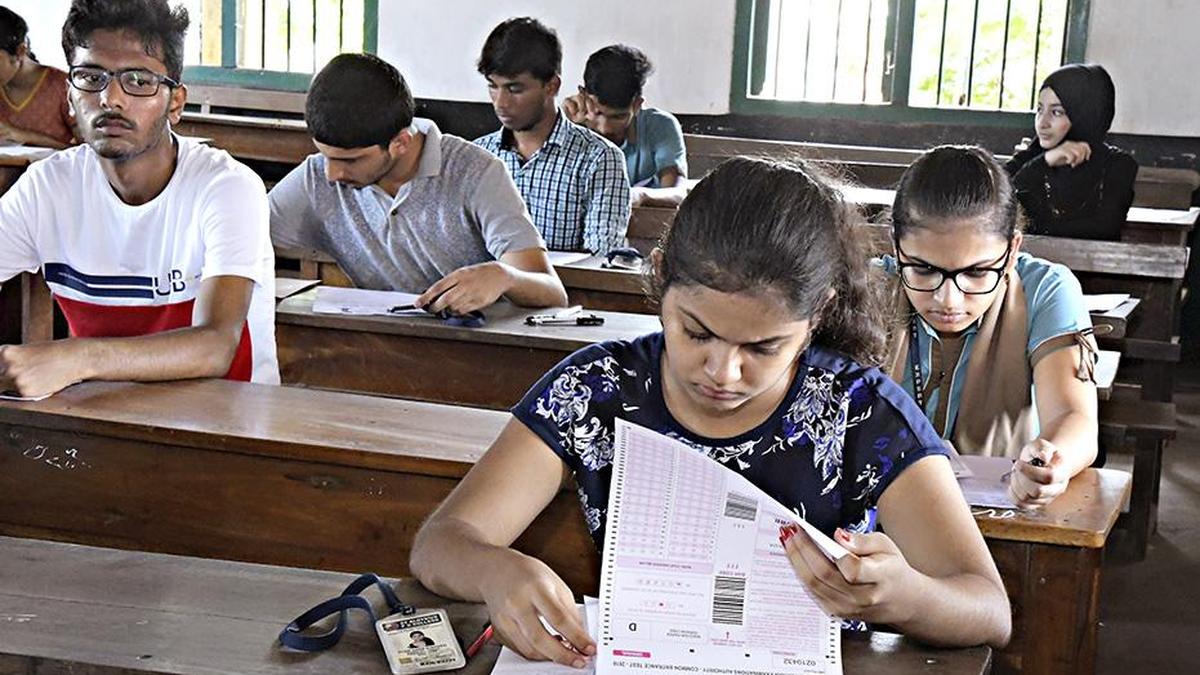
Who was the ruler who called himself “devaputra”, or “son of god”?This is a question that can make a student preparing for a Humanities entrance examination stop and search their memory. This question appeared in the Common University Entrance Test-UG (CUET-UG) History paper in 2025. The answer is a Kushana ruler.(Sign up for THEdge, The Hindu’s weekly education newsletter.)A 2025 CUET-PG English paper asks candidates to match Bartleby, Project MUSE, WorldCat and Shodhganga with the type of research material they provide. In the UGC-NET English examination, candidates encounter questions such as: Who defined culture as “one of the two or three most complicated words in the English language”? The answer is literary critic Raymond Williams.Then there are questions based on an unfamiliar passage, where the candidate has to understand what a writer is saying or draw an inference from the text.Join THEdge LinkedIn groupAll of these are multiple-choice questions (MCQs). The questions mentioned above test different skills; some may require recall of a specialised historical fact; another tests familiarity with research resources; another recognises a scholar’s formulation; and a passage-based question can require interpretation.For admissions in Humanities courses, from UG-level courses to Ph.D., exams are increasingly being conducted through MCQs. Thus, it is important to scrutinise what skills they are testing in a candidate.To examine that question, The Hindu analysed CUET-UG History and Political Science papers from 2024 and 2025, and looked at postgraduate and UGC-NET English question papers. The aim was to examine the knowledge and skills that Humanities candidates are asked to demonstrate through MCQs. In the 2024 CUET-UG History paper, 31 of the 50 questions analysed — 62% — were classified as factual recall. Nine (18%) tested conceptual understanding and 10 (20%) were based on two unseen passages. In the 2025 paper, 30 of the 42 questions analysed — about 71% — were classified as factual recall, while 12 were source-based and two required historical reasoning or application.The questions were not simply about remembering dates. In 2025, 10 questions involved names or attribution, eight involved factual associations or matching pairs, six required chronology or sequencing, five concerned events or places, and only one was an explicit date-recall question.One question, for instance, asked candidates to arrange four developments in Harappan archaeology in chronological order. Another asked what the Gandatindu Jataka describes. A third asked candidates to identify which description was associated with Al-Biruni.For students, preparation consequently involves remembering not just individual facts but connections between them — a scholar and a work, a traveller and an observation, or events in their correct sequence.That preparation strategy is reflected in what candidates themselves say.Shubham Kumar, who prepared for CUET History, says, “The dates given in between the chapters are being asked directly, but the ones given in timelines are only being asked to arrange in chronological orders, not the exact date.”Shreekanth Katika, a second-year student at Delhi University studying B.A. History (Hons.) advises students to stay close to their NCERT textbooks. “Even if you just read the pink boxes properly, you’ll be able to guess a lot of answers after looking at the options,” he says, adding that timelines, important dates and pictures should also be revised.The pattern changes somewhat when the examination moves to a specialised subject and a higher level of study.For UGC-NET English, candidates describe preparing for chronology, literary theory, criticism, linguistics, authors and their works, and recurring areas identified through previous-year papers.Harsh Govind, a Ph.D. scholar at Christ University, who says that he cleared all the NET attempts he appeared for, advises candidates to have a strong grasp of the history of English literature and literary theory. “Try to learn the dates of important author’s works, they ask a lot of chronology-based questions,” he says.Akarshit Gulati says previous-year questions helped him identify writers who appeared frequently. “I switched to the Previous-Year Questions (PYQs) and got an idea of the writers who were asked frequently. I found that there were some on repeat almost every year — Hardy, Dickens, Eliot to name a few. So these became my top priorities.”Arjun C.P., a researcher at PSG College of Arts and Science, similarly organised his notes chronologically because of the way questions are framed. “If you are annotating the books, make sure to use an A4 sheet to track down the works of the writers because let’s face it, they are going to throw five different works and ask you to arrange them.”The questions, however, also move towards research-related knowledge. A postgraduate English entrance question that asks candidates to match Bartleby, Project MUSE, WorldCat and Shodhganga is testing whether they know where different kinds of academic material can be found.This is different from a question asking who Raymond Williams was or which scholar is associated with a particular formulation. Yet both rely on the candidate recognising and retrieving specialised knowledge.The distinction becomes sharper when an examination uses an unseen passage.In the 2024 CUET-UG History paper, two passages accounted for 10 questions. In 2025, source-based questions accounted for 12 of the 42 questions analysed. Some required candidates to identify information stated in or associated with the source; others required comprehension or inference.Lack of testing on regular applicationFor Professor Farhat Hasan, Department of History, University of Delhi, this is an important distinction in humanities education.“The current setup makes no attempt to prepare students for reflecting on the historical changes or society changes. The concept of learning to reflect, ask questions and understand the process of social changes has been undermined with the huge insistence on fact-driven questions,” he said. “There is an absence of testing students on regular applications,” he added.Professor Hasan says Humanities education also requires interpretation and the ability to work with different viewpoints. “It requires abilities such as interpretation, knowledge, and command in language. These are all pushed aside, and pure hardcore fact-driven approaches have taken a centre stage,” he says.The same problem arises in Political Science. In the CUET-UG Political Science paper analysed for 2024, institutions accounted for 24% of the questions and thinkers and leaders for 20%. Political concepts accounted for 12% and application of concepts for 4%, while 32% were classified as factual or historical recall.In 2025, factual and historical recall accounted for 60% of the 50 questions analysed. Institutions made up 12%, constitutional facts 10%, political concepts 8%, application of concepts 6% and thinkers or ideologues 4%.One 2025 question asked candidates to arrange the formation of the DMK, Indira Gandhi’s Ten Point Programme, K. Kamaraj’s proposal that Congressmen resign from office and the fifth Lok Sabha election in chronological order.Prof. Vaishali Jain, Department of Political Science, Kurukshetra University, says that the format can make it difficult to assess the abilities expected from Humanities students.“The entrance examinations for Humanities (Political Science) should be descriptive, as it is tough to analyse students using MCQs alone. At the core, Humanities is all about analysing and interpretation,” she says.The issue takes on another dimension at the research-entry stage.Dr. Parama Gupta, Assistant Professor at the University of Madras, says MCQs can serve a purpose at the entrance stage. “MCQs can assess subject knowledge and research aptitude along with an understanding of research methodologies. At the entrance level that may be sufficient,” she said. But the demands of research extend beyond what an entrance test can measure, the professor added.“The Ph.D. journey demands much more. It requires patience, resilience, tenacity and clarity of thought.” These qualities, the professor says, develop through mentoring, experience and the research process itself.The examination papers therefore contain several kinds of MCQs: questions that ask candidates to recall specialised knowledge, connect related facts, recognise concepts, understand sources and, in some cases, apply what they know. However, they fall short of testing analytical and interpretative skills required in Humanities subjects.For a student, the preparation may still begin with a deceptively simple task: remembering who was called “devaputra”.
Are MCQ-based Humanities entrance exams testing the right skills?
Full Article
Original Source
Read the full article at Thehindu →KhanList aggregates and links to publicly available news content. We do not host full articles from third-party sources. Always verify important information with original sources.