
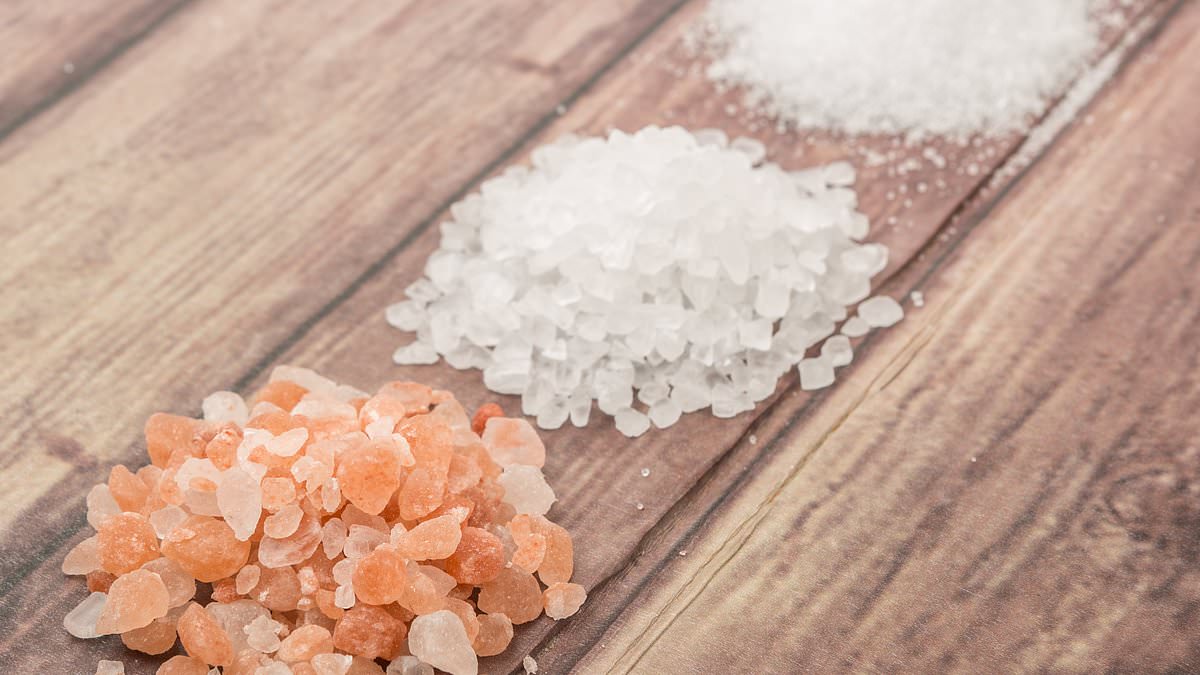
Maldon salt, named after a town near its manufacturing site, in fact, starts life 500 miles from its Essex home, according to new revelations.The British staple, popular with foodies and celebrity chefs, and deemed far more sophisticated than regular table salt, is in fact manufactured using rock salt that's mined in Germany.The firm uses a 'salt-on-salt' technique, which involves using the German salt to 'enrich' Essex seawater with 'natural minerals'. But does the method bring any benefits whatsoever - for health, or otherwise? Some premium brands behind similar fancy salts - like Himalayan pink varieties - claim their product contains more vital nutrients than table salt, and are better for blood pressure.So what's the truth? Here, experts reveal the difference between the hundreds of different products on supermarket shelves, and the types with surprising health benefits. Maldon salt is made using a crystals extracted by a German mining companyWhat's in salt - and how much is healthy?Salt is a natural mineral made of sodium chloride and is sourced in two ways - either being harvested from seawater or mined from an underground rock named halite.When taken from the sea, it forms when water evaporates. Sun and wind gradually remove the water, leaving behind salt crystals which are then harvested, washed, dried and processed.Meanwhile when taken from rock, salt is crushed, ground and purified before undergoing similar processes to make it suitable for consumption.While both types are chemically very similar, sea salt is more commonly used in food, whereas rock salt is also widely used for industrial purposes, such as de-icing roads.One teaspoon - around 6g - of salt contains roughly 2,325mg of sodium - over 100 per cent of the daily recommended value - along with trace amounts of other minerals, including about 1.4mg of calcium, 0.5mg of potassium, 0.06mg of magnesium and 0.02mg of iron.These nutrients all play varying roles in helping the body. Sodium helps regulate fluid balance and nerve function, while calcium strengthens bones and teeth, potassium supports heart and muscle function, magnesium aids energy production and the nervous system, and iron helps carry oxygen in the blood.Most table salt is stripped of these essential minerals when it goes through processing.The NHS recommends that adults consume no more than 6g of salt per day, including salt present naturally in food and any added during cooking or at the table.Concerningly, most British adults are markedly exceeding this limit, consuming around 8.4g a day - 40 per cent above the maximum recommended amount.What's the difference between table, sea and flaky varieties?The most commonly consumed in the UK is table salt - mined from rock and heavily refined before being sold in its familiar fine white granular form. Saxa and Cerebos are the UK's top sellers, and you'll find them on most supermarket shelves. Typically, you can buy 750g of table salt for under £2.For many people, using salt in the kitchen is a process done on autopilot, added to boiling water or meals before even taking a bite.But there are a variety of other kinds of salt - and some of them are eye-wateringly pricey.Maldon salt, for example, known for its crunchy texture and used as a finishing garnish, retails at around £2.85 for 250g. Turkish restaurateur Nusret Gökçe, aka Salt Bae, earned global fame with his sprinkling skillsIts hollow texture is often attributed to the area's high salinity - meaning there is a higher concentration of salt per ml of water.Sea salts can have different properties - both physical and chemical - depending on the waters it has been harvested from.Another commonly mentioned salt - particularly in US recipes - is kosher salt.This has larger crystals that make it easy to sprinkle over food. Kosher salt is typically mined from land deposits, while sea salt is evaporated from active ocean water.Iodised salt - a form of table salt mixed with small quantities of sodium iodide or potassium iodide - is also widely used, with people drawn to it due to how iodine can support healthy thyroid function.There's also flaky salt, a sea salt known for its thin, delicate crystals commonly used on grilled meats. Turkish restaurateur Nusret Gokçe, also known as Salt Bae, earned global fame with his theatrical sprinkling skills on £850 gold-leafed tomahawk steaks.Other types of rock salt - mined from underground deposits which formed over time due to evaporated seas and lakes - include black salt, widely used in Indian and South East Asian cooking. Its colour is formed by heating and mixing charcoal, herbs and spices.Meanwhile Himalayan salt - the distinctive pink variety - is mined from the Khewra Salt Mine in Pakistan, where it is expected that supplies will last for the next 350 years.It is surrounded by mythology - not only due to its fascinating colour but because of claims that using it as a lamp can cleanse the air, work as a detox for the body and even increase libido.What's the best salt for our health? While many of these claims seem far-fetched, Himalayan salt does contain more than 80 minerals - most of which are in small amounts - whereas table salt is more heavily refined and has the majority of them removed.Nutritionist Jenna Hope notes that Himalayan salt can be a 'good option' for home cooking because it retains small amounts of these nutrients, but stresses that salt should not be relied upon as a meaningful source of nutrition.Ms Hope adds that iodised salt can help people on plant-based diets because their iodine intake - important for healthy thyroid function and cognitive health - is often lower because they miss out on iodine-rich products like fish, eggs, cow's milk and yoghurt.However Dr Oliver Guttmann, a consultant cardiologist at the private HCA Wellington Hospital in London, says the type of salt matters 'far less than how much is consumed'. Switching to LoSalt could dramatically reduce heart risk, experts sayHe tells the Daily Mail: 'Sea salt, rock salt, and Himalayan pink salt all contain broadly similar amounts of sodium chloride, and the cardiovascular risks associated with excess intake apply equally to all of them.'Patients with hypertension or heart failure should not be reassured by reaching for a "premium" salt - the sodium burden on the heart is the same.'Most of the problems linked to long-term high salt consumption are cardiovascular - relating to the heart, arteries and veins - because sodium forces the body to retain water, leading to an increase in blood pressure.The British Heart Foundation warn that high blood pressure, also known as hypertension, can put you at risk of heart attack, heart failure, stroke and even vascular dementia.The World Health Organisation says 2.5million deaths could be prevented each year globally if salt consumption were reduced to less than 5g a day for adults.Dr Guttmann explains: 'The evidence linking high sodium intake to elevated blood pressure is robust and well-established.'Hypertension is one of the leading modifiable risk factors for stroke, heart failure, and coronary artery disease, so from a cardiovascular standpoint, excess salt intake is a genuine and significant public health concern.'Most people in the UK consume considerably more than the recommended 6g of salt per day, often without realising it, because the majority comes from processed and restaurant foods rather than the salt shaker.'The hidden sodium in bread, cereals, and ready meals is where the real risk accumulates.'Earlier this year British researchers claimed that almost 13,000 UK deaths a year could be avoided if more people swapped regular salt for a low-sodium version.Researchers found replacing regular salt with a potassium-enriched version could also prevent 60,000 cases of cardiovascular and kidney disease annually in the UK.The alternative salt, sold as own brand supermarket products, as well as brands such as LoSalt for just over £1, replaces much of the sodium with potassium. The experts stressed, however, that potassium-enriched salt may not be suitable for everyone.They said people with advanced kidney disease could be at risk from the extra potassium.This is because damaged kidneys can struggle to remove it from the blood – allowing it to build up to dangerous levels.
Are fancy flakes healthier than bog standard table salt? Amid the Maldon salt scandal, experts reveal the surprising type that's best for you - and it costs just over a quid
Full Article
Original Source
Read the full article at Dailymail →KhanList aggregates and links to publicly available news content. We do not host full articles from third-party sources. Always verify important information with original sources.