
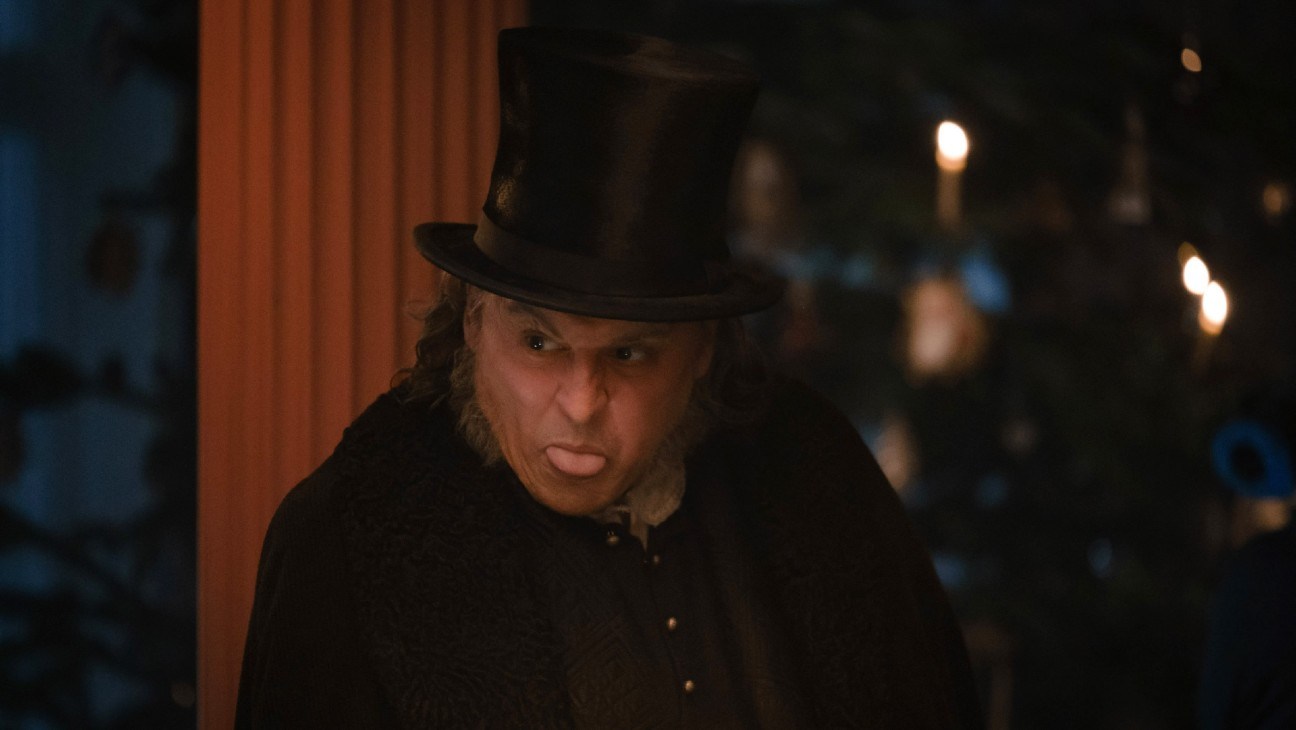
For many onlookers, it likely seems fitting that Johnny Depp returns to the big screen this weekend to play a man haunted by past mistakes. Depp has largely disappeared from public life for nearly a decade following allegations of domestic abuse, along with negative headlines surrounding his and ex-wife Amber Heard‘s messy 2022 defamation trial. Depp won the case and has denied any abuse allegations, but his professional path has seen its share of setbacks, including Warner Bros. dropping him from the Fantastic Beasts franchise in 2018 on the heels of the actor losing a libel suit against the publisher of The Sun. He has yet to hit the big screen for a studio project in the ensuing years. That is set to change with Ebenezer, as director Ti West‘s feature adaptation of Charles Dickens’ classic A Christmas Carol hits theaters Friday. Paramount Pictures, which greenlit the film shortly after David Ellison’s Skydance Media acquired the studio two years ago, releases Ebenezer in more than 3,500 North American locations and projects an opening of $20 million domestically, along with another $20 million internationally. Such a turnout is likely to place it No. 1 at the North American box office, as the other major release for the frame is David Leitch’s How to Rob a Bank, eyeing a domestic launch in the high single digits against a $40 million budget. Adrian Daub, who serves as director of the Clayman Institute for Gender Research at Stanford University, closely analyzed social media reactions to Depp and Heard’s legal battle. He tells THR that many individuals’ viewpoints were based on feeling connected to Depp’s roles during his stretch as a major Hollywood star, and indeed, plenty of YouTubers were rewarded with a bounty of clicks from posts defending Depp and blasting Heard. Many Depp fans likely feel nostalgic for the era in the 2000s when the actor, initially known as a reluctant heartthrob and rebellious Hollywood outsider with Edward Scissorhands and What’s Eating Gilbert Grape, rocketed up the A-list with the 2003 smash Pirates of the Caribbean, which became the first of his three Oscar nominations in that decade. “When my team and I analyzed millions of YouTube comments around Depp v. Heard, we found that a lot of commenters seemed less swayed by the specific facts in the case and more by a general nostalgia for Depp roles of the early aughts that they felt were meaningful,” says Daub. “Lots of invocations of Jack Sparrow — that sort of thing. It also seems like non-North American audiences seem much readier to move on — so the studio is likely banking on nostalgia, and on the fact that non-English speaking audiences like Depp and didn’t track #MeToo in Hollywood all that closely.” Johnny Depp and Penélope Cruz in Pirates of the Caribbean: On Stranger Tides. Peter Mountain/Walt Disney Pictures/Courtesy Everett Collection In his heyday, Depp was among the industry’s highest-paid stars, collecting a reported $50 million and beyond, including backend, for his Pirates sequels and 2010’s live-action Alice in Wonderland. But his track record included box office hiccups even before his relationship with Heard began generating unflattering press, as he suffered critical and financial disappointments with 2014’s Transcendence and 2015’s Mortdecai. Heard’s first allegations of abuse against Depp came in court documents filed just days before Disney released the sequel film Alice Through the Looking Glass, which became a money loser for the studio in 2016. Notably, Depp has participated in limited press opportunities to promote Ebenezer, most of which the star did while in character as Scrooge, including an unannounced appearance at an unrelated San Diego Comic-Con panel that saw the actor riffing for much longer than expected. Paramount has been pleased with data suggesting that audiences want Depp back and that he still holds universal appeal, with the in-character appearances having been intended to remind fans of the way that he has previously immersed himself to portray memorable roles like Jack Sparrow and Willy Wonka. Earlier this month at the film’s London premiere, Depp hinted at his involuntary hiatus from studio work. When the Associated Press asked him about not having booked a Hollywood film in years, he quibbled about the question’s wording before replying, “There was a bit of a vacation, which is fine,” and then a publicist quickly whisked him away from the reporter. “Refusing to come out of character in promotional events feels like a form of protection for Depp,” Brian J. Robb, author of the 1996 biography Johnny Depp: A Modern Rebel, tells THR. “It both gives audiences a flavor of what the film might be like and very helpfully protects the star from any searching questions about the recent past. He clearly wants to disappear into the role of Ebenezer, hoping that if audiences respond well to the character and the film, then he will have a chance to secure a more long-term comeback. It’s a clever — if obvious — strategy.” Johnny Depp in Ebenezer. Paramount Pictures It doesn’t take a detective, the likes of which Depp has played in such projects as 1999’s Sleepy Hollow, to unearth that his real-life trajectory bears similarities to that of Ebenezer Scrooge, a public figure with PR issues until he gets a chance at redemption. Indeed, Ebenezer’s marketing itself has leaned into this connection, with the first trailer featuring Depp delivering the line, “It’s good to be back.” The film appears to have divided critics, as it holds a 50 percent approval from critics on Rotten Tomatoes, although THR’s favorable review declares that it “fulfills its ostensible goal of restoring the actor to A-list status.” Depp is set to follow Ebenezer with Lionsgate’s Day Drinker, director Marc Webb’s thriller that is slated for a March 2027 release and also stars Madelyn Cline and Penélope Cruz. If the comeback works, Depp would look to follow the paths of such embattled stars as Robert Downey Jr., who bounced back from his addiction-related controversies to lead the MCU and earn an Oscar, and Mel Gibson, whose headlines for antisemitic, racist and anti-gay remarks preceded his best director Oscar nomination for Hacksaw Ridge, not to mention his work helming the forthcoming high-profile follow-up to The Passion of the Christ. Other ostensibly “canceled” public figures have found ways to pivot, whether shifting to lower-profile work or catering directly to a right-wing crowd. Ernest Owens, author of the book The Case for Cancel Culture and the forthcoming release Divided We Stan, sees a missed opportunity in Depp’s decision to avoid acknowledging his challenging past. “I thought it would be a cool narrative that he could say, ‘Look, I was a Scrooge. I was a very misguided person and reflected on it, and I’m a new person, like he becomes in the end of A Christmas Carol,‘” the journalist says. “That would have been an interesting, metaphorical way of talking about the movie and his journey. But you have to actually feel that way. And I think Depp is not someone who actually thinks he did anything wrong.”
Are Audiences Ready for a Johnny Depp Career Comeback?
Full Article
Original Source
Read the full article at Hollywoodreporter →KhanList aggregates and links to publicly available news content. We do not host full articles from third-party sources. Always verify important information with original sources.