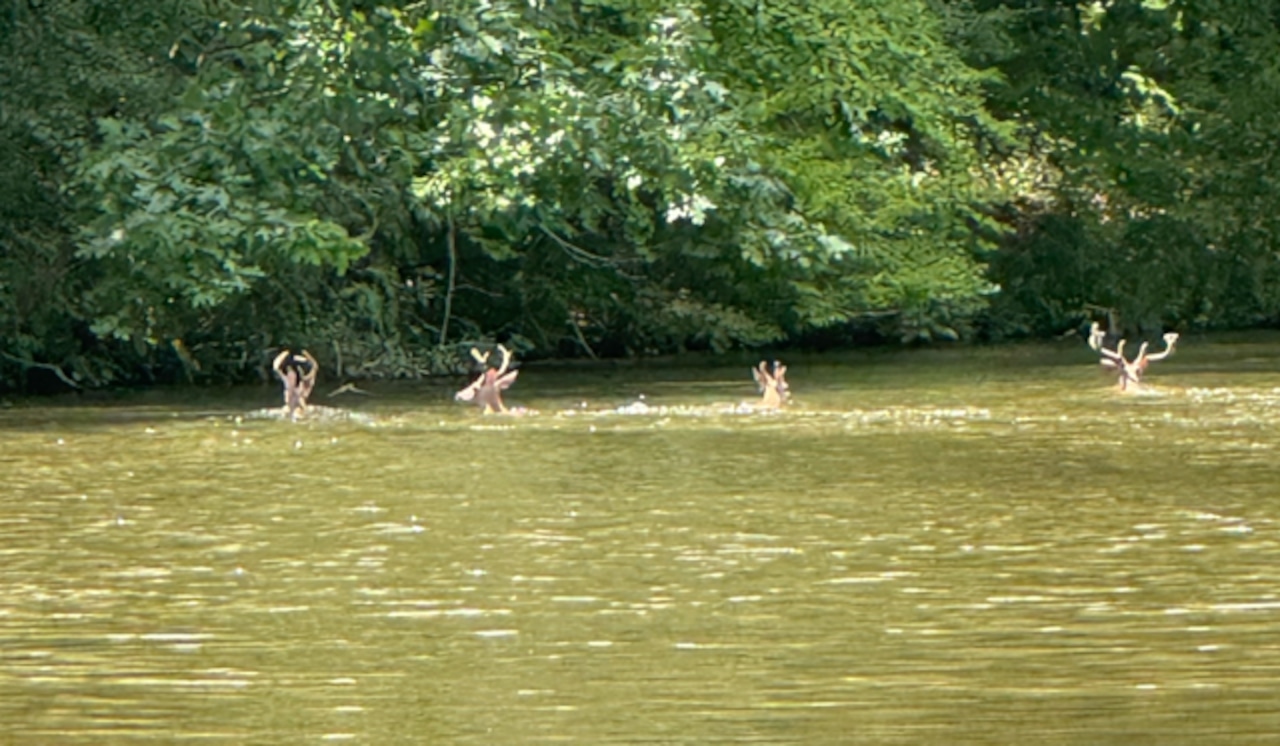
NewsFour antlered deer swim across Alabama's Weogufka Creek Aug. 5, 2026.Justinn OvertonBy John Archibald | jarchibald@al.comI set out for Lake Mitchell last week stewing over the Flock cameras that watch us and the data centers that will soon surround us and the artificial brand of intelligence that already tells us how to write and work and think. I went to the Coosa River — the fifth most endangered river in America in 2022 — to talk PCBs and the other poisons that infest our waters. I went to learn of a graphite mine that vows to put 100 or so people to work in the Coosa River’s watershed but has already locked up $30 million in incentives from a state that will always prostitute itself for the prospect of a few jobs.In a county where it would take 100 typical workers 10 years of toil to add up to $30 million.My smart watch told me that morning, as I thought about those dystopian developments, that my heart rate was unusually high while sitting. But I drove on.Until what always happens happened. Until I turned off onto a county road in rural Alabama and the pines on each side funneled me to a place of contentment. Until I stepped onto a boat on Alabama water and stopped hearing traffic and chatter and began to see and hear the world. As it was meant to be.I met up with Justinn Overton, the Coosa Riverkeeper, and two of the people who help her protect it like a mama bear, at Barrett’s Fish Camp boat dock in Rockford.Overton and Abby Brown and Lucas Allison told me important things as we cruised out across the mirrored surface of Lake Mitchell, how it is a constant battle to warn people of the dangers of eating fish on some parts of that river without sounding like Chicken Little. They explained that dangerous PCBs are measured but forever chemicals like PFAS are harder to quantify. How the fight against coal ash and this new graphite mine go on. Because, as Overton says, “a river has a mouth but not a voice.” So she’ll speak with hers until they etch that on her gravestone.I am overtaken by rivers and streams, transported to misty mornings fly fishing with dad, tromping through creeks with my kids, feeling every time I’m alone on water that this is where I feel most spiritual, most connected to the universe, most at peace with myself, and most angry at politicians and bureaucrats and bastards who would turn us against each other in order to exploit our natural wonders for money.I asked my boatmates, in the middle of all this beauty and all the threats to it, to describe what provided them hope. Brown spoke of her faith. Overton described the feeling of peace that comes from doing everything you possibly can to protect something you love. Allison, the riverkeeper’s field director, talked of breaking through the narrative that tries to paint environmentalism as a left-wing issue. It is only a partisan issue until devastation comes to your own backyard. Or backwater.“We have to fight for it like it’s our backyard,” one of them said. “This place is just too special to let it go.”I don’t know which one of them said that. To be honest I lost my ability to take good notes after Overton pointed out the first osprey nest in the distance, taking me back to my childhood in Decatur, taking me back to young adulthood pointing out such nests to my children at the Wheeler National Wildlife Refuge, hearing them squeal when they saw the silhouette of young birds.We saw cranes and herons, fish and turtles and bigleaf magnolias — the smell of the South, if the South had a smell, Overton says. I heard the stories of her engagement on the banks of these waters, how families helped all three of these people connect to the outdoors, and how the outdoors in turn helped them connect to family. I didn’t need notes for that. I’ve lived the same thing. So many of us have.It is easy, sometimes, to feel the wonder in places like this and forget that they need us. It is easy to forget that we need them.In the afternoon, as we trolled toward home base along the Weogufka Creek, I heard a gasp from the front of the boat. Four antlered deer tromped up the bank just ahead of the boat. Young, beautiful, free. They returned to the water just around the bend and swam across to the other side. “Thank you, universe,” Overton whispered.Another gasp — they never get old — came moments later. A bald eagle soared across the water just above us.Thank you, universe. Thank you river. Thanks to all who appreciate and protect them, and refuse to politicize them. John Archibald is an opinion writer, author and podcaster who has written about politics, injustice, and life in Alabama for almost 40 years. He is a two-time winner of the Pulitzer Prize and in 2024 was...
Archibald: When protecting Alabama’s treasure is not a partisan issue
Full Article
Original Source
Read the full article at Al →KhanList aggregates and links to publicly available news content. We do not host full articles from third-party sources. Always verify important information with original sources.