
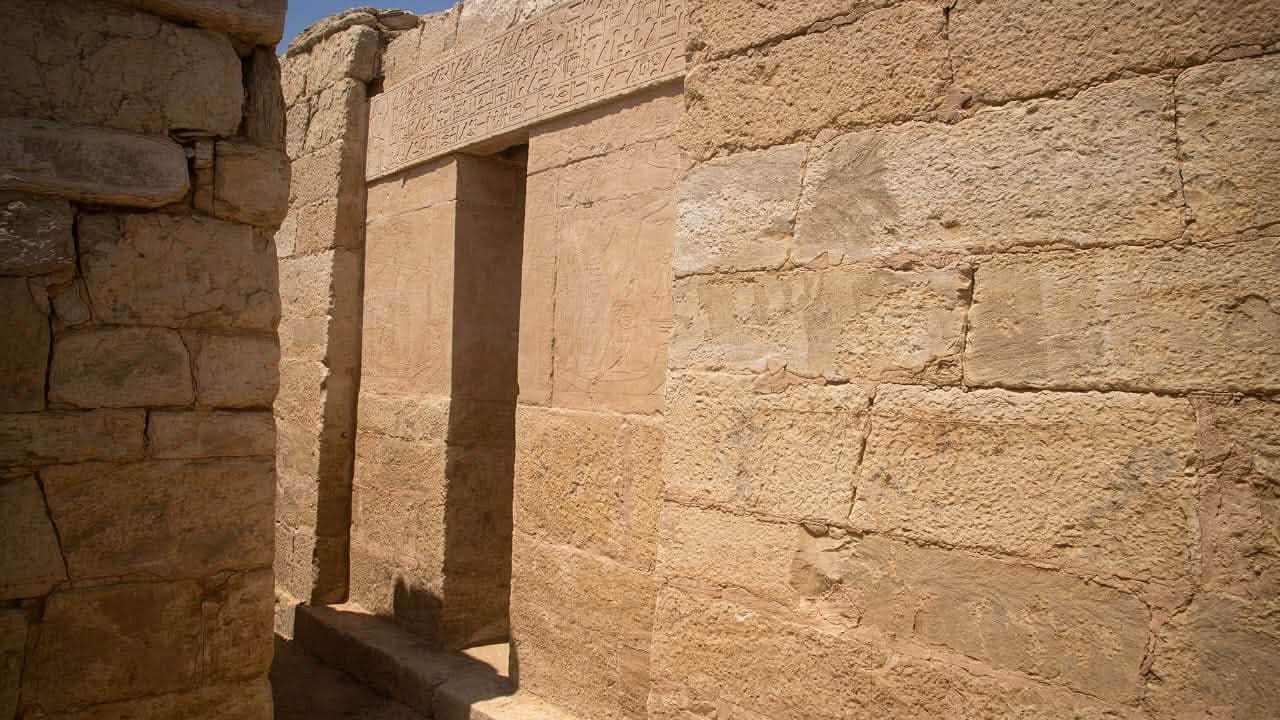
SEPTEMBER 19, 2026 07:55The funerary chapels of an ancient Egyptian judge and scribe were recently discovered at the Mariette Cemetery site located north of the village of Saqqara, Egypt’s Tourism and Antiquities Ministry announced earlier this month.It was discovered by a joint Egyptian-Spanish archaeological mission and dates back to the reign of Pharoah Djedkare Isesi during the Fifth Dynasty (between the late 25th century to mid- 24th century BCE).The mission operates as part of a joint scientific project between the Autonomous University of Barcelona in Spain and Egypt's Supreme Council of Antiquities.The two chapels were discovered within a medium-sized mastaba-style tomb at the site.While the tomb itself had been previously known, discovered by French archaeologist Auguste Mariette in the nineteenth century, Secretary-General of the Supreme Council of Antiquities Dr. Hisham El-Leithy explained that the chapels found within it were not.Funerary reliefs found within the chapels discovered at Mariette Cemetery site located north of the village of Saqqara, Egypt, September 18, 2026. (credit: EGYPTIAN TOURISM AND ANTIQUITIES MINISTRY)Both father, son served in judiciary positionsThe main chapel, located on the north side of the tomb, belongs to a man named Yunmin, who held several high-ranking judicial positions, including that of a judge, court director, and chief scribe responsible for reviewing petitions and complaints.Dr. Cervelló Autuori, who leads the mission on behalf the Autonomous University of Barcelona, added that the mission found a distinctive architectural facade bearing funerary texts and an offering formula within the chapel, alongside the official name of the tomb’s owner.The chapel’s walls were also found to be decorated with high-quality reliefs depicting a number of agricultural activities and processions carrying offerings to the tomb, added Autuori.Many of these scenes retained their original colors, he said.The second chapel, located on the southern side of the tomb, belongs to Yunmin’s father, a man named Iti, who held various scribal positions connected to the administration of agricultural land and offerings.Autuori noted that Iti’s chapel contains a false door and colored wall decorations depicting scenes of offering presentation, though explained that many of these decorations have also been lost.False doors served in ancient Egyptian belief as a threshold between life and death, where deity or spirit of the dead could cross back and forth. They are usually carved or painted along the west wall of a tomb’s funerary chapel, in line with the ancient association of the west with the land of the dead.Leithy stressed the importance of the discovery, as it adds new archaeological information about the Saqqara necropolis during the late Fifth Dynasty.He added that the find sheds light on the tombs’ architectural and artistic styles, as well as on the administrative posts held by senior state officials at the time.Funerary reliefs found within the chapels discovered at Mariette Cemetery site located north of the village of Saqqara, Egypt, September 18, 2026. (credit: EGYPTIAN TOURISM AND ANTIQUITIES MINISTRY)Remains of tomb, false door of ancient royal chamberlain at SaqqaraIn a separate statement from earlier this month, Egypt’s Tourism and Antiquities Ministry announced that the tomb of an ancient Egyptian royal chamberlain was discovered in Sector A of the Bubasteum necropolis in Saqqara during its first excavation season.The necropolis, located on the desert boundary of Saqqara, is part of a Ptolemaic and Roman temple complex dedicated to the ancient Egyptian deity Bastet (Bast), the goddess of cats. Excavations of the site revealed the remains of an Old Kingdom tomb’s funerary chapel, as well as the tomb’s false door still in its original position.In front of the false door, archaeologists uncovered a complete set of alabaster funerary tools, including an offering table and disc, a purification basin, a jug, and a basin. Both the false door and several of the tools bear hieroglyphic inscriptions of the tomb owner’s name, Sekhentiu-Ptah, and their titles as one who served in a prominent administrative position.The titles include Royal Chamberlain, Overseer of All the King's Works, Overseer of Royal Documents, Keeper of the Secrets of Royal Commands, Priest of the goddess Maat (ancient Egyptian deity of truth and balance), and Overseer of Scribes.Follow us on Google
Archaeologists unearth tomb shared by ancient Egyptian judge and his scribe father
Full Article
Original Source
Read the full article at Jpost →KhanList aggregates and links to publicly available news content. We do not host full articles from third-party sources. Always verify important information with original sources.