
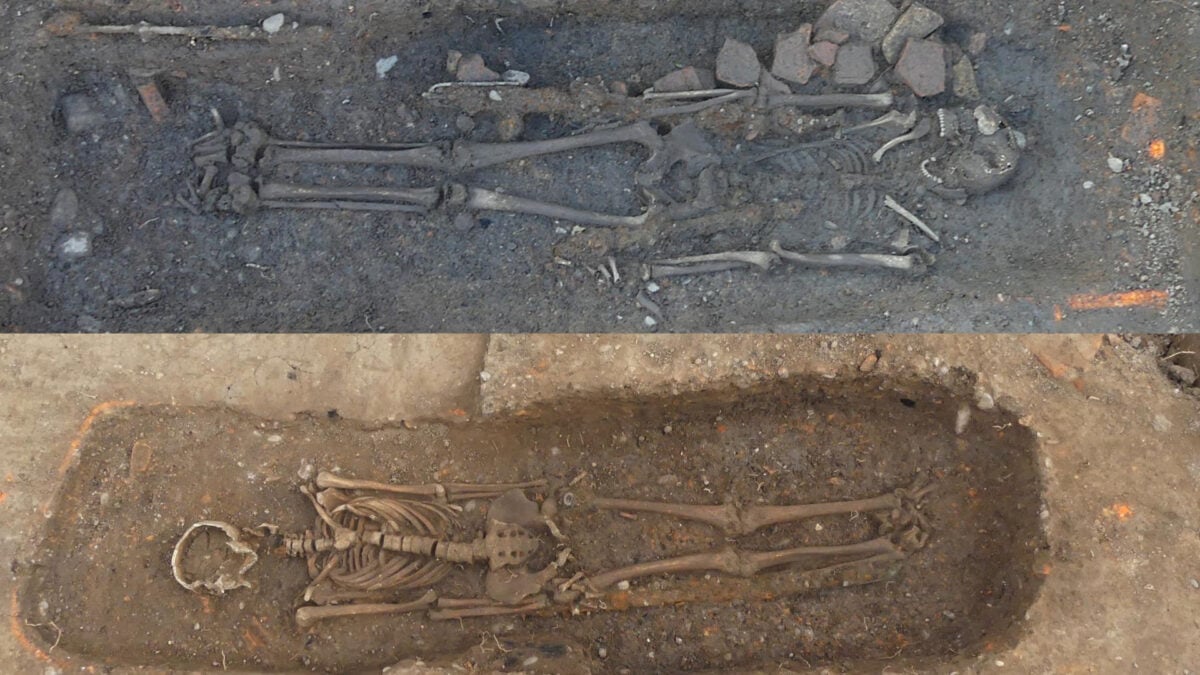
Archaeologists have found a 1,500-year-old cemetery in eastern France’s Alsace region, including lavish burials and horse graves. On Friday, the French National Institute for Preventive Archaeological Research (INRAP) announced the discovery of an “exceptional” 5th-century funerary complex in Horbourg-Wihr, a town near the city of Colmar, including gorgeous burial goods. The complex, among other findings, provides insight into the obscure transition from the Roman Empire to the Merovingian era in Alsace. The excavations took place within the context of preventive archaeological work executed ahead of a housing construction project. Archaeologists unearthed 11 adult or older adolescent graves, three child graves, and two horse graves, along with varying amounts of burial objects. Two male burials were particularly notable. In their graves, archaeologists found a sword in a semi-preserved wooden scabbard, a shield, a scramasax (a single-edged blade used by the Anglo-Saxons), and an angon (a kind of javelin used by Germanic warriors). Archaeologists excavating a sword from a burial. © M. Hermsdorff, Inrap According to the translated INRAP statement, these objects indicate that the males were either Germanic chieftains or foederati (members of tribes allied to the Roman Empire) incorporated into Rome’s 5th-century army. The team also found gold and silver decorative elements that would have originally graced weapons and clothing, further proving their high-class ranks. As for the other burials, two seem to have belonged to women, yielding objects such as pairs of silver-gilt looped brooches, silver bird-shaped brooches, glass bead necklaces, belt buckles, and a bone comb. Horses were also buried within the cemetery with their harnesses. The cemetery as a whole dates back to the second half of the fifth century, the same period that saw the last Western Roman emperor overthrown by the German chieftain Odoacer in 476. Within the same archaeological site, archaeologists also excavated a neighborhood with a residential area and road networks. They found hearths, wells, and ambiguous structures possibly associated with artisanal work. The quarter was part of a broader Gallo-Roman vicus, or village, and was continuously inhabited from the first to the third century CE. In the fourth century, however, the area was sporadically occupied before the burial complex was created in the later half of the fifth century. One of the horse graves. © H. Cicutta, Inrap “While this archaeological excavation enhances our understanding of the development and organization of the Gallo-Roman vicus in the northwest sector of Horbourg-Wihr, its primary significance lies in the discovery of a unique burial complex linked to the Migration Period,” the statement concluded. Western Europe’s Migration Period saw groups of people such as the Huns, Goths, Vandals, and Franks move into the lands of the bygone Western Roman Empire. The Merovingian dynasty (476 to 750 CE), for example, was a Frankish dynasty. The graveyard’s significance is greatly due to the fact that the region has few sites bearing evidence of Germanic settlement from the Migration Period. “This new data will undoubtedly revitalize research on the dynamics of settlement in the region and the upheavals that marked this territory in the second half of the 5th century.”
Archaeologists Unearth 1,500-Year-Old Warrior Graves in France—Horses and Swords Included
Full Article
Original Source
Read the full article at Gizmodo →KhanList aggregates and links to publicly available news content. We do not host full articles from third-party sources. Always verify important information with original sources.