
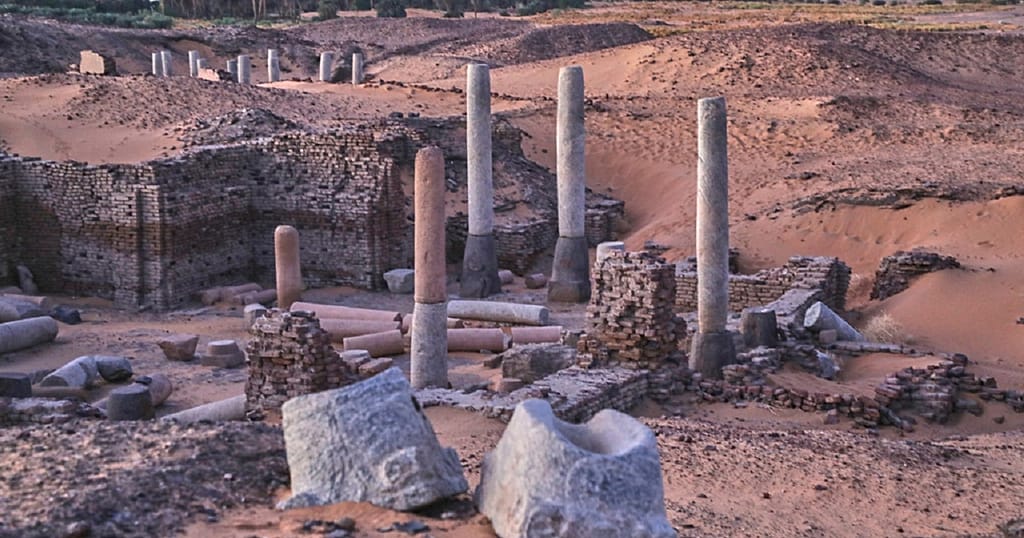
The site where Polish-Sudanese archaeologists unearthed the original floor of a monumental medieval cathedral is seen, Nov. 13, 2026, in Old Dongola, Sudan. - Copyright © africanews Mohnd Blal/AP Photo/Mohnd Blal Last updated: 19 minutes ago Sudan A hidden cathedral floor has been discovered in Sudan, revealing one of the biggest churches of medieval Nubia. The team working on the excavation believes the cathedral could be bigger than the White House. Archaeologists have unearthed the original floor of a monumental medieval cathedral in northern Sudan that could be bigger than the White House. The discovery reveals the scale and architectural significance of one of Nubia’s most important Christian buildings. A Polish-Sudanese mission earlier this month uncovered a staircase with 11-meter (36-foot) high walls that led them to the original floor level of the Great Church of Jesus, probably the largest church in medieval Nubia, in Sudan’s ancient city of Old Dongola. The church was first found in 2021, but much of it remains buried, with the staircase the only area where archaeologists managed to reach the floor. “So, the new discovery can be associated with the Great Church of Yesu (Jesus), the cathedral, the most important church of medieval Makuria," says Artur Obłuski, head of the Polish-Sudanese archaeological mission. Makuria was one of three medieval kingdoms that emerged along the middle reaches of the Nile River following the arrival of Christian missionaries in the sixth century. “This was the largest church in this territory. It was three times larger than the other known Nubian churches as well. And it was also a church where the head of the church’s ecclesiastical organisation stayed. And the archbishop of this church, he controlled the entire church hierarchy in the Makurian state" explains Obłuski. The head of the Sudanese mission Abdel-Hay Abdel-Sawy says the archaeological work is extremely detailed: “The documentation process takes a great deal of time. After the initial phase of clearing away sand and removing layers of debris comes a more meticulous stage, involving the use of trowels and brushes, and then followed by detailed recording, precise mapping, and complex technical work, all of which are time-consuming." The church is in Old Dongola on the eastern bank of the Nile, about 160 kilometers southeast of modern-day Dongola. The city is known for its numerous ancient churches Related articles
Archaeologists uncover medieval cathedral floor in northern Sudan
Full Article
Original Source
Read the full article at Africanews →KhanList aggregates and links to publicly available news content. We do not host full articles from third-party sources. Always verify important information with original sources.