
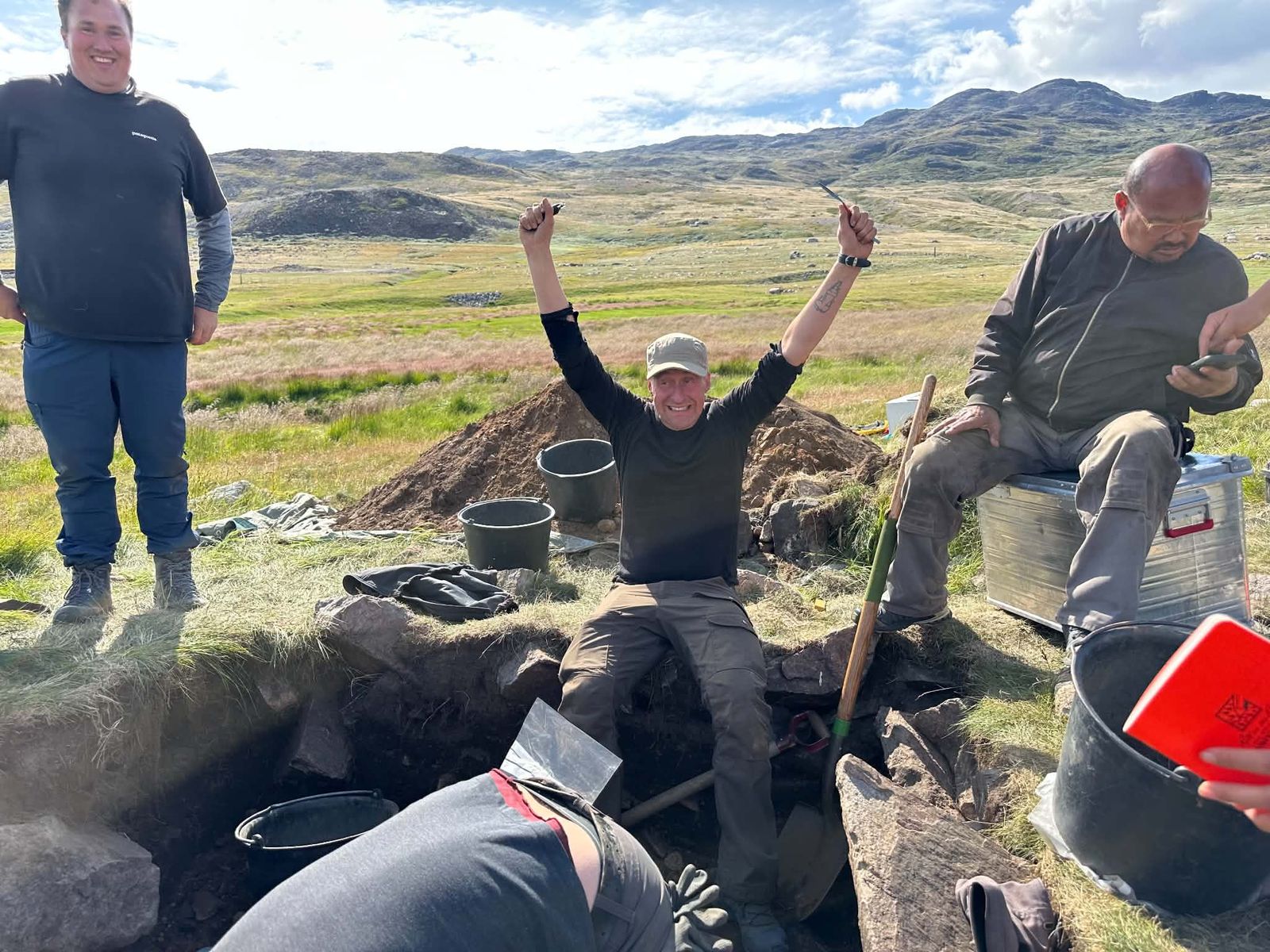
The site was first identified as a possible church decades ago, but researchers did not confirm that hunch until they found human remains there this summer. It could offer another clue to the Viking’s unexplained 15th-century disappearance October 20, 2026 7:00 a.m. The archaeologists were thrilled when they found the human remains. Ellen Frederiksen Archaeologists have discovered the remains of a Norse church in southern Greenland, a find that could offer new insights into the lives of the Vikings who once called the island home. “Churches were vital in Norse society, which makes them key to understanding how their society, especially the power structures, developed,” Christian Edelfelt Koch Madsen, an archaeologist with the National Museum of Denmark and co-leader of the dig, says in a statement. Norse settlers from Iceland, also referred to as Vikings, first settled in Greenland around 985 C.E., led by explorer Erik the Red. They lived on the massive island until the early 15th century, when they mysteriously vanished. As Tim Folger wrote for Smithsonian magazine in 2017, Norse settlers didn’t “just get by” in Greenland. They “built manor houses and hundreds of farms; they imported stained glass; they raised sheep, goats and cattle; they traded furs, walrus-tusk ivory, live polar bears and other exotic arctic goods with Europe.” Such success, he adds, makes their disappearance all the more perplexing. The red line marks the suspected cemetery wall. National Museum of Denmark For decades, researchers have been conducting archaeological excavations in hopes of better understanding the rise and fall of Norse society in Greenland. In the early 2000s, researchers discovered a rectangular stone wall with the remains of a stone building in the middle, a layout that suggests the site was once home to Norse church. But to definitively confirm the building’s purpose, they wanted to find a cemetery. In 2025, archaeologists once again revisited the site. On the final day of that excavation, researchers started unearthing bits of charcoal, which suggested humans had once occupied the site. Then, they found what appeared to be a decomposed human bone. When researchers returned this past August, they uncovered the remains of an entire human skeleton buried with its arms placed by its sides and its head pointing east, a positioning that suggests a Norse Christian burial sometime during the early Middle Ages. “This is ‘the smoking gun.’ Now there is no doubt that this is a church,” Madsen says in the statement. That would make it the first Norse church discovered in Greenland in more than 60 years. Based on its size and construction from hewn stones, the researchers suspect it dates between 1100 and 1300 C.E., a period that aligns with when Norse settlers in Greenland were transitioning to Christianity. The discovery of human remains suggests the site was once home to a Norse church. Michael Nielsen / Greenland National Museum and Archives The church is located near the modern town of Narsarsuaq in southern Greenland, roughly three miles from Brattahlíð, the estate of Erik the Red and the primary hub for the entire Norse colony in Greenland, which numbered 3,000 individuals at its peak, Madsen tells the Viking Herald’s Jonathan Bennett. In total, researchers have discovered the remains of six churches around Brattahlíð, likely constructed by rich local farmers or landlords. The researchers suspect they were competing for the religious power—and revenue—that accompanied church ownership. “These churches seem to demonstrate that, in the early Middle Ages, [Norse settlers] started competing about who’s going to run the show,” Madsen tells the Viking Herald. Did you know? Erik's exile Born in Norway, Erik the Red left for Iceland after his father was exiled for manslaughter. During Erik’s own subsequent banishment from Iceland, the explorer first reached Greenland with a small group of men around 982 C.E. and returned three years later to start a settlement. The site appears to correspond with a “Church Under the Sunny Mountains” mentioned in a medieval Icelandic manuscript called the Flateyjarbók, or the “Book of Flatey.” The remains sit in front of a mountain range that receives abundant sunshine because of its proximity to the North Pole and the region’s frequent high-pressure weather systems. However, as Madsen tells the Viking Herald, “there are a lot of mountains and a lot of places that look the same in Greenland.” The document mentions two other churches that could be nearby. Archaeologists have now discovered six churches in the area surrounding Erik the Red's main estate. National Museum of Denmark Looking ahead, the team plans to study the artifacts discovered during the recent dig. If they’re able to secure more funding, they hope to return to the church and narrow down when it was constructed. In the meantime, they are still reveling in the success of the recent excavation, which “is another piece of the puzzle that may bring us closer to understanding what happened to the Norse colony in Greenland and the mystery of why it disappeared,” Konrad Smiarowski, an environmental archaeologist at the University Museum of Bergen and co-leader of the project, says in a statement, per High North News’ Trine Jonassen. You Might Also Like Get the latest stories in your inbox every weekday. More about: Archaeology Christianity Cool Finds Greenland History Iceland Medieval Ages Norway Religion Religious History Vikings
Archaeologists Searching for Evidence of a Norse Church in Greenland Have Found 'the Smoking Gun' Near Erik the Red's Settlement
Full Article
Original Source
Read the full article at Smithsonianmag →KhanList aggregates and links to publicly available news content. We do not host full articles from third-party sources. Always verify important information with original sources.