
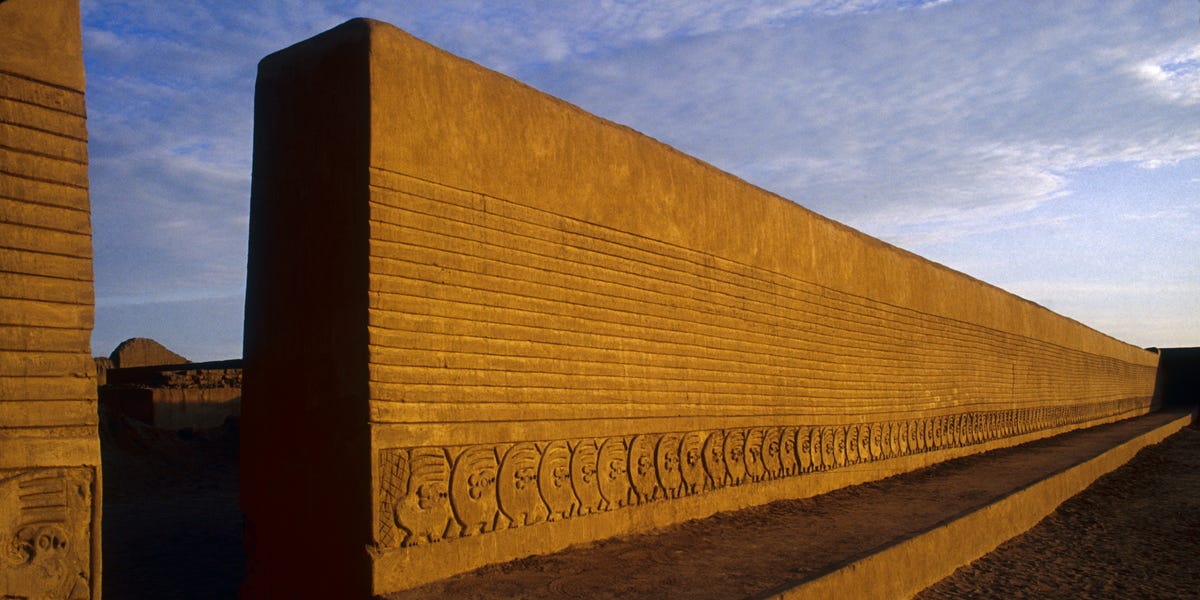
3 min readHere’s what you’ll learn when you read this story:Excavations at Peru’s well-studied Chan Chan uncovered a burial ground hidden for nearly 600 years.Archaeologists believe the sealed mausoleum served the ruling elite of the pre-Hispanic Chimú kingdom's capital.Chan Chan ranks as the largest city in pre-Columbian America, ruled by successive Chimú kings.After more than a century of excavation at the site of the ancient city of Chan Chan, in Northern Peru, archaeologists finally found something the looters missed. It was a gold-laden funerary platform, sealed for roughly 600 years, that likely held Chimú royalty.In the newly uncovered mausoleum at the Utzh An walled complex, which dates back to the 15th century, the team not only uncovered human remains, but also grave goods that may have once belonged to the civilization’s most elite, including gold, copper, jewelry, beads, colorful textiles, and metal weapons.Even at a UNESCO World Heritage site that’s been combed over for decades, the find stands out because it’s “the first time that Peruvian archaeologists have been able to come across an almost intact [funerary] platform, with unaltered contents, a platform that was designed for an elite individual, whose main chamber has remained sealed for almost 600 years,” said Jorge Meneses, lead archaeologist, according to the BBC.Archaeologists had found elite burials at Chan Chan before, but looters always got there first, particularly after the Inca conquest of the city. The newly discovered burial chamber remained unmolested, however, allowing experts to really mine the site, especially the four-foot-wide and 16-foot-tall central chamber reached by descending an eight-foot long staircase.Archaeologists discovered a total of 38 sets of human remains buried across the funerary area, split nearly evenly between one of two rooms on either side of the central tomb and the larger platform. The main tomb contained just one individual, and its skull was stained a deep blood red.“This pigment, likely mercury sulfide, known as cinnabar, is present across the Central Andes,” said Peruvian Ministry of Culture archaeologist Henry Gayoso Rullier, according to The Art Newspaper. “It was used in pottery, murals, on warriors’ bodies, in sacrifices, and on funerary masks covering the bodies and faces of the deceased.”Some of the remains show signs of reburial (including missing bones), a common practice in the region as the living often held onto and worshipped the bones of the deceased.“The discovery’s importance lies not only in the intact central chamber, but also in the exceptional information provided by the funerary platform,” Meneses said. It’s the expensive grave goods that tell the early story. “What is clear to us so far is that these people were part of the elite or were associated with the elite,” as Gayoso Rullier told the New York Times.Chan Chan was a key city in northern Peru from around 900 C.E. to the late 1400s C.E., reaching its height in the 15th century before succumbing to the power of the Incas. The largest adobe city in the pre-Columbian Americas, Chan Chan survived in one of the driest places on Earth by pulling water across the desert through a network of canals. The Smithsonian reports that each Chimú king is thought to have built his own walled palace compound, and many of those compounds contained funerary platforms like the one just excavated.“This discovery provides,” said Ari Caramanica, a Vanderbilt University anthropologist, “a nearly complete picture of a context of intense meaning centered on an elite individual—the node of power around which choreographies of the living and dead would have been directed.”Tim Newcomb is a journalist based in the Pacific Northwest. He covers stadiums, sneakers, gear, infrastructure, and more for a variety of publications, including Popular Mechanics. His favorite interviews have included sit-downs with Roger Federer in Switzerland, Kobe Bryant in Los Angeles, and Tinker Hatfield in Portland.
Archaeologists Opened a Tomb Sealed for 600 Years—and Found Gold, Bones, and a Blood-Red Skull
Full Article
Original Source
Read the full article at Popularmechanics →KhanList aggregates and links to publicly available news content. We do not host full articles from third-party sources. Always verify important information with original sources.