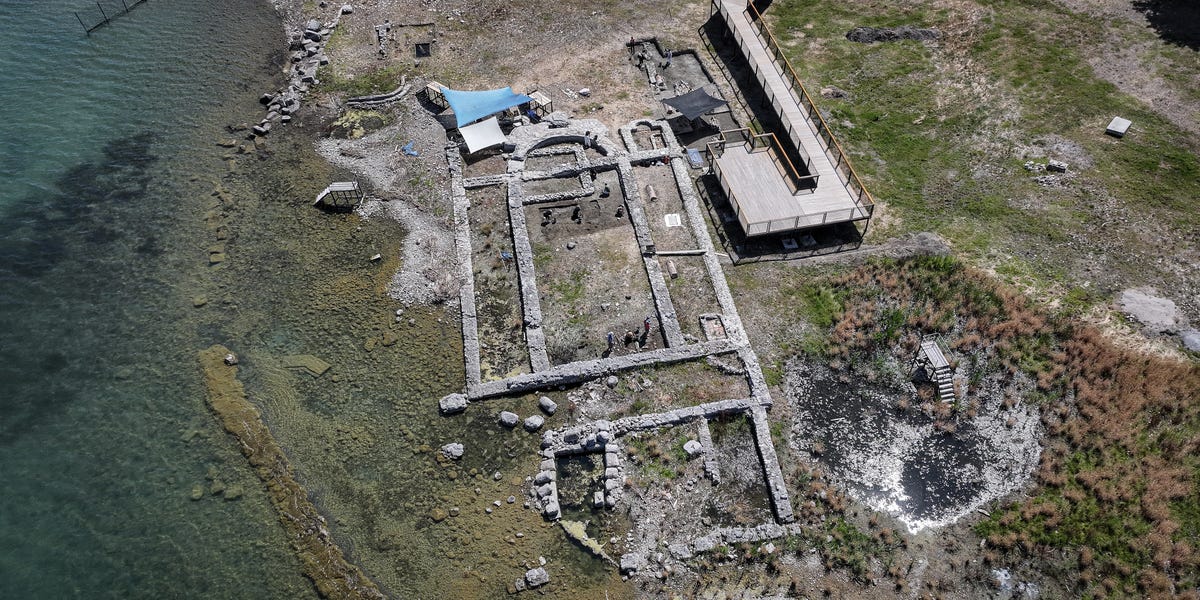
3 min readHere’s what you’ll learn when you read this story:The discovery in 2014 of an ancient basilica in Turkey later revealed the remains of an even older church beneath it.The smaller church, identified as the Church of Saint Neophytos, was likely the location of the First Council of Nicaea in 325 C.E. An earthquake destroyed the original church 43 years after the council meeting, leading to a second church being built on top of it. Emperor Constantine I brought early Christian church leaders together in 325 C.E. in ancient Nicaea. The meeting, now known as the First Council of Nicaea, led to the Nicene Creed, a major unifying document in the early Christian church. Exactly where this historic event took place has long remained an open question. But archaeologists in Turkey believe they have the answer.A 2014 photograph launched an archaeological exploration into an ancient basilica that led to a fresh discovery of what experts believe is the Church of Saint Neophytos, the location of the First Council of Nicaea in 325 C.E.An aerial photograph of a lake near Iznik (ancient Nicaea) revealed a structure in the shape of a church beneath the surface of the water. The discovery had a much deeper meaning, as experts wondered if the site might contain the “place of worship” that Eusebius of Caesarea, who attended and wrote about the First Council, described in his writing. The First Council of Nicaea represented the early Christian church’s first meeting to create a consensus on doctrine. The council also addressed the Arian heresy—the question of whether Christ was a created being—and approximately 300 bishops attended, with Emperor Constantine paying their travel expenses.Eusebius wrote that “the church was so small that how so many clergymen fit into this church was a great miracle of God.” Where that church once stood remained a mystery. Some believed the group met at Constantine’s summer palace, but historians believed an actual church was the likely location based on historic accounts. The sunken structure offered a possible solution, but when a layer of stone from the church was dated, it was found to be newer than 325 C.E., effectively ruling it out.However, from the moment excavations began in 2015, special attention was paid to wooden features. A distinctive floor surface found in a storage area of liturgical items continued outside, beyond the newer basilica. Following a trench east beyond the church walls, evidence showed that an earlier phase of the church still existed.Then came the breakthrough. Recent excavations uncovered wall sections, floor paving, and a column base, now identified by a team led by Mustafa Sahin of Bursa Uludag University as the Church of Saint Neophytos, which stood before a larger stone structure was built on top of it.Historical records show that the Church of Saint Neophytos was destroyed in a 368 C.E. earthquake. As Sahin told Turkiye Today, the older structure was the Church of Saint Neophytos, while the more recent structure was the Church of the Holy Fathers, built sometime after 380 C.E. to honor the clergy who participated in the First Council.Excavation at the site, which is now in its 11th year also revealed graves, some of which helped date the church. A gold ring decorated with palm tree and sword motifs, along with a bronze thimble, come from the period when the Umayyads besieged Iznik in 729 C.E. Historians have long known that an Umayyad commander entered the Church of the Holy Fathers during the siege, even though the city itself successfully resisted capture. Every excavation adds a fresh link to the history of the First Council of Nicaea.Tim Newcomb is a journalist based in the Pacific Northwest. He covers stadiums, sneakers, gear, infrastructure, and more for a variety of publications, including Popular Mechanics. His favorite interviews have included sit-downs with Roger Federer in Switzerland, Kobe Bryant in Los Angeles, and Tinker Hatfield in Portland.
Archaeologists May Have Found One of the Most Important Churches in Christian History
Full Article
Original Source
Read the full article at Popularmechanics →KhanList aggregates and links to publicly available news content. We do not host full articles from third-party sources. Always verify important information with original sources.