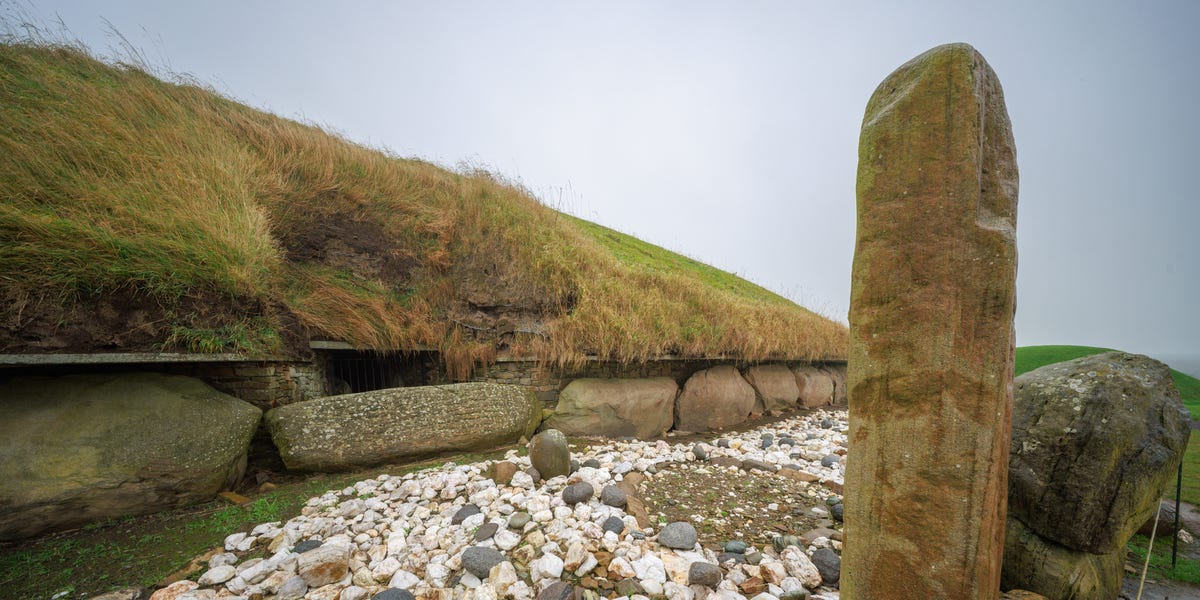
3 min readHere’s what you’ll learn when you read this story:A research team studying a pair of earthen barrows in France discovered what could be signs of an unexplored burial ritual from the fifth millennium B.C.E.The barrows are primarily made of earth and silt, but also include granite stones, which likely formed burial chambers. Researchers took thousands of electrical resistivity readings by hand to map the site. Researchers from La Rochelle University trudged through the dense landscape of trees and brush near the Coeby Neolithic cemetery outside of Tredion, France, taking thousands of point-by-point electrical resistivity readings by hand. Their reason? The barrows hidden beneath the greenery may themselves be hiding a 7,000-year-old mystery.According to the team’s new study, published in the journal Archaeological Prospection, located within the ancient cemetery site are TRED30 and TRED31—two long barrows, or ancient burial mounds, with shapes akin to elongated cigars,Originally discovered in 1986, the barrows sit near standing stones, passage graves, and clusters of other long barrows—some reaching over 260 feet in length—buried under layers of overgrown landscape and with a service road cutting right through the grounds. The researchers used electrical resistivity mapping—think of a souped-up metal detector—to peek into the mounds by sending electrical currents into the ground to measure density. The silt layers easily conducted electricity, but when the currents hit a granite slab, it sent back a much different reading.“Several groups of long barrows of significant shape and size reveal unusual anomalies that raise questions about the functionality and origin of these structures,” the authors wrote, adding that it “seems reasonable to confirm that these two barrows are indeed funerary monuments belonging to the Coeby cemetery.”The electrical surveys were an attempt to answer questions about the internal makeup of the earthen mounds, and the “results point to structures that could be similar to Passy-type constructions covering rough and anthropomorphic standing stones.”The Coeby examples resemble the Passy-type barrows that were popular from Normandy to the Yonne River in the middle of the fifth millennium B.C.E., making the new find an important southwestern extension of the tradition.The readings revealed that there’s a strong likelihood that slab-built burial chambers reside within the barrows, covered by the earth. These two barrows could be genuine funerary monuments, and the data indicated the “very likely presence of stone clusters.”The team got a little help from a visible anomaly, as erosion exposed a granite standing stone right in the center axis of one of the barrows, atop the most densely reported findings. “We are fortunate to have, within our study area, well-preserved examples of these earthen giants with clearly visible above-ground structures,” the authors wrote. “The coexistence of standing stones embedded within the burial mounds and positioned atop them suggests scientifically interesting interactions.”A 1990s exploration of a different barrow on site revealed two stone slabs carved in the shape of humans, raising obvious questions about the site’s use. “The presence of standing stones in these burial mounds remains a mystery to this day,” the authors wrote. “An extensive excavation of this type of monument would provide more information about these internal anomalies.”Tim Newcomb is a journalist based in the Pacific Northwest. He covers stadiums, sneakers, gear, infrastructure, and more for a variety of publications, including Popular Mechanics. His favorite interviews have included sit-downs with Roger Federer in Switzerland, Kobe Bryant in Los Angeles, and Tinker Hatfield in Portland.
Archaeologists May Have Found a Mysterious 7,000-Year-Old Burial Ritual
Full Article
Original Source
Read the full article at Popularmechanics →KhanList aggregates and links to publicly available news content. We do not host full articles from third-party sources. Always verify important information with original sources.