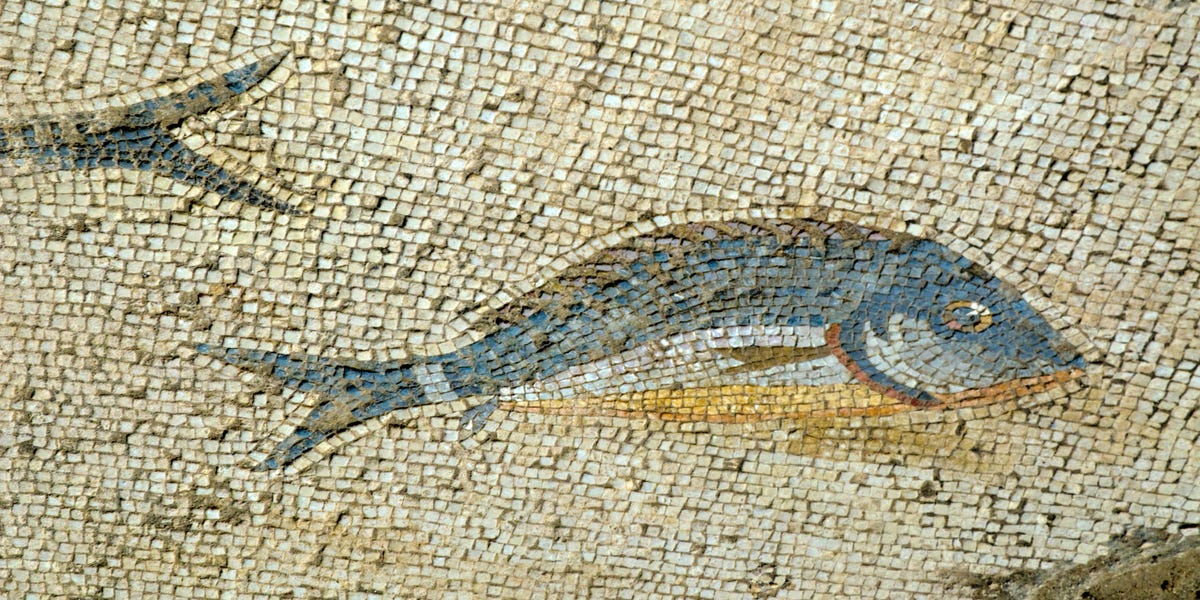
3 min readHere’s what you’ll learn when you read this story:The remains of eight rooms found in Rome’s Villa Celimontana may indicate that the building was once a barracks for Roman firefighters known as the Vigiles.Often mocked for running around with brooms and buckets, the Vigiles were a military body tasked with watching over the city, as well as preventing and putting out fires.Archaeologists continue to study the ruins, but similarities between mosaics at the villa and an ancient port suggest that they once housed the Fifth Cohort of Vigiles. While work to stabilize the retaining wall of Rome’s historic Villa Celimontana was underway, a project funded by Italy’s National Recovery and Resilience Plan (PNRR), workers made a remarkable find—an entire building that had remained hidden for 2,000 years.Built during the second century C.E., the structure (which appears to have once been a lavish residence) contained eight rooms, and while three were in shambles from centuries of being abandoned and buried, the other five have now been completely excavated. Elaborately painted plaster walls and ceilings were inlaid with opus sectile marble panels, on which mosaics were fitted together from pieces of colored stone, shell, or glass. Later floors, built during the third century, covered older Antonine-period mosaics.The building used to stand on Caelius Mons (Caelian Hill), one of Rome’s fabled seven hills, southeast of the city center between the Colosseum and the Baths of Caracalla. The Caelian Hill began as a gravesite, but would eventually become one of the oldest and most luxurious districts of Rome. Among the wealth of frescoes, marble and mosaics found at the site, what stood out the most was a splendid blue and white mosaic depicting a fish, a lobster, a crab, and a dolphin swimming around a krater—a type of ancient Greek and Roman vessel used for mixing water with wine. Such elaborate decor suggests that these rooms belonged to an aristocratic home, but the symbolism may speak to something else. Researchers realized that a similar mosaic had previously been found in the barracks of ancient firefighters at the port of Ostia.Known as the vigiles or cohortes vigilum, these military men—who, in addition to short swords, kept an arsenal of equipment that included buckets, pumps, sponges, brooms, hooks, and axes—extinguished the fires that constantly sprang up in the wooden houses and other structures of densely-populated Rome. First assembled by Augustus in 6 C.E, the earliest bands of vigiles were freed slaves who were divided into seven cohorts, each of which originally consisted of about 500 men. Doubling as firefighters and night watchmen who patrolled the city after dark, the vigiles were often mocked for rushing to put out fires that turned out to be a false alarms.The newly excavated building is thought to have housed the Fifth Cohort of the vigiles, but whether the newly discovered structures were the actual rooms in which the vigiles waited until called into action isn’t completely certain.Archaeologists will have to carefully study walls, floors, artifacts and the surrounding soil to find out what changes the building endured through centuries of use, but the marine mosaics found at Villa Celimontana and Ostia might be a giveaway. Since the vigiles were closely associated with water, and often stereotyped as frantically running around with buckets and brooms, the mosaics might have been emblematic. Earlier excavations nearby had found small rooms that might have been sleeping quarters, and two statue bases still standing at the entrance of the villa are inscribed with the names of cohort members.“Rome continues to amaze us by revealing artifacts that expand our knowledge of the ancient city,” said Daniela Porro, Special Superintendent of Rome, in a recent press release. “Using PNRR funds to secure an ancient retaining wall, the Superintendency has also made an archaeological discovery of great scientific value, which opens up new avenues for research and preservation.”Elizabeth Rayne is a creature who writes. Her work has appeared in Popular Mechanics, Ars Technica, SYFY WIRE, Space.com, Live Science, Den of Geek, Forbidden Futures and Collective Tales. She lurks right outside New York City with her parrot, Lestat. When not writing, she can be found drawing, playing the piano or shapeshifting.
Archaeologists Just Discovered a Roman Mosaic—and an Unsolved Ancient Mystery
Full Article
Original Source
Read the full article at Popularmechanics →KhanList aggregates and links to publicly available news content. We do not host full articles from third-party sources. Always verify important information with original sources.