
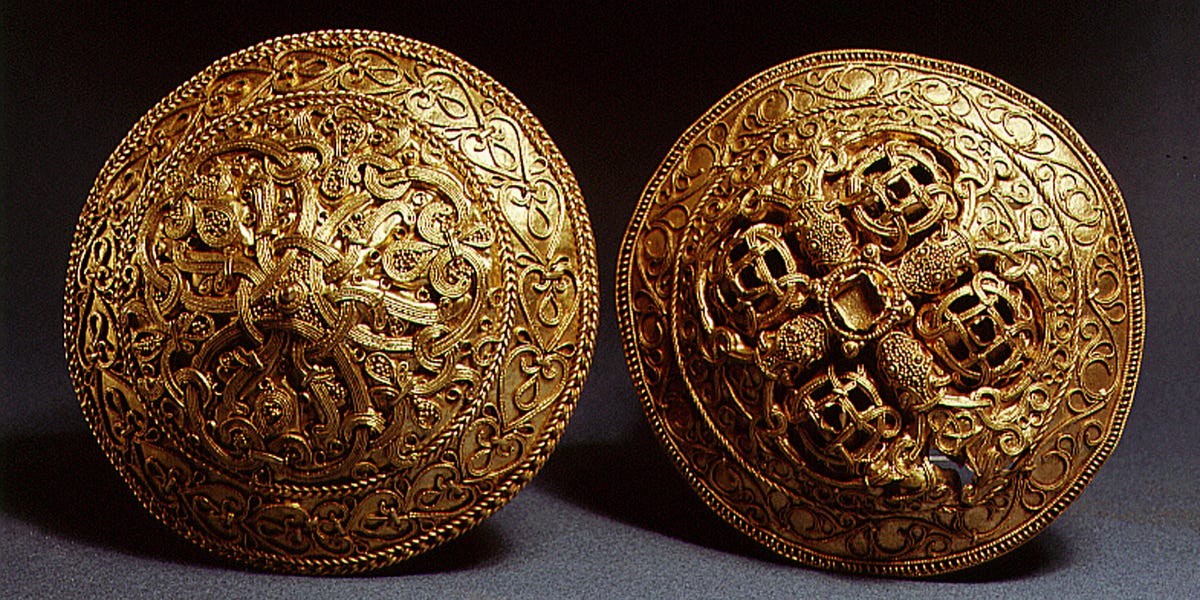
3 min readHere’s what you’ll learn when you read this story:Archaeologists in Denmark uncovered two brooches worn by a Viking Age female that still contain traces of fabric.Analyzing the fabric on both sides of the brooches may provide key details about Viking clothing patterns.The clothing had been preserved for 1,300 years, an extremely rare length of time for fabric to survive.Tucked inside a Viking Age grave in Denmark, the discovery of two oval brooches could help tell the story of just how the Vikings dressed 1,300 years ago. Nicknamed “the girl with the oval brooches,” the remains in the grave provide a singular glimpse of jewelry and the fabric used in clothing from a key time in Scandinavian history.As Smithsonian Magazine reported, the Skonager archaeological site in West Jutland first began revealing its secrets in 2024, when archaeologists discovered a cluster of Viking graves containing iron knives, glass beads, and other grave goods. Two oval brooches emerged from one of the graves, and when experts examined them, they found traces of fabric still clinging to both sides.According to a translated Facebook post from Archaeology West Jutland, the jewelry’s corrosion leaked metal salts that helped preserve the fabric while it lay in the grave alongside the woman. Viking graves in West Jutland are rare. “The fact that teeth and textiles have also been preserved—as is the case here—makes it truly magical,” the group wrote.The brooches both hold traces of fabric on the outside and inside, potentially giving experts insight into the woman’s outer garment as well as what she wore close to her body.The National Museum of Denmark wrote on its website that since it’s uncommon to find clothes from the Viking Age, much of our knowledge about how the Vikings dressed comes from written sources or pictures on tapestries. “Like today’s men and women, the Vikings dressed according to sex, age, and economic status,” the museum wrote. “The men preferred trousers and tunics, whilst the women dressed in strap dresses worn over undergarments. Ordinary Viking clothes were made of local materials, like wool and flax, woven by the women.”Finds in graves have shown that wealthy Vikings sometimes imported their clothes, using their resources to adorn themselves in silk and gold beads. The Vikings also commonly supplemented their dress with jewelry and animal furs. Using oval brooches, such as the ones found at Skonager, commonly helped women secure an outer dress over undergarments.The brooches may be significantly older than the cloth they fastened. The archaeologists said one of the brooches showed signs of repair, suggesting it was an older heirloom, but planned radiocarbon dating can better pinpoint the age of the discovery. Oval brooches like these were characteristic of the Viking Age, conventionally dated in this region to between 800 and 1050 C.E. The region has a known history of textile production, with an earlier discovery revealing a site from between 600 and 900 C.E. where craftspeople produced flax.Researchers are now studying both the fabric and the brooches. “We are gaining a close-up look at the girl with the oval brooches,” the archaeologists wrote. The University of Southern Denmark will analyze the teeth, and other groups will research the soil grain by grain to help analyze the textiles. The museum’s Textile Colors of the Viking Age project will search for pigments, potentially revealing the original colors of the fabric. If the pigments survived alongside the threads, the girl with the oval brooches may soon be seen in color for the first time in 1,300 years.Watch Our Science VideosTim Newcomb is a journalist based in the Pacific Northwest. He covers stadiums, sneakers, gear, infrastructure, and more for a variety of publications, including Popular Mechanics. His favorite interviews have included sit-downs with Roger Federer in Switzerland, Kobe Bryant in Los Angeles, and Tinker Hatfield in Portland.
Archaeologists Found Two Pieces of Jewelry That Could Bring a Lost Woman Back to Life
Full Article
Original Source
Read the full article at Popularmechanics →KhanList aggregates and links to publicly available news content. We do not host full articles from third-party sources. Always verify important information with original sources.