
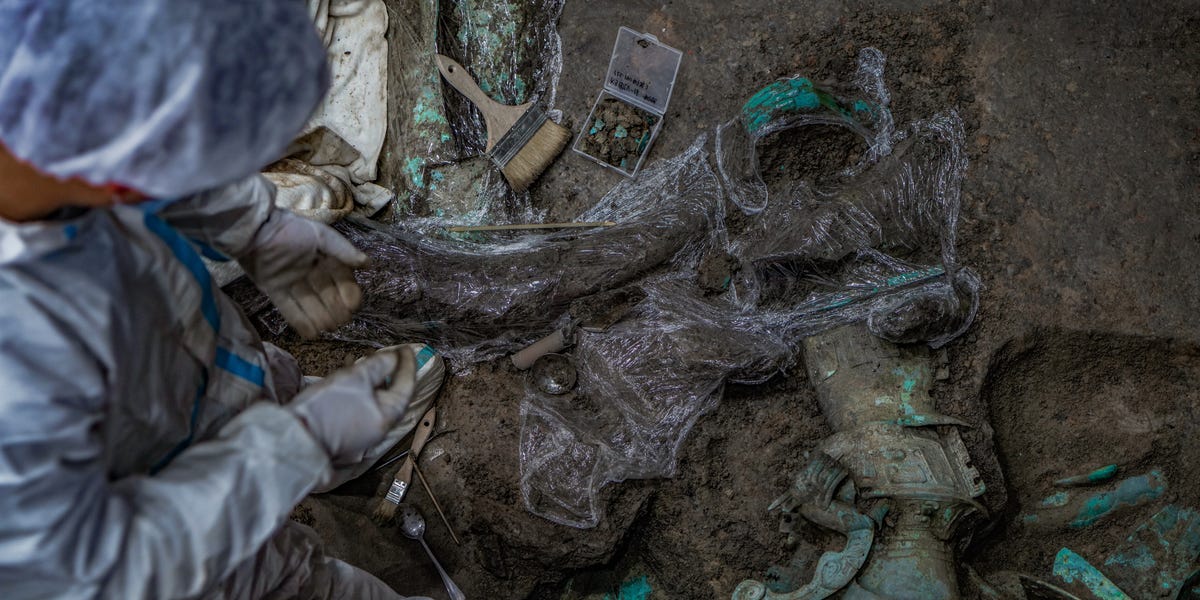
3 min readResearchers discovered a 3,000-year-old axe-like artifact at China’s Sanxingdui site made from meteoric iron, making it the oldest such object found in Southwest China and filling critical gaps in regional metallurgical records.The K7QW-TIE-1 artifact’s composition of over 90% iron and 7% nickel proved it came from space, since Bronze Age China lacked iron smelting technology, placing it among only 13 known meteoric iron objects ever found in China.Found within a sacrificial pit at Sanxingdui, the mysterious axe may have held ritual significance rather than serving a practical purpose, suggesting China’s ancient peoples valued celestial metal for sacred ceremonies just as Egyptians and Anatolians did.The strange and alluring relics found within and around the famed Sanxingdui site in Guanghan, China, don’t just raise questions for the casual observer and the scholar—they practically seem to invite outlandish theorizing. Dating back to the Shang Dynasty, the carefully laid-out area is replete with a palatial zone, production areas, and most hauntingly, sacrificial pits. Unusually shaped bronze masks and figurines found at the site have lent themselves to some wild speculation, with some fringe forums and Chinese tabloids floating that old conspiracy-theory standby: alien artifacts.A study recently published in Archaeological Research in Asia certainly doesn’t confirm that outlandish speculation, but the broad strokes of its examination of a fragmented tool, or possibly a weapon, found in the site’s Pit No. 7 might make the casual reader think so. The research posits that something in that pit may have actually come from outer space; specifically, meteoric iron.VCG//Getty ImagesA broken gold mask found in a sacrificial pit at the Sanxingdui siteMetallographic examination of the object, which was axe-like in shape and split into three fragments, showed no evidence of it being significantly cold-worked. It also showed a composition of over 90% iron to roughly 7% nickel, with that nickel being evenly distributed throughout the object in a manner highly uncommon for Bronze Age artifacts, as China had not yet developed iron-smelting technology. This led the researchers to conclude that this artifact, dubbed K7QW-TIE-1, was made from meteoric iron.This puts the axe in rare company. While objects made from meteoric iron have been found throughout the world, K7QW-TIE-1 is one of only 13 meteoric iron objects ever found in China. While the oldest of these 13 is a knife found in a cemetery in Xinjiang, which is dated to around 3000 B.C.E., K7QW-TIE-1 holds the distinction of being the oldest such item found in Southwest China.The “elder” status of these two objects isn’t the only commonality they share. While the other 11 artifacts were made from a combination of iron and bronze, only the knife and this axe are monometallic objects, meaning made solely from this meteoric iron.VCG//Getty ImagesA vast assemblage of artifacts uncovered within Sanxingdui Pit No. 7, photographed in 2022The study notes that K7QW-TIE-1 “fills a critical gap in the region’s metallurgical records,” offering further insight into iron use in the Bronze Age, while also highlighting the distinct metallurgical techniques of Southwest China in contrast to the Central Plains practices exemplified by some of the other meteoric iron objects found. What researchers are unable to ascertain at present is precisely what this axe-like object was used for. While it’s entirely possible that the axe was simply a practical tool, its discovery within a sacrificial pit at the Sanxingdui site suggests the tool or weapon may have had a ritual significance, a sacred role that superseded any practical purpose.Though the item featured no physical decorations or adornments to denote religious significance, metal of celestial origin was used to craft ritual objects in ancient Egypt and Anatolia, so it wouldn’t be unreasonable to conclude that the metal’s heavenly provenance might have motivated similar thinking for the occupants of the Sanxingdui site. The axe of extraterrestrial metal may have been used to craft the transfixing bronze masks that clearly had ritual significance in the region, or it may have played a role in rituals all its own. Even as this new discovery broadens our understanding of Bronze Age metallurgy in Southwest China, it simultaneously deepens the ever-alluring mysteries of the Sanxingdui sacrificial pits.Michale Natale is a News Editor for the Hearst Enthusiast Group. As a writer and researcher, he has produced written and audio-visual content for more than fifteen years, spanning historical periods from the dawn of early man to the Golden Age of Hollywood. His stories for the Enthusiast Group have involved coordinating with organizations like the National Parks Service and the Secret Service, and travelling to notable historical sites and archaeological digs, from excavations of America’ earliest colonies to the former homes of Edgar Allan Poe.
Archaeologists Found an Ancient Weapon Not of This Earth
Full Article
Original Source
Read the full article at Popularmechanics →KhanList aggregates and links to publicly available news content. We do not host full articles from third-party sources. Always verify important information with original sources.