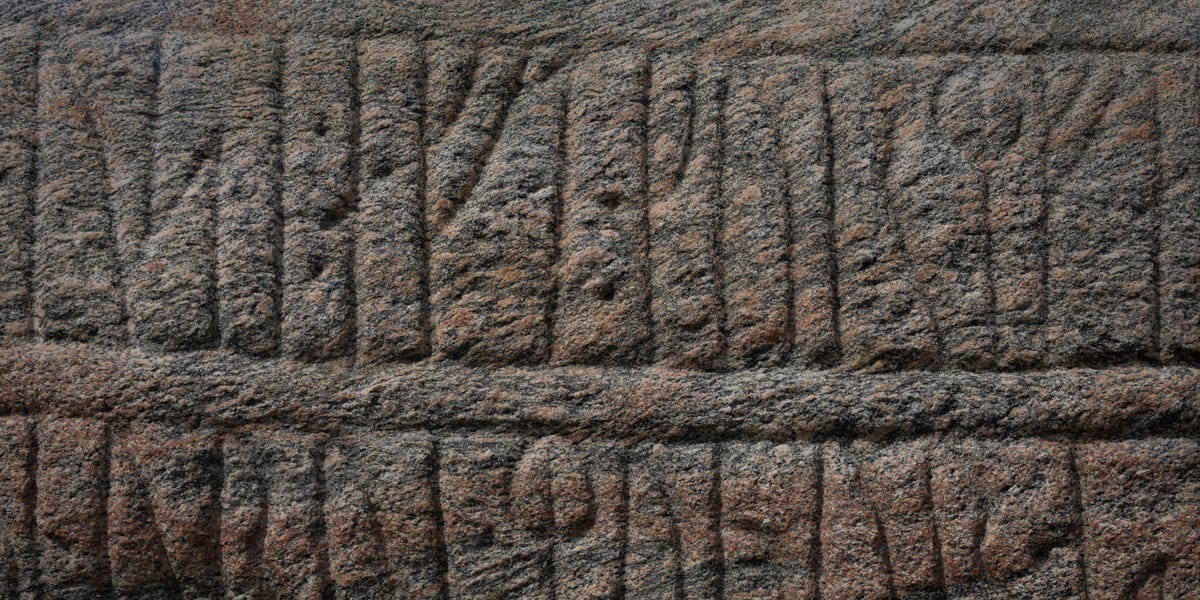
3 min readHere’s what you’ll learn when you read this story:Ancient runestones are rare in the Faroe Islands, but one has recently surfaced at an archaeological site on the island of Sandoy.The stone was used in the floor of a building thought to have been an early chapel or prayer house.A preliminary interpretation of the runes found the words “Her hvílur,” or “Here lies,” suggesting it was a grave marker. In the Faroe archipelago, which lies halfway between Iceland and Scotland in the North Atlantic, Sandoy is an island of grassy hills, craggy shores, and silvery lakes where shaggy Faroese sheep graze at the water’s edge. In Sandur, a gingerbread village set against a backdrop of weathered cliffs that reach to the sky, the wind carries the smell of salt and peat while archaeologists unearth relics of an long-gone era.Partly eroded by the saltwater of a nearby bay, the Á Sondum archaeological site shows evidence of being settled as far back as the fourth century. Norse settlers arrived in the ninth century, but it was only around the year 1000, when the chieftain Sigmundur Brestisson brought Christianity from Norway at the behest of King Olaf Tryggvason, that the islands’ first churches and chapels appeared. These early structures would eventually crumble, leaving their graveyards behind. Excavated remnants at Á Sondum include the rocky foundations of what used to be a chapel or prayer house, and one of the stones from its floor was recently found to be engraved with runes—angular letters used in Nordic regions before the introduction of the Latin alphabet. Runestones are common throughout the Nordic world but rare in the Faroes, which makes the Sandur find unusual.Whether the runestone from Á Sondum was a reused relic of pagan times or had another purpose at the dawn of Christianity on the Faroe Islands is so far unknown. After a preliminary examination, National Museum archaeologist Helgi Michelsen has managed to translate a segment of its inscription from Old Norse. It appears to say “Her hvílur,” meaning “Here lies.” That may identify this piece of rock as a grave marker from what was once a churchyard. Though what follows “Here lies” is still awaiting further translation from a runeologist, the writing appears similar to that on other runestones found on the Faroe Islands, such as the Sandavágur stone. The entrance of the building it belonged to is at its west end. The structure itself faces both east and west, typical of early medieval prayer house architecture in the region.The find sits within an unusually rich Christian landscape, and more Christian artifacts were discovered during the excavations in Sondum. Excavations beneath Sandur’s present-day church revealed a succession of earlier church buildings on the site, and the village also yielded an 11th-century coin hoard. Michelsen continues searching for more traces of the medieval Christian settlement with archaeologists and students from Aarhus University and Moesgaard Museum in Denmark. Among these are fragments of a miniature statue of the Virgin Mary cradling an infant Jesus in her arms, along with a kola, a small lamp meant to burn oil or animal fat. These objects could slowly piece together the religious life of Sandoy a thousand years ago. The building’s architecture was likely comparable to that of other ancient churches on the Faroe Islands, such as Bønhústoft on the island of Eysturoy.Fragile after removal, the stone is currently at the National Museum awaiting further analysis.Who was buried under the stone remains a mystery for now. What is known about graves in the Faroe Islands from the time of the runestone is that soldiers and the elderly received special honors. The grave of a soldier who fell in battle was surrounded by rocks with a standing stone in the middle. Elders were buried the same way, except the middle stone was laid flat. It’s possible that prayers for the deceased were engraved on the newly discovered runestone, although that can only be verified through careful interpretation. Some of the other artifacts from the early period of Christianity in the Faroe Islands may have been brought over by Irish and Scottish monks. Missionaries often carried devotional items with them for both their own prayers and sharing with prospective converts.Excavations at Sondum will continue until the end of August. While archaeologists will make an effort to report on their findings periodically, they ask that visitors keep their distance from the excavation field because of its fragile remains.Elizabeth Rayne is a creature who writes. Her work has appeared in Popular Mechanics, Ars Technica, SYFY WIRE, Space.com, Live Science, Den of Geek, Forbidden Futures and Collective Tales. She lurks right outside New York City with her parrot, Lestat. When not writing, she can be found drawing, playing the piano or shapeshifting.
Archaeologists Found a Floor Stone Covered in Runes—and It Might Be a 1,000-Year-Old Tombstone
Full Article
Original Source
Read the full article at Popularmechanics →KhanList aggregates and links to publicly available news content. We do not host full articles from third-party sources. Always verify important information with original sources.