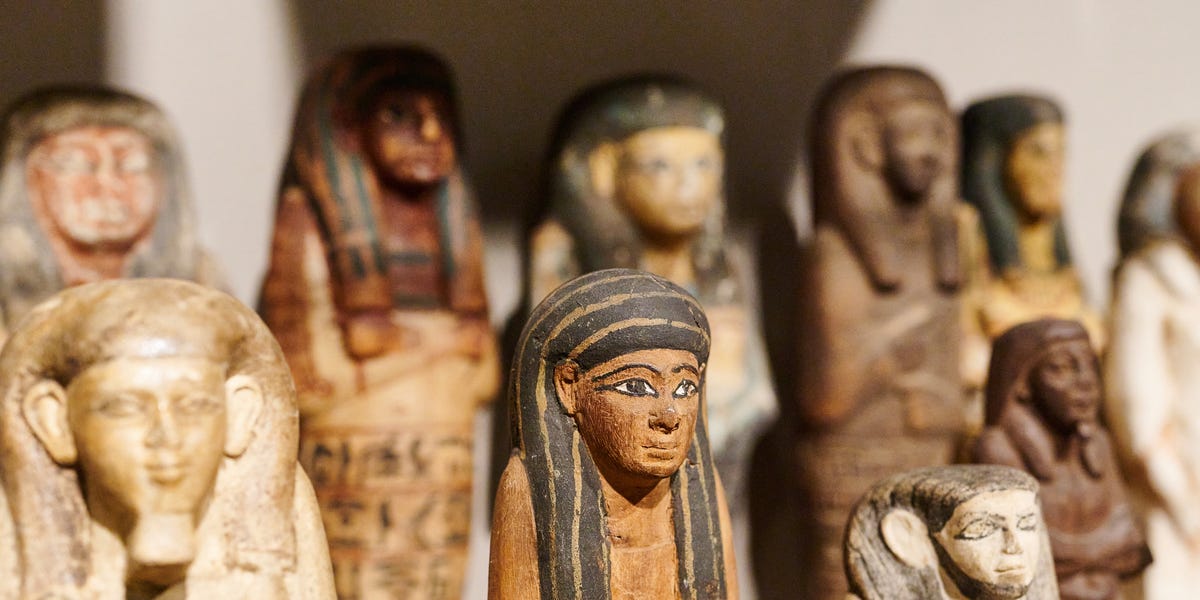
3 min readHere’s what you’ll learn when you read this story:An excavation at Egypt’s Tell Athar Quesna necropolis uncovered a range of artifacts, providing information about Egyptian funerary traditions during a period of over 1,300 years.The tomb complex featured evidence of Egyptian customs and traditions, as well as goods imported from areas around the Mediterranean. Over 500 ushabti figurines were located, each one different, some carrying texts from the Book of the Dead. When archaeologists recently conducted an excavation inside the necropolis of Quesna in the Egyptian central Nile Delta region, they discovered much more than a series of interconnected tombs. Alongside burial remains and large numbers of artifacts, the teams uncovered 560 ushabti statues made of faience—a ceramic with a brightly colored glaze.The discovery, as announced in a translated statement by the Egyptian Ministry of Tourism and Antiquities, expands our view of funerary traditions for non-royals spanning the Late Period through the Greco-Roman period—roughly 664 B.C.E. to 641 C.E.—as hundreds of artifacts throughout the burial chambers tell the story of rituals and cross-cultural trade.The ushabti figurines, each varying in size and shape, were crafted in a traditional style honoring Osiris, the god of the afterlife in Egyptian culture. Some of the small figurines carried texts copied from the Book of the Dead, which is full of spells the dead were supposed to use to help protect them in the afterlife.The Tell Athar Quesna necropolis, first discovered in 1991, is considered one of the most significant non-royal burial sites in the central Nile Delta. During recent work in the Quesna necropolis, the archaeological mission from the Egyptian Supreme Council of Antiquities discovered an organized architectural plan with a main hall connected by several rooms. Many ceilings had collapsed, but the entrances to the rooms were still somewhat intact—and inside the rooms were human burials in various conditions of preservation.Within these areas, archaeologists found objects representing a wide range of funerary traditions, including the hundreds of miniature figurines. Calling it one of the most important tombs in the central Delta region, Sherif Fathi, minister of Tourism and Antiquities, said the find’s value lies not only in the diversity of archaeological objects it contains, but in the fresh information it yields for understanding cultural and economic practices during the period.Additional statues were found that were made of semi-precious stones, including a finger amulet, an Eye of Horus amulet, a Knot of Isis amulet, and figurines of Egyptian deities associated with protection, rebirth, and resurrection, said Mohamed Abdel Badi, head of the Egyptian antiquities sector at the Supreme Council of Antiquities.A mixture of pottery offered examples of burial traditions across many centuries. The team discovered plates and vessels in an assortment of sizes, including jars, storage vessels, and two oil lamps. One ceramic jar still had residues thought to be mummification materials inside, and another ceramic piece came from the Greek island of Rhodes, with the vessel’s handle bearing its maker’s name. The diverse range of pottery, including the imported goods, offers evidence of trade relations between Egypt and Mediterranean communities during the Late and Greco-Roman periods.In one of the more unique discoveries, the team found plates set under the arm of one of the deceased, with another plate placed between their thighs. The custom was likely part of a funeral ritual that isn’t currently understood, offering just one more example of ancient Egyptian practices ripe for study.Tim Newcomb is a journalist based in the Pacific Northwest. He covers stadiums, sneakers, gear, infrastructure, and more for a variety of publications, including Popular Mechanics. His favorite interviews have included sit-downs with Roger Federer in Switzerland, Kobe Bryant in Los Angeles, and Tinker Hatfield in Portland.
Archaeologists Found a Burial Ritual in a 2,600-Year-Old Egyptian Tomb That No One Can Explain
Full Article
Original Source
Read the full article at Popularmechanics →KhanList aggregates and links to publicly available news content. We do not host full articles from third-party sources. Always verify important information with original sources.