
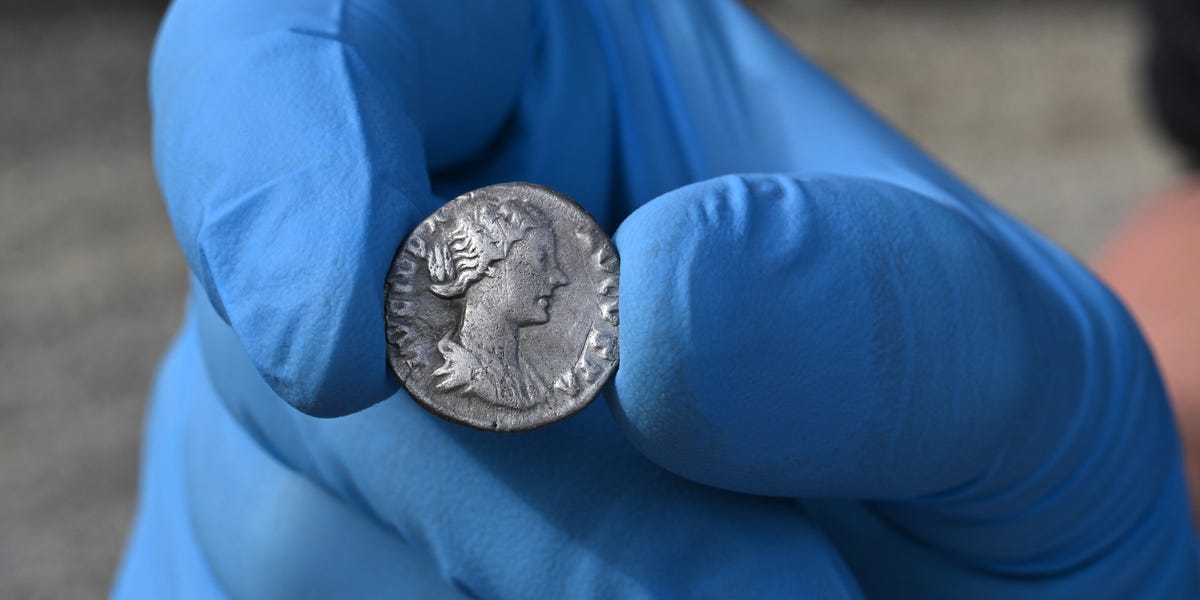
3 min readHere’s what you’ll learn when you read this story:Archaeological explorations ahead of a construction project in Germany turned over the soil of a sports field to reveal a collection of Celtic coins.The 11 silver quinarii discovered in Singen represent the largest such collection ever found together.Experts believe the coins were produced 2,000 years ago, but exactly where remains unclear.Ahead of the construction of a fire station on land that formerly housed a sports field, archaeologists made a discovery that set off some alarms of its own, so to speak.The field sits in Singen, in the German state of Thuringia. Digging there, archaeologists recovered 11 rare silver coins known as quinarii that were made by an ancient Celtic culture. The coins were likely buried together in the first century B.C.E. in an area that was heavily populated by the Celts roughly 2,000 years ago. The silver coins were slightly scattered through the field thanks to plowing over the years, but now they’ve been reunited.All 11 coins represent the Prague style of a silver quinarius. Having once been buried together, likely in an organic container that has since degraded, the coins could help experts better understand regional mints and the movement of goods in the Celtic-dominated region, according to the Thuringian State Office for Heritage Management and Archaeology as reported by Arkeonews.Archaeologists called the discovery, located in an area of about 20 feet by five feet, a “closed find,” an example of coins that were buried together at a single point in time. While archaeologists discovered other artifacts at the site—including a Roman denarius minted sometime between 164 and 169 C.E., a different silver coin from later in history, and additional beads and buttons—no additional clues surfaced about the person who buried the 11 quinarii, or how the coins got there in the first place.An initial search in 2025 discovered the first coins in the field, and further excavation dug up the rest in 2026. Archaeologists now believe they’ve found all the quinarii present at the site. While the state office didn’t release additional details about the coins, numismatists said they believe the coins were produced in the Gotha region northwest of Singen, where there was a heavy concentration of Celtic settlements.Despite the name, “Prague style” coins have nothing to do with Prague beyond the fact that the first discovery of this type of coin was found there. They were struck in Thuringia. The quinarius was a Roman silver coin valued at half of a Roman denarius. The Celtic version mimicked the size and weight of the Roman quinarius and was often designed with Celtic abstracts. They commonly included a stylized horse or Greco-Roman designs and circulated throughout Central Europe.Archaeologists learned at Singen that one pass is rarely enough—a follow-up search is always a good idea. Switzerland offers another, similar lesson. In Switzerland, coins dating from 2,100 to 2,300 years ago were found in the Bärenfelser bog near Arisdorf multiple times. Two coins found in 2025 are the oldest ever unearthed in Switzerland, both dated to the middle or second half of the third century B.C.E. But before that, in 2023, archaeologists found 34 Celtic silver coins dated to roughly 80 B.C.E. It can really pay to give things a second look.Tim Newcomb is a journalist based in the Pacific Northwest. He covers stadiums, sneakers, gear, infrastructure, and more for a variety of publications, including Popular Mechanics. His favorite interviews have included sit-downs with Roger Federer in Switzerland, Kobe Bryant in Los Angeles, and Tinker Hatfield in Portland.
Archaeologists Found 11 Silver Coins Buried 2,000 Years Ago—and an Unsolved Riddle
Full Article
Original Source
Read the full article at Popularmechanics →KhanList aggregates and links to publicly available news content. We do not host full articles from third-party sources. Always verify important information with original sources.