
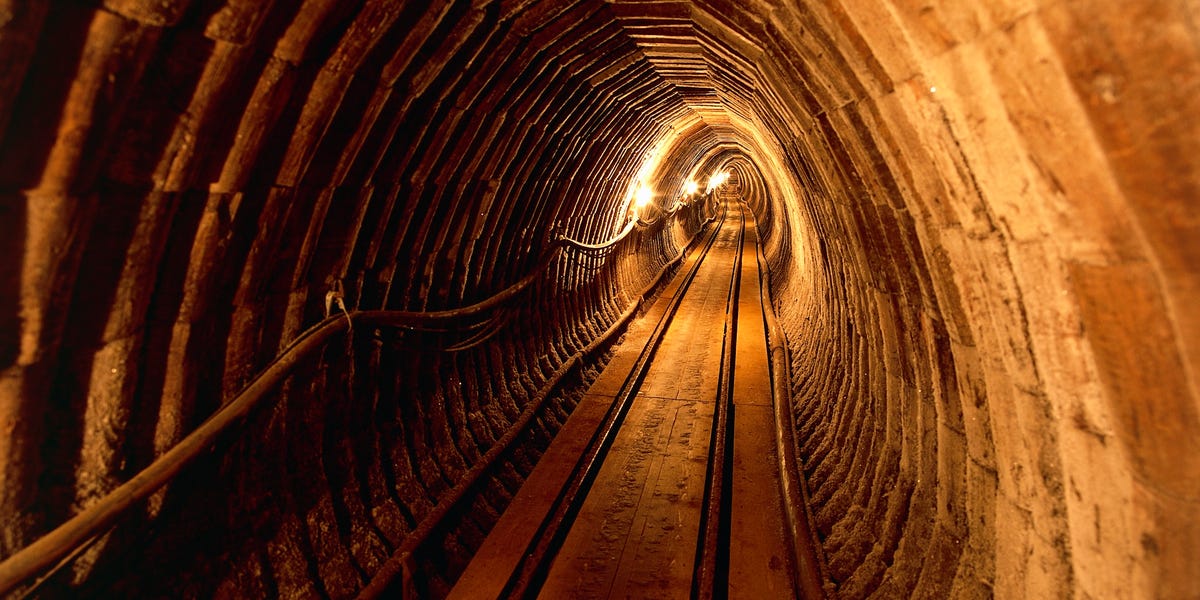
3 min readHere’s what you’ll learn when you read this story:Research into ancient Austrian salt mines revealed an extensive Iron Age tunnel complex and evidence of mining from as long as 7,300 years ago.Archaeologists uncovered nearly 1,000 feet of mining tunnels through the mountains at Hallstatt.Finds from within the mining chambers show the history of the site and the evolution of tool usage.Nearly 1,000 feet of ancient salt mining tunnels and chambers in the mountains near Hallstatt, Austria, have revealed a remarkably extensive mining history from the Iron Age. But the mountain’s history of salt mining goes back even further—7,300 years to be exact. Archaeologists have the ancient tools to prove it.As the Natural History Museum in Vienna continues to open a window into the salt mining history of the site, newly discovered mining chambers tell the story of how ancient inhabitants tracked salt deposits through the mountains, digging deeper with each hopeful find. “These impressively demonstrate how salt mining has driven innovations in technology, organization, and transport since prehistoric times, playing a pivotal role in Hallstatt’s development into one of Europe’s oldest industrial centers,” the museum wrote in a statement. “The exceptionally well-preserved finds from the salt mine provide valuable insights into the economic practices and lifestyles of past societies.”Experts believe that when Neolithic inhabitants settled in the area above Hallstatt 7,300 years ago, they began mining salt almost immediately. Salt production hit an all-time high around 1200 B.C.E., in the late Bronze Age, with daily totals soaring to 1.5 tons of salt extracted from the mountain.It’s the extensiveness of the mining chambers and the clues left behind inside them that help illuminate that history. Archaeologists discovered not just a single massive mining cavern, but a series of tunnels and chambers, some running in parallel directly over and under others, progressively dipping deeper into the mountain. Geological drilling helped reveal additional tunnels that were previously unknown.According to a report by Austria Press Agency (APA) published by Salzburger Nachrichten, experts say the chambers reached widths up to 80 feet and heights of 65 feet. The chambers traced salt deposits, showing how ancient miners chased the valuable mineral deep into the mountains.Throughout the centuries, intense landslides caused major disruptions in salt production. “But mining went on and on,” Daniel Brandner, head of underground excavations from the museum’s prehistoric department, told APA. “It was a very resilient community that provided salt again in a few years after these landslides.”Excavating the chamber floors—where mining debris and sediment have accumulated into a layer nearly 30 feet thick in places—turned up broken tools hafted in several different ways. Iron Age mining implements are typically standardized and purpose-built, so the variety suggests that uniformity gave way to experimentation as the period went on. The site’s Neolithic beginnings are documented separately, by antler and stone picks recovered elsewhere in the mountain.Additional artifacts include burnt pine splinters, clothing fragments, wooden bowls with food residue, and even human waste. The very salt mined in the mountains helped preserve the artifacts.With a bounty of finds peppering the 1,000 feet of chambers, archaeologists hope to continue searching the mountain for additional evidence of chambers in the mining network while analyzing the finds to create a better picture of prehistoric and ancient mining near Hallstatt.Tim Newcomb is a journalist based in the Pacific Northwest. He covers stadiums, sneakers, gear, infrastructure, and more for a variety of publications, including Popular Mechanics. His favorite interviews have included sit-downs with Roger Federer in Switzerland, Kobe Bryant in Los Angeles, and Tinker Hatfield in Portland.
Archaeologists Found 1,000 Feet of Tunnels Hiding an Entire Underground World
Full Article
Original Source
Read the full article at Popularmechanics →KhanList aggregates and links to publicly available news content. We do not host full articles from third-party sources. Always verify important information with original sources.