
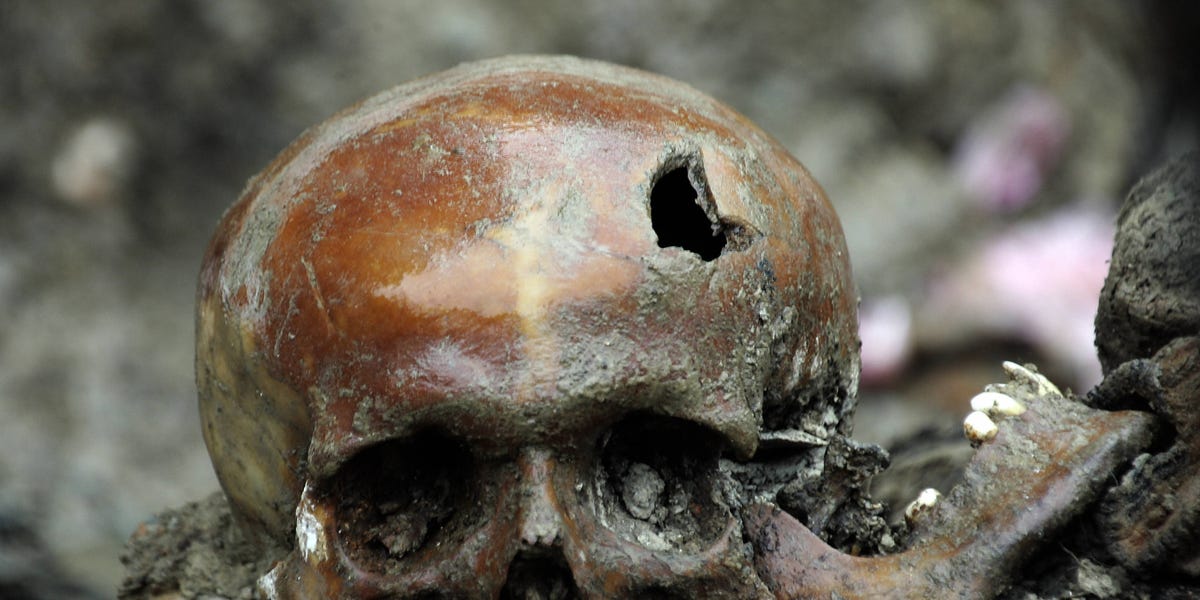
4 min readHere’s what you’ll learn when you read this story:In three caves in the Spanish province of Granada, archaeologists studied human bones with knife and tooth marks that suggested cannibalism. Along with being defleshed, some of the bones had been boiled, while others were mysteriously covered in powdered cinnabar, possibly as a funerary ritual. Whether the cannibalism was revenge on enemies or reverence for the dead remains unknown.While exploring Neolithic caves in the Spanish province of Granada, archaeologists found human bones scattered in the Malalmuerzo, Carigüela and Majolicas cave sites. Thousands of years ago, bodies might have been buried by human hands and then unburied by wandering animals, or possibly saved for later in a prehistoric carnivore’s cache. It was only when the researchers looked closer that they realized these remains weren’t from disturbed graves or casualties of animal attacks. Whoever occupied these caves had used human bodies as food.Rumors of Stone Age cannibalism had long swirled around these caves, but proving that it really happened required a closer look at the bones themselves. Archaeologist Palmira Saladié of the Catalan Institute of Human Paleoecology and Social Evolution in Tarragona, Spain, and her research team put the bones through radiocarbon dating and visually analyzed them using a bright light and a microscope. What they observed was unnerving. Their analysis suggested that the bones had been purposely stripped of flesh, probably with stone tools, and some had been cracked open for marrow, while others showed teeth marks. Other bones had whiter and slightly translucent surfaces, indicating that they had been boiled. At Carigüela, the researchers discovered two bone cups that had once been human skulls. What drove Stone Age people to do this is a separate, and more difficult, mystery.“When approached through the archaeological record, accessing [cannibalism] is often extremely difficult,” Saladié said in a study recently published in Journal of Archaeological Science. “The material record does not always allow a full exploration of relational meanings or intangible aspects…Human cannibalism encompasses a wide range of forms, functions, and contexts, making it one of the most challenging behaviors to decipher in prehistoric archaeology.”Europe’s earliest inhabitants appear to have practiced cannibalism, and the behavior resurfaced across the continent for hundreds of thousands of years. The bones themselves have been known since the mid-20th century, with butchery marks reported at Malalmuerzo as early as 1973, but no one had ever dated them directly. Saladié’s team combined radiocarbon dating with a fresh microscopic analysis, placing the Malalmuerzo assemblage—714 bones and fragments from 36 people, most exceptionally preserved though heavily fractured by processing—at roughly 5300 to 4950 B.C.E. The dates show that cannibalism here wasn’t an isolated episode, but a practice that recurred throughout the Neolithic.Three upper jawbones are fractured in ways that suggest violence, but they may have been broken by butchery, since the two can leave nearly identical damage. Neolithic methods of reaching soft tissue were often destructive for bones, so butchery may have left the jawbones in question with the same fractures they would have had from intense blows to the face. These impacts told Saladié that the skulls these jaws were once attached to had been deliberately opened to extract the brain through the endocranial cavity. Uneven breakage in most of the bones at Malalmuerzo also suggests that they were broken perimortem, meaning they were processed shortly after death. Bones that are dry, by contrast, usually snap straight across.There were also boiled bones at Malalmuerzo, though it’s impossible to know whether they were cooked with the flesh attached or if it had already been removed from the bone. Some of the bones had partially turned slightly red in color from being heated. At Carigüela, there wasn’t as much evidence for cooking, though there were the skull bone cups. After disarticulation from the rest of the body, the scalp and muscle were removed, followed by the face and the base of the head, and what remained of the skull was painstakingly trimmed and shaped into a cup. Marks from dismemberment and de-fleshing were also found on longer bones.The Majolicas remains showed the same processing as the other two caves, but some bones received unusual treatment once the flesh was off. Not all long bones had been cracked for marrow. Some bones of juveniles and young adults were also stained with a red substance that turned out to be powdered cinnabar, which is thought to have had a ritual meaning. Complicating matters, animal bones at the site carried the same red smudges. That could mean hunted animals were buried alongside the humans who had been eaten, but it may simply be that the pigment was transferred from the hands doing the work.Scholars have two main theories to explain why cannibalism arose in this region during the Neolithic period. One theory is that they are enemies captured in battle or during a raid (exocannibalism), and the other is that they consumed human flesh from their own group (endocannibalism), possibly as a death ritual. The last remaining modern cannibals offer detailed examples of the latter motive. Among the Korowai of Papua New Guinea, an unexplained death was traditionally blamed on a khakhua—a malevolent spirit wearing the face of someone the victim knew—and the accused was killed and eaten in retribution. The Wari’ of Amazonia see eating the dead as releasing them to the afterlife. Other cultures used to consume their dead so they could keep them close to the living.“Cannibalism in the southern Iberian Peninsula was not isolated,” Saladié said. “[It] recurred throughout the Neolithic, reflecting changes in social organisation, intergroup relations, and the management of violence and death.”Elizabeth Rayne is a creature who writes. Her work has appeared in Popular Mechanics, Ars Technica, SYFY WIRE, Space.com, Live Science, Den of Geek, Forbidden Futures and Collective Tales. She lurks right outside New York City with her parrot, Lestat. When not writing, she can be found drawing, playing the piano or shapeshifting.
Archaeologists Exploring Ancient Caves Found Grisly Remnants of a Stone Age Cannibal Mystery
Full Article
Original Source
Read the full article at Popularmechanics →KhanList aggregates and links to publicly available news content. We do not host full articles from third-party sources. Always verify important information with original sources.