
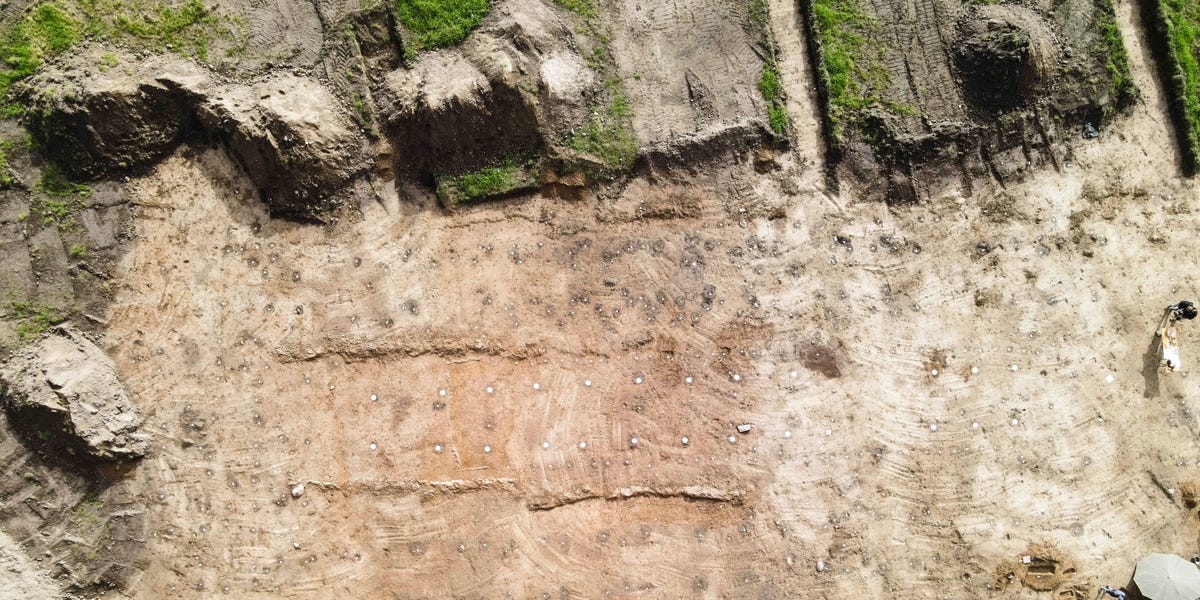
3 min readHere’s what you’ll learn when you read this story:An excavation in Westphalia, Germany, uncovered 30 Roman-era longhouses likely built along a popular trade route. The houses were constructed surprisingly close to each other, an unusual choice for that era. Precise dating will come after more detailed analysis is completed, but recovered pottery at the site and from the burial grounds nearby suggest that populations peaked during the second and third centuries.An archaeological excavation uncovered a 30 large longhouses tightly packed together, creating an “unusually large Germanic settlement” that operated from the second to the fifth century C.E. in Roman-era Bielefeld-Sieker.The longhouses, some measuring 26 feet wide and almost 100 feet long, are surrounded by outbuildings and small, sunken-floored huts. The excavation team from the Westphalia-Lippe Regional Association (LWL) called this new find an exception for the era, as most people in East Westphalia at the time were living on isolated farmsteads or relatively small hamlets of just a few farms. Sven Spiong, head of LWL Archaeology in Bielefeld, said in a translated statement that it must have been a “significant center for the region at the time.”Prior to the current excavation work, there were hints that this site was different. In the 1980s, an excavation team working southeast of the Mühlenback stream found a row of main houses tucked close together. Some had been rebuilt two or three times on the same spot, indicating a continuity of use for up to 200 years. Then, just a few years ago, excavations in the region uncovered a Roman marching camp I Sennestadt, roughly six miles from the new settlement discovery. The Romans also had a watchtower on the Sparrenberger Egge ridge along the way.Precise dating will come after more detailed analysis is completed, but recovered pottery at the site and from the burial grounds nearby suggests that populations peaked during the second and third centuries. Eva Manz, excavation director, said a small Roman coin from the second century helped with initial dating. “It came from the fill of a hole that had held a scaffolding post for a house,” she said, “thereby providing a precise date for the post-built structure.”Archaeologist Sebastian Düvel said it should come as no surprise that the inhabitants chose to settle and build where they did. The location (on the northern slopes of the Teutoburg Forest) has plenty of fertile soil, and was situated near the Mühlenbach stream, which would have flowed through the settlement and provided a steady, year-round supply of fresh water. The site was also near an old Roman pass.“The Romans left their mark on East Westphalia during their conquests,” Düvel said, noting that the Romans secured supply lines by controlling river routes. And LWL experts said that even when the Romans left the area, the route connections remained. “A trade route evidently developed along this axis and remained active well into the fifth century,” Duvel said, “a theory supported by the numerous Roman coins found along the path.”The settlement likely used the quality soil to their economic advantage, growing surplus food and selling it to passing traders. The foreign artifacts found in the region may have come from travelers trading for food or could have been brought back by soldiers as war spoils during Roman rule.“The route certainly attracted not only peace-loving traders but also individuals drawn by the population’s prosperity,” said Spiong. “The settlement was apparently unfortified, and no nearby hillfort existed at the time to provide protection. We therefore wonder whether living in such close quarters might have offered a security advantage, given that local settlers of that era typically placed great importance on maintaining significant distance from neighboring farmsteads.”The team has finished excavations, but as part of the West Germanic Lands in Transition project, they plan to continue analyzing the finds to gain an understanding about the culture across the four centuries, including just why the homes were so tightly packed together.“Based on current findings, one thing stands out above all: The settlement in Bielefeld-Sieker must be regarded as a significant regional center, likely originating from its strategically favorable location during the Roman era,” Spiong said. “During the period of upheaval surrounding the fall of the Roman Empire in the fifth century, these traditional routes of communication and exchange came to an end.”So did the settlement discovered nearly 2,000 years later.Tim Newcomb is a journalist based in the Pacific Northwest. He covers stadiums, sneakers, gear, infrastructure, and more for a variety of publications, including Popular Mechanics. His favorite interviews have included sit-downs with Roger Federer in Switzerland, Kobe Bryant in Los Angeles, and Tinker Hatfield in Portland.
Archaeologists Discovered the Remains of 30 Ancient Longhouses From an Unusual German Settlement
Full Article
Original Source
Read the full article at Popularmechanics →KhanList aggregates and links to publicly available news content. We do not host full articles from third-party sources. Always verify important information with original sources.