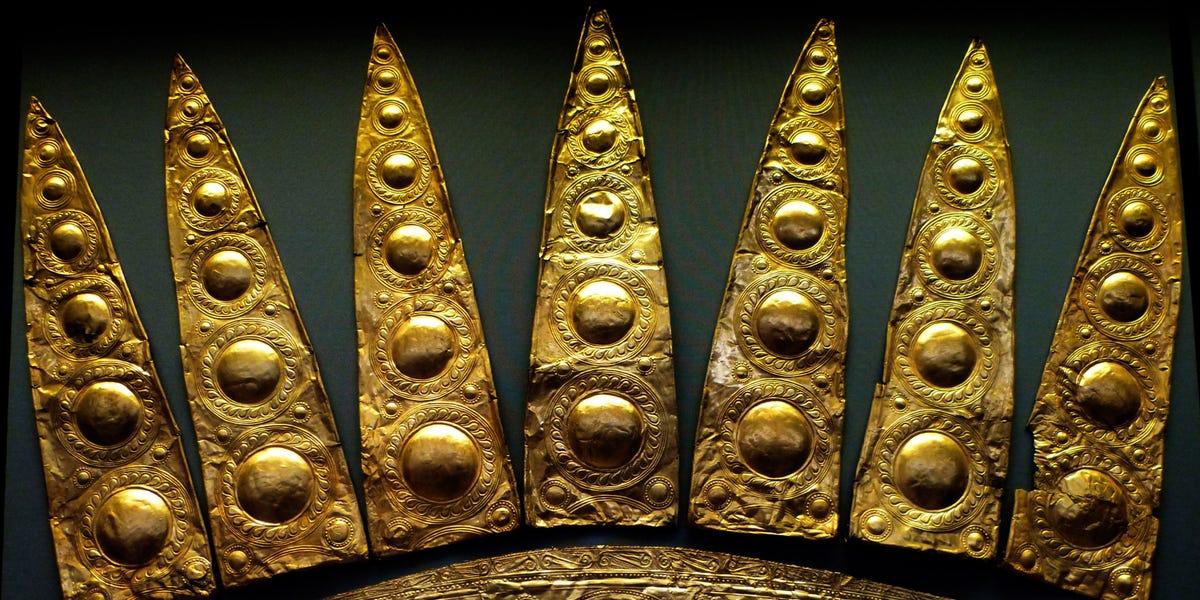
4 min readHere’s what you’ll learn when you read this story:For over a decade, a team from Sweden’s University of Gothenburg has been excavating tombs just outside a Bronze Age city called Hala Sultan Tekke on the island of Cyprus.Recently uncovered chamber tombs contained an extraordinarily rich collection of grave goods, some traded from afar.A new study on the discoveries shows the local and global influence on craftsmanship that defined one of the largest Mediterranean cities of the Bronze Age. A prominent Bronze Age port city on the Mediterranean island of Cyprus flourished for centuries as a hotbed of copper trade from 1500 to 1300 B.C.E. We’re now learning more about just how well connected it was with cultures from across Europe thanks to the discovery of a collection of grave goods preserved in collapsed tombs there.Archaeologists from Sweden’s University of Gothenburg have worked in the area for over a decade, uncovering an array of artifacts—the latest find, from 2023, being a collection of high-status pieces from tombs found adjacent to the site of the ancient city Hala Sultan Tekke. A 2026 study published in the Oxford Journal of Archaeology helps put the 3,400-year-old pieces in a cultural context.“The results indicate local Cypriot production that integrates Minoan, Mycenaean, Egyptian, and near Eastern influences while maintaining a distinct regional style,” wrote Peter Fischer, professor, expedition leader and study author. “These findings offer new insights into craftsmanship, intercultural exchange, and mortuary practices in the eastern Mediterranean during a period marked by intense connectivity and cultural interaction.”While teams have been working at the UNESCO World Heritage site Hala Sultan Tekke and the Larnaca Salt Lake Complex since 2010, the 2023 discovery was the biggest windfall so far, with the university calling the collection of artifacts the richest of its type ever found in the Mediterranean region and proof the location was a center for copper trade.“Considering the richness of the grave goods, it is a reasonable assumption that these were royal tombs, even though we do not know much about the form of government practiced in the city at the time,” Fischer said. “Undoubtedly those buried here were part of the city’s government.”The tombs outside the Bronze Age city feature underground chambers accessed through a narrow passage from the surface, with the largest chamber measuring about 13 feet by 16 feet. Inside two individual tombs, the team found more than 500 complete artifacts, many made from precious metals, gems, ivory, and high-quality ceramics. About half the artifacts were imported from foreign cultures. Gold and ivory came from Egypt, the precious stones—including blue lapis lazuli, dark red carnelian, and blue-green turquoise—were from Afghanistan, India, and Sinai, and there were amber objects from the Baltic region.The tombs also had several well-preserved skeletons, including one of a woman with a 1-year-old and a ceramic toy beside her. “Several individuals, both men and women, wore diadems, and some had necklaces with pendants of the highest quality, probably made in Egypt during the 18th dynasty at the time of such pharaohs as Thutmose III and Amenophis IV and his wife Nefertiti,” Fischer said.Embossed images of bulls, gazelles, lions, and flowers adorned the diadems. Most of the ceramic vessels came from modern-day Greece. There were pots from Turkey, Syria, Palestine, and Egypt. The grave goods included bronze weapons, some inlaid with ivory, and a gold-framed seal made of the hard mineral hematite with inscriptions of gods and rulers.“The vast wealth of the entombed individuals came from the production of copper,” Fischer said. “Nearby mines in the Troodos Mountains produced copper ore, which was refined in the city. This port city then exported and refined metal in large quantities to neighboring cultures. Copper was an important commodity because, combined with tin, it becomes the hard alloy bronze, which gave its name to the Bronze Age.”In the study, Fischer dissected gold diadems and mouthpieces from eight tombs the team had found in the Hala Sultan Tekke region since excavations started in 2010. The diadems, long forehead adornments, show wear patterns that suggest they were worn during life, not just as a burial adornment. Still, there are smaller examples, like the two mouthpieces, that don’t show any signs of wear and were probably just placed on the body at the time of burial as funerary objects.Fischer said that the nine diadems were for both men and women, plus one that appears to be for a child no more than 5 years old. “All of these items derive from elite burial contexts in chamber tombs,” he wrote, “associated with individuals interred alongside rich assemblages of mortuary goods, including numerous imports that attest to participation in extensive intercultural exchange.”The diadems and mouthpieces were produced in Cyprus, Fischer noted, as the designs incorporate foreign motifs while showing distinctly local characteristics. “Skilled Cypriot artisans seem to have adapted broader Near Eastern traditions,” he wrote, “creating hybrid stylistic forms that blended influences form the Near East, Egypt, and the Aegean.”Located at the southeastern coast of Cyprus and near the Larnaca Salt Lake, the city sat at a strategically beneficial point along the Mediterranean, and the natural harbor served as one of the island’s most accessible ports, making it a perfect position to facilitate long-distance trade. At 62 acres in size, the city was not only the largest on Cyprus during the Bronze Age, Fischer said, according to Phys.org, but one of the largest urban centers of the age across the eastern Mediterranean.Tim Newcomb is a journalist based in the Pacific Northwest. He covers stadiums, sneakers, gear, infrastructure, and more for a variety of publications, including Popular Mechanics. His favorite interviews have included sit-downs with Roger Federer in Switzerland, Kobe Bryant in Los Angeles, and Tinker Hatfield in Portland.
Archaeologists Discovered 3300-Year-Old Tombs Filled with Diadems and Gems from Around the Ancient World
Full Article
Original Source
Read the full article at Popularmechanics →KhanList aggregates and links to publicly available news content. We do not host full articles from third-party sources. Always verify important information with original sources.