
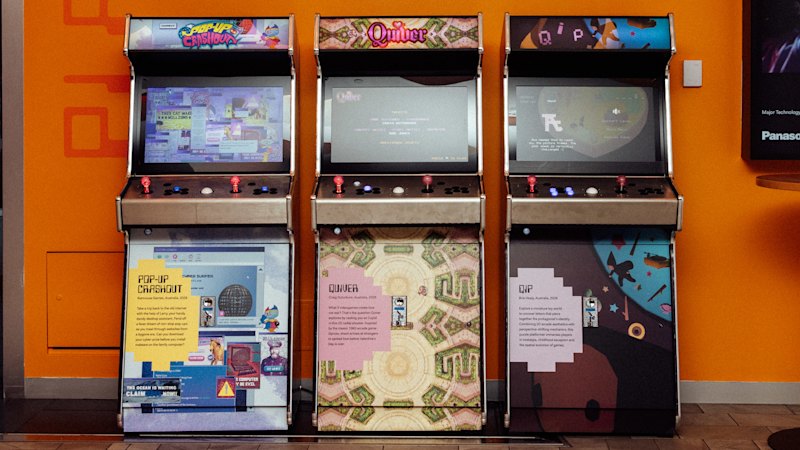
September 25, 2026 — 7:22pmWhen Brie Healy was a child, her father became obsessed with Space Invaders. He discovered the 8-bit arcade game during a family visit to a local cafe, becoming so hooked that he dropped the kids off at home and returned for hours to beat his high score.“[The 8-bit] style brings me back to that feeling of childhood,” the Hobart-based game developer and artist says. “When I see those types of games, it makes me think about those specific moments, like when I used to sit behind my brother while he played video games because he wouldn’t let me have a turn.”Craig Duturbure playing his new 8-bit game Quiver at ACMI’s Play On display.Pablo BarnesMost adults today probably share similar memories. For Ratmouse Games’ co-founder Anthony Doueihi, it’s of playing Time Crisis with friends in an arcade, and for his fellow co-creator Peak Distapan, it’s of chasing high scores in Point Blank on his PlayStation. Craig Duturbure, meanwhile, recalls getting lost in the 1983 scrolling shooter Xevious.These Australian developers are counting on this nostalgia to pull audiences into their new 8-bit arcade games, all of which are displayed at ACMI as part of the interactive showcase Play On. But there’s a twist: the games may look old-school, but they explore very modern-day anxieties.Duturbure’s game Quiver, for example, flips typical video-game violence on its head. In his 2D radial shooter, instead of shooting weapons to incite violence, you shoot Cupid’s arrows to spread love. Inspired by the 1983 tube shooter Gyruss, the aim of Duturbure’s game is to spread as much goodwill as possible before the end of Valentine’s Day.“Today, this style of game doesn’t always have to be about violence and shooting things to death. We’ve got enough bad news. Just make people happy,” the Melbourne-based developer says.“There’s a sort of elegance to 8-bit games because they’re so pure in a way that you can’t hide behind flashy stuff. You just have to boil it down to core mechanics and what could be fun. It makes sense to people.”Healy’s game QIP, meanwhile, places you inside a miniature toy world where you must locate different items to piece together your character’s identity. This was partially inspired by Healy’s desire to live inside a Polly Pocket house, but it was also created to encourage players to consider their own identities, something that has become increasingly difficult in the age of social media and constant visual stimulation. Who are we when we’re not simply a notch in the algorithm?Retro arcade games are enjoying a comeback, but not exactly in the way you’d think.ACMI“I see video games as an in-depth way to spark those kinds of feelings and questions in people. And it’s more interactive, it’s guided, so you can disarm the player with a fun vibe or something they can relate to, and then get them to do some self-reflection.”Retro 8-bit styles have proven particularly effective in prompting such self-exploration, Healy says. The pixels make the visuals more abstract, meaning any player could see themselves in the “blurry characters”. And unlike more modern games, 8-bit games generally don’t require hundreds of hours of gameplay or major strategising, leaving more room for either introspection or simple fun.Anthony Doueihi, Peak Distapan, Jae Pietersen Scott, Craig Duturbure and Brie Healy (left to right) at ACMI’s Play On display.ACMIRatmouse Games’ Pop-up Crashout leans more towards “simple fun”. With the help of a desktop assistant, players must fend off a deluge of pop-ups and malware while exploring the early internet. It harks back to a time when the internet was less stale and each website had its own charm, Doueihi says. However, Distapan says it also touches on the digital fatigue and online anxiety most of us currently feel thanks to relentless algorithms and constant cyberthreats.“I grew up loving the internet, but I feel like a lot of that love is gone – for fair reasons. I want people to recapture that joy,” Distapan says.All of these games attempt just that: to recapture the joy retro games evoked. Since gaming is a relatively new form of pop culture, Doueihi says nostalgia around ’80s and ’90s arcade games has only really begun to kick in somewhat recently.That said, arcades never disappeared. Jae Pietersen Scott, who created the music for Pop-up Crashout, says arcade games have simply evolved into things like Dance Dance Revolution or MaiMai. What’s different now is the growing nostalgia for specific ’80s or ’90s games, and the simplicity and communal nature they fostered. In fact, ACMI is set to open a Community Games Library as part of Melbourne International Games Week, an initiative similar to street libraries where visitors bring their favourite childhood games to swap with someone else.“There’s a trend in media towards analogue technology, and that’s feeding into how we’re consuming and making art as well,” Scott says. “Arcade games, since the very beginning, have been something that’s brought people together. That never stopped.”Nell Geraets is a Culture reporter at The Age and The Sydney Morning Herald.Connect via X or email.From our partners
Arcade games are making a comeback – but not in the way you’d think
Full Article
Original Source
Read the full article at Smh →KhanList aggregates and links to publicly available news content. We do not host full articles from third-party sources. Always verify important information with original sources.