
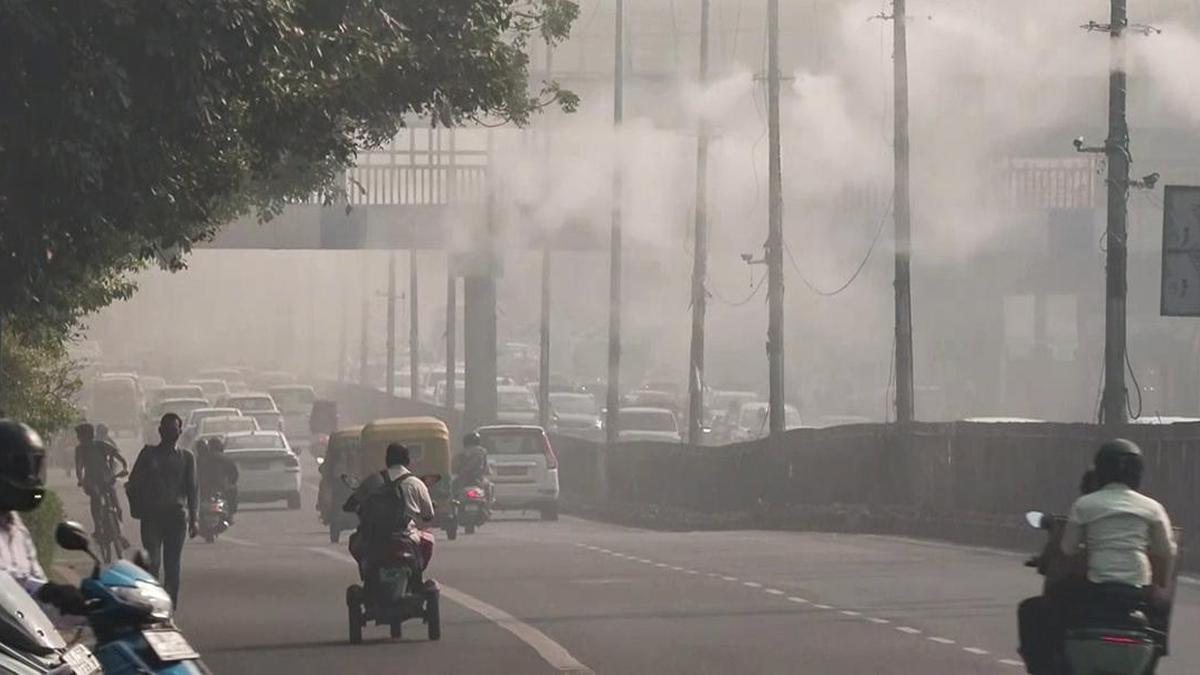
Thick smog engulfed several parts of the national capital and reduced visibility during the early morning hours. File | Photo Credit: ANI Delhi Air Quality Index slips near “severe” mark as a thick layer of toxic haze engulfed India’s National capital on Monday (November 9, 2026). Despite stringent restrictions on fireworks imposed by the Supreme Court, people defied the deadline way past 10 p.m. on Deepavali night.According to the Central Pollution Control Board Live Dashboard, Delhi AQI levels have gone up to 404 at 4 a.m. today and have been in respite since then.Burari Crossing registered the highest reading at 441, followed by Vivek Vihar at 437, Delhi Technological University (DTU) at 434, North Campus of Delhi University and Jahangirpuri at 433 each, and Rohini at 430.Beyond the National Capital, AQI also slumped in several other Indian cities. Mumbai saw hazy conditions, with a thick layer of smog blanketing the Kalanagar and Bandra areas as air quality worsened.According to monitoring data, Kherwadi-Bandra East recorded an AQI of 264, followed by Sewri at 226, Ghatkopar at 221 and Chembur at 216. Byculla recorded an AQI of 193, Mindspace-Malad West 191, Kandivali West 187 and Worli 148. Kurla recorded an AQI of 96.In Uttar Pradesh, a thick layer of smog blanketed Lucknow as several parts of the city woke up to hazy conditions.AQI spikes recorded across Indian citiesNorthern and western hubs bore the brunt of the pollution, with Lucknow (246), Amritsar (242), Jodhpur (234), Ahmedabad (230), Dehradun (228), Jaipur (223), Udaipur (223), and Surat (207) all slipping into the “poor” category.Central and industrial belts similarly saw a spike in readings, including Nagpur (239), Pune (221), Bhopal (205), Mumbai (171) and Kolkata (167), exacerbated by Deepavali emissions.Meanwhile, southern cities maintained relatively cleaner profiles, with Chennai standing at 208 (”poor”), while Bangalore (127), Hyderabad (120) and Thiruvananthapuram (67) recorded moderate-to-satisfactory air quality levels.Stage III GRAP restrictions imposedAccording to CPCB classification, an AQI between 0 and 50 is considered ‘good’, 51-100 ‘satisfactory’, 101-200 ‘moderate’, 201-300 ‘poor’, 301-400 ‘very poor’ and 401-500 ‘severe’.With Stage III measures in force following the CAQM’s decision, existing restrictions will continue alongside additional pollution-control measures, increased enforcement and directions to concerned agencies to prevent further deterioration in air quality.The emergency action plan applies across Delhi and adjoining districts of Haryana, Uttar Pradesh and Rajasthan. It is invoked as a precautionary measure based on meteorological and pollution forecasts provided by the India Meteorological Department (IMD) and the Indian Institute of Tropical Meteorology (IITM), allowing restrictions to be implemented before citywide AQI levels reach the ‘severe’ category.GRAP is a four-stage emergency framework managed by the CAQM in coordination with the CPCB and regional state governments. Restrictions become progressively stricter as air quality deteriorates.(With ANI inputs) Published - November 09, 2026 09:50 am IST
AQI slips to 'severe' in Delhi; Mumbai, Chennai wake up to smog morning after Deepavali
Full Article
Original Source
Read the full article at Thehindu →KhanList aggregates and links to publicly available news content. We do not host full articles from third-party sources. Always verify important information with original sources.