
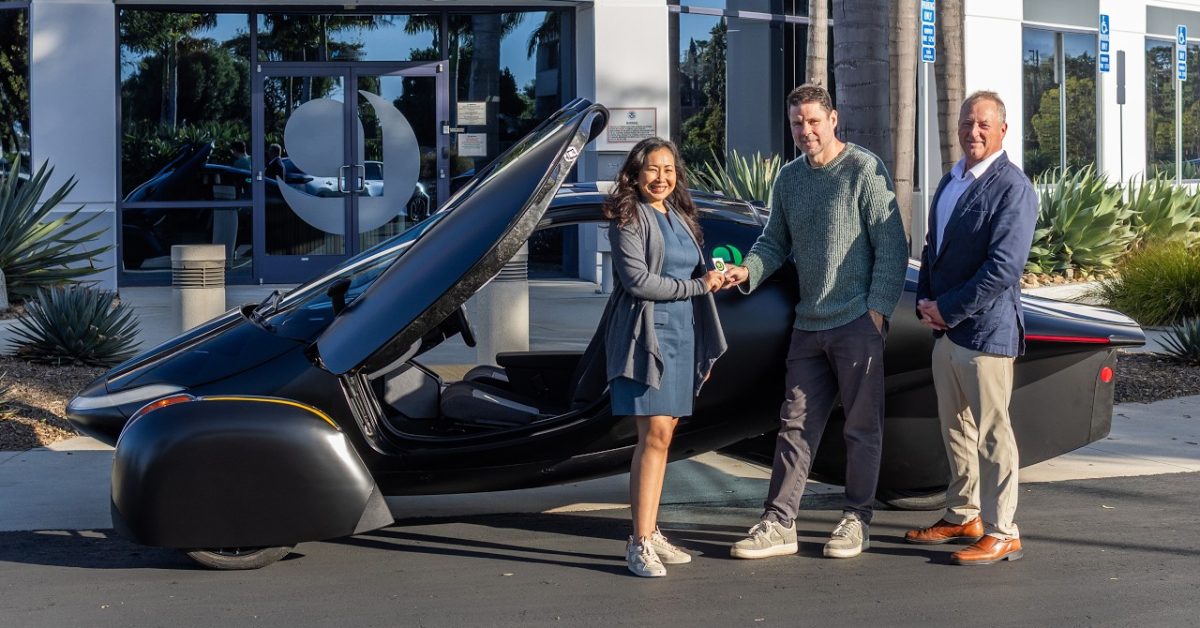
Aptera (SEV) has finished building its first solar electric vehicle for a paying customer. It’s going to Martin Hartono, the startup’s No. 1 “Accelerator” investor, and it’s being exported out of the US. It’s a real milestone for a company that has pushed back its delivery dates since 2022. And it comes a week after Aptera reported $9.2 million in cash against the roughly $25 million it says it needs to start series production. A matte black Aptera for Accelerator #1 Aptera announced today from its Carlsbad, California headquarters that it completed what it calls its first production solar electric vehicle. The car is finished in “Noir,” a matte black exterior, and was built for Accelerator #1. Accelerators are investors from Aptera’s community funding program, where delivery priority goes to whoever invests the most. So the first customer car went to the biggest check. Hartono is the CEO of GDP Venture, the Jakarta-based venture arm of Indonesia’s Djarum Group. Aptera didn’t say which country the car is going to, what he paid for it, or when it will actually be handed over. In the release, Hartono said Aptera is a fit for people who want to “minimize their energy consumption without compromising the ability to travel long distances.” Co-CEO Chris Anthony called it “the moment our team has worked toward for years” and said the company is working to finish more vehicles for early customers as soon as possible. No number was given for how many more. Where Aptera actually stands The timing is interesting. Just seven weeks ago, Aptera cut its estimated cost to start production to about $25 million, down from $40 to $45 million, and said the first 40 production vehicles would start building by the end of 2026, with customer deliveries in early 2027 “subject to financing.” Its Q3 report last week didn’t change that picture much. Aptera ended September with $9.2 million in cash, and $4.1 million of that is refundable reservation fees. It lost $14 million in the quarter, and its own filing says substantial doubt about its ability to continue as a going concern “has not been alleviated.” On November 10, it priced a $6 million registered direct offering at $1.75 per share. SEV closed at $1.67 on Tuesday, with a 52-week high of $7. The solar side of the pitch holds up better. In August, TÜV Rheinland measured 4.23 to 4.75 kWh per day going into the battery from the car’s integrated panels in Carlsbad, which works out to roughly 40 miles of daily driving. But that conversion relies on Aptera’s 100 Wh/mile efficiency target, and today’s release itself notes that figure isn’t yet confirmed for production vehicles. The release’s risk factors are also worth reading. They list export, import, certification and registration requirements, state dealer licensing, single-source suppliers, and whether reservations will convert into binding orders. Shipping car No. 1 to an investor overseas sidesteps most of those for now. Electrek’s Take Credit where it’s due. Aptera has a finished car built to a customer’s spec, which is more than Lightyear or Sono Motors ever got to before they ran out of money. We’ve followed this company since it came back in 2019, and plenty of people (us included, at times) didn’t think we’d see this day. But I have to be honest, this looks more symbolic than like the start of a production ramp. This is a single vehicle, built before Aptera has raised the money it says it needs for series production, and it went to the person who put the most money into the company. That’s a thank-you and a good press release ahead of what will likely be another raise. It doesn’t tell us much about Aptera’s ability to build cars at a cost that works. The real test is still the first 40 cars, and whether they reach regular reservation holders in the US. Aptera says it needs about $25 million to get there. It has $9.2 million, $4.1 million of which customers can ask back for, and it’s raising money at under $2 a share, which means a lot of dilution for every dollar. We want this to work. Ultra-efficient cars are the only way vehicle-integrated solar makes sense, and Aptera is the last serious attempt standing. So can it fund those 40 cars before the cash runs out? If you’re buying an EV, powering it with home solar can cut your fuel costs to nearly zero, even if your car doesn’t have panels built into the body like the Aptera. With electricity rates up almost 10% last year and expected to keep climbing, going solar is one of the best ways to protect yourself against rising costs. And with lease and PPA options, you can do it with zero upfront cost and start saving immediately. If you want to find the best deal, check out EnergySage. It’s a free service with hundreds of pre-vetted installers competing for your business, so you save 20 to 30% compared to going it alone. No sales calls until you pick an installer. Get your free quotes here. FTC: We use income earning auto affiliate links. More.
Aptera (SEV) completes its first customer solar EV — for its top crowdfunder
Full Article
Original Source
Read the full article at Electrek →KhanList aggregates and links to publicly available news content. We do not host full articles from third-party sources. Always verify important information with original sources.