
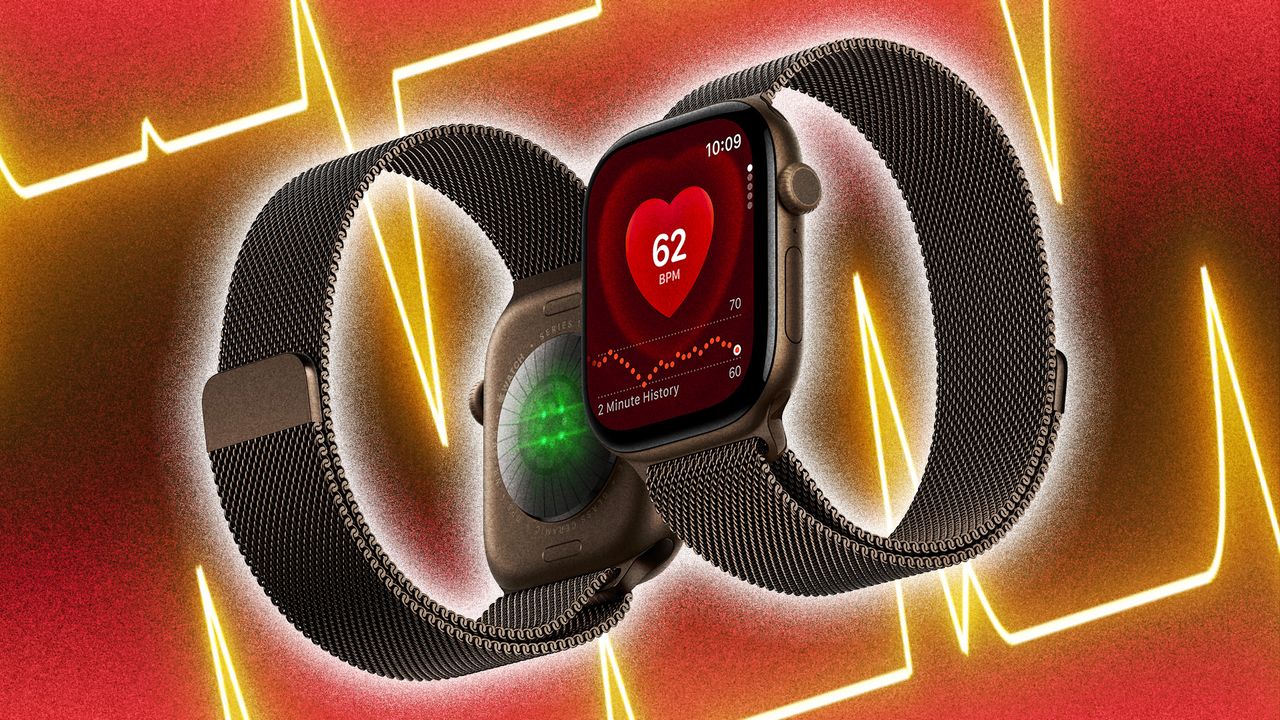
The Apple Watch wasn’t made to save lives, it just kind of turned out that way. Back in 2014, the OG smartwatch majored on its style credentials with a buckle-less strap design borrowed from indie brand Ikepod and co-signs from the likes of Pharrell, Beyoncé and Tom Ford. If anything, its health tracking was an afterthought – something to geek out over at first and then forget about completely. As evidenced by a Heart app, which would show your current heart rate and almost nothing else.In the space of its first weekend on sale, the Watch’s fate was changed completely. “We had a customer emailing Tim [Cook, Apple CEO] saying, ‘I was feeling funny and my heart rate was really low, so I went to the ER and had a blocked artery,’” says Eugene Kim, vice president of hardware engineering at Apple. A decade later, the Apple Watch Series 12’s launch is majoring not on a glossy new ceramic case or AI-proof S11 chip but the most advanced heart rate tracking in a wearable yet. You might have guessed it from the countless schmaltzy ad campaigns repping its now much-improved capabilities, but wellness is the theme that unites the team of designers, software engineers and health professionals that all work on the Watch. “Some people do have that email framed, actually,” Steve Waydo, director of health sensing at Apple. “I still look at it in my inbox every once in a while when I need that dopamine hit.”Watch Series 12Watch Ultra 4It’s a good time for the Watch to be getting this kind of technical glow-up. Apple might still outsell the entire Swiss watch industry combined, but the last year or so has seen screenless wearables that fixate on your health take off in a major way. Both Harry Kane and Declan Rice were made Oura Ring brand ambassadors prior to the summer’s World Cup, while Jay-Z is probably the first person to wear a Whoop band with an all-gold “John Player Special” Daytona. Unsurprisingly, one of the first rumours to emerge from John Ternus’s era as Apple’s new CEO was the prototyping of a rival tracker.There’s more to the Series 12 and Ultra 4’s redesigned heart rate tracker than increased precision, even if a recent scientific study ranked it the most-accurate wearable going. Where the first Watch’s heart rate app took a measurement every five minutes or so, it now checks in every five seconds. That's still useful when monitoring for potential complications such as an irregular rhythm, but much more so when you just wanna figure out how you’re feeling. “It's changing with everything you do,” says Asha Chesnutt, a member of Apple’s clinical team. “So it really helps me understand if I'm behind on my water intake or if I shouldn't have had that extra cup of coffee.”Fittingly for a company that created a new ink formulation just so the iPhone 18 Pro’s glass has a consistent shade of burgundy, the Series 12’s sensor array is arranged like gemstones on an iced-out Nautilus. Larger, more power-efficient LEDs are surrounded by a circle of photodiodes, each of which has been shaped into a trapezoid at the insistence of Apple’s design team to leave no dead space in the coverage. Of course, you can’t see any of this finesse without ratcheting off the Watch’s electrode panel, but it’s a perfect example of how Steve Jobs’ legacy still percolates through the company he founded. “When you’re a carpenter making a beautiful chest of drawers, you’re not going to use a piece of plywood on the back, even though it faces the wall and nobody will ever see it,” Apple’s former CEO told Playboy in 1985.To interpret the Watch’s results, no medical or PT qualifications are necessary—just wear it consistently, and the Series 12 will cook up a new “Readiness” score that summarizes your ability to take on the day. Much like Whoop’s “Recovery” rating, Apple’s “Readiness” score is personalized according to how long you slept last night, how hard you’ve worked out lately and other vitals such as your blood oxygen rate and heart rate variability. It’s a win for high-performance types who love proteinmaxxing, but the concise summaries are just as useful if you’re waking up to a hangover and wondering whether you’re in any state to grab some fresh air before midday.“We try to deliver things that are actionable,” says Chesnutt. “People are already overwhelmed with data in their lives.”Still, there’s a lot more data to come. Alongside the Series 12’s new upgrades, Apple revealed a redesigned Health app that does a much better job of surfacing the Watch’s insights on your iPhone and elaborating on them further. Most notably with a “Health Age” rating that uses HRV, sleep, and even biomarkers from blood work to show how your body’s wellness holds up against your physical age. It’s not quite rating your mortality, but Apple’s wellness tech is already doubling down on the kind of longevity data that Whoop once claimed a niche for itself with. And that’s before a rumored screen-free band sees the light of day.For now, there’s a reason why Apple hasn’t switched up the Watch’s aesthetic in more than a decade: people vibe with it. Even noted watch nerds like Ryan Reynolds and John Mayer. Turns out, the hardest part of measuring someone’s heart rate is to get them to strap on a tracker on them in the first place.“A lot of those letters we still get tell us, ‘I bought my watch for this entirely separate thing and then it told me this important information,’” says Waydo. “And so if we weren't building something that people wanted to wear, we’d miss all of them.”Apple’s Watch Series 12 is available from $399. At apple.comA version of this story appeared in British GQ.
Apple’s Watch Series 12 Is Coming for Your Whoop
Full Article
Original Source
Read the full article at Gq →KhanList aggregates and links to publicly available news content. We do not host full articles from third-party sources. Always verify important information with original sources.