
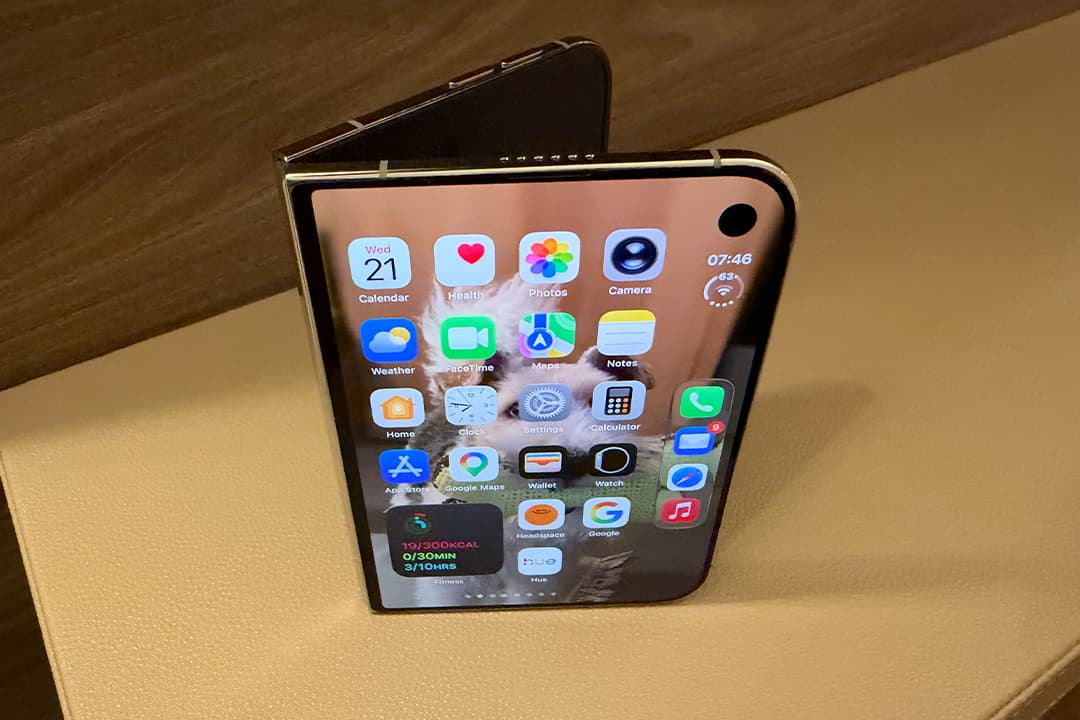
Apple’s first foldable phone – and its most expensive – goes on sale on Friday, 23 October. It’s already causing a stir, not just because online pre-orders sold out in minutes (though there are reports that delivery dates are creeping earlier, perhaps as Apple ramps up production).The phone is almost like an iPad mini that you can fold in half (don’t try that with a regular iPad mini). When it’s open, the display measures 7.6 inches and has such thin bezels that it looks bigger than it feels. Folded, it’s about the size and shape of a passport, which means that it fits happily in a pocket, and it’s almost exactly the same weight as the iPhone 18 Pro Max.In use, it’s unmistakably an iPhone, but there’s still a bit of a learning curve compared to other phones: it uses Touch ID, not Face ID, for a start. And although it’s pricier than the iPhone 18 Pro Max, it has two rear cameras, rather than the three the Pro boasts – though there are two front-facing cameras as well, one of which is hidden under the inner display. As a tech critic, I was among the first to see the phone when it was unveiled in September. And after testing the duo over the last few weeks, here’s everything you need to know. How I tested I’ve had a preview of the iPhone duo ahead of its general sale David Phelan The iPhone Duo is an innovative phone, so I looked into how easy it was to set up, whether there were extra steps because of the two-screen design and if there was a learning curve compared to other times (spoiler: there was, but it wasn’t steep).Some early foldable phones lacked durability, so I checked out how solid it looked and felt. I looked at as many apps as I could to see how they functioned with a two-display experience. Of course, I checked how fast and effective the phone was and, finally, I looked at how long the battery lasts.Apple iPhone Duo Apple iPhone Duo Three★★★★☆What we love: Stunning design, great matte-finish inner screen, and exceptional softwareTake note: No Face ID, and two rear camerasDesignThe iPhone Duo is both familiar and strikingly original. The size of a passport, it fits nicely in hand: the enlarged curved corners mean you can cradle it comfortably. The first major difference is the home screen layout. The dock of four icons, which is constant on every home page, now sits vertically on the right edge, not at the bottom – that’s down to the wider, shorter display. Though unbalancing at first, I quickly got used to the new arrangement. There are elegant new items to discover, like a circular icon showing battery life, Wi-Fi strength and cellular connectivity, seated below the corner-mounted front-facing camera. Unlocking the phone is also a surprise, and something of a throwback: unlike current iPhones which use Face ID, this uses Touch ID. Where older iPhones had this fingerprint sensor on the phone’s front, below the screen, it’s now been mounted in the side button – similar to the iPad Air. Apple used Touch ID to give consistency to the unlocking process – whether it’s lying on the table open or closed, you unlock using the same technique. I missed Face ID a lot, but if you have an Apple Watch, you can set this to unlock the phone when it’s on your wrist and nearby.Open the foldable, and the inner screen reformats its content so everything you were just looking at on the outside is in the same place on the inside. The build quality of the Duo is also immaculate: there’s a titanium frame, tough and scratch-resistant Ceramic Shield 2 on the front, and the original, drop-resistant Ceramic Shield on the rear. The cleverly designed hinge is easy to open (unlike many earlier foldables) and, unlike many current ones, it can be adjusted to stay in multiple different positions. You can lay it flat, sit it with one half vertical, the other horizontal, or stand it like a tent. This is particularly useful as it offers the StandBy view found on other iPhones, which display a clock while the phone is charging. The difference here is you can set it in this position, and StandBy will activate, even if the phone is unplugged. DisplaysDavid Phelan/The StandardBoth displays are OLED, so they are rich, colourful and detailed. The outer screen matches the pixel density of the iPhone 18 Pro and iPhone 18 Pro Max (460 pixels per inch), which, in short, looks fantastic.The inner screen isn’t quite as high-resolution (430ppi), but you’d be hard-pressed to see a difference. And the much bigger space is highly immersive. And there’s another key difference: a nano-texture finish like that found on high-end devices such as the iPad Pro. This means there are no annoying reflections on the inner display, and fingerprints don’t show up. The nanotexture means the crease is completely invisible, too. That’s not just because of the nanotexture – Apple has built supporting plates and other materials which make the crease vanish. In fact, even if you run your finger across the join, it’s hard to Another subtle benefit to the display design is the aspect ratio. This exact size is like a piece of paper that, every time you fold it in half has the same shape. It means that when you open or close the phone, the aspect ratio is consistent, so everything looks the same inside or out. The camera on the inner display is hidden under the screen – you can just see it if you squint. It’s a lower-resolution camera than the front camera, and it’s designed for video calling. This means that if you’re watching video, there’s nothing to interrupt your view.CamerasDavid Phelan/The StandardAs mentioned above, there are only two rear cameras on the iPhone Duo: a main and an ultra-wide. There’s no telephoto, though, as both cameras have 48-megapixel resolution; you can use the main camera to achieve a 2x optical zoom equivalent by cropping in to the central portion of the sensor, though this drops the resolution to 12 megapixels. In practice, I rarely noticed the absence of the telephoto camera, and I found the other lenses delivered similar quality to the iPhone 18 Pro, with one exception: there’s no adjustable aperture here. But there are key photo extras on this phone that make use of the extra display. First of all, when you’re taking someone’s photo, you can let them see themselves and pose accordingly. You open the camera on the inner screen and turn on the front screen. You can even use this to take a selfie using the superior rear camera and the Camera Control, which lets you zoom in and out, as well as take a photo or shoot video. There’s also a great feature called Kid Cue, which works in the same way but instead of showing the frame you’re about to shoot, it plays an adorable series of cartoons starring Snoopy to attract the attention of your subject. You can use this for adults as well, assuming they like Snoopy (and if they don’t, do you really want to take their photo anyway?).Performance and batteryThe Duo has the same fast processor found on the iPhone 18 Pro, so it’s no surprise that it’s very fast. It handles everything on both screens with speed and aplomb. Performance here is as good as on any other iPhone. Battery life is decent, managing a full day but definitely needing an overnight charge. It’ll drain the battery faster if you have the display open, but there’s not much in it. AppsDavid Phelan/The StandardApp developers are scrambling to update their apps so they look good on the new screen real estate. Some apps, such as the BBC News app, look fine on the outer screen, but when you open the phone, it sits marooned in the middle of the larger display. Apple has a solution to this: turn the phone to portrait orientation and a zoom icon appears so you can expand what’s on screen to fill the display. But this is no substitute for properly optimised apps. In the time that I’ve been testing the phone, Instagram, Threads and Facebook were Duo-optimised in one day alone. Key apps including Netflix, Sonos and Slack are also ready to go. Apple has also introduced new software that’s unique to the Duo, so you can grab an open app on the inner screen, swipe upwards and hold, and it can be placed on the right or left side. Then a second app can be placed to fill the rest of the display. This kind of multitasking is useful and is a key bonus gleaned from the extra screen real estate.Apple’s own apps, unsurprisingly, shine on the new device. The calculator is proficient on the cover screen, but scientific calculations spread more elegantly inside. Calendar, Timers, Health and others all look tremendous on the Duo, and Safari even allows you to open two windows side by side, for example.Display, outer:, 5.4in OLED, 120Hz, 2,034 x 1,398 pixels, 460ppi Display, inner:, 7.6in OLED, 120Hz, 2,674 x 1,878 pixels, 430ppi, nano-texture finish CPU: Apple A20 Pro Storage: 256GB / 512GB /1TB / 2TB Size, open: 164.6mm x 117.8mm x 5.2mm Size, closed: 84.1mm x 117.8mm x 11.3mm Weight: 254g Main camera: 48MP Ultra-wide camera: 48MP Selfie camera, outer: 12MP Selfie camera, inner: Under-display Face ID camera Colours: Night Sky, Star White It’s not perfect; it takes a little getting used to, and it’s expensive. But using it is a revelation – the joy of the extra screen real estate in a pocketable phone is the key extra for a foldable, and Apple has created an exceptional folding phone. Not just the beautiful hardware, but the way the software integrates with the form factor. The invisible crease is better than on other foldables, mostly because of the matte-finish inner screen, and the hinge, which adjusts perfectly to different shapes, is a bonus. The only real absences in terms of hardware are the telephoto lens found on the Pro models (and many won’t miss that) and Face ID – which I did miss. The Duo is effortlessly seductive and, in time, is likely to be the product that takes foldable phones mainstream.
Apple's iPhone Duo is a revelation – and is sure to take foldables mainstream
Full Article
Original Source
Read the full article at Standard →KhanList aggregates and links to publicly available news content. We do not host full articles from third-party sources. Always verify important information with original sources.