
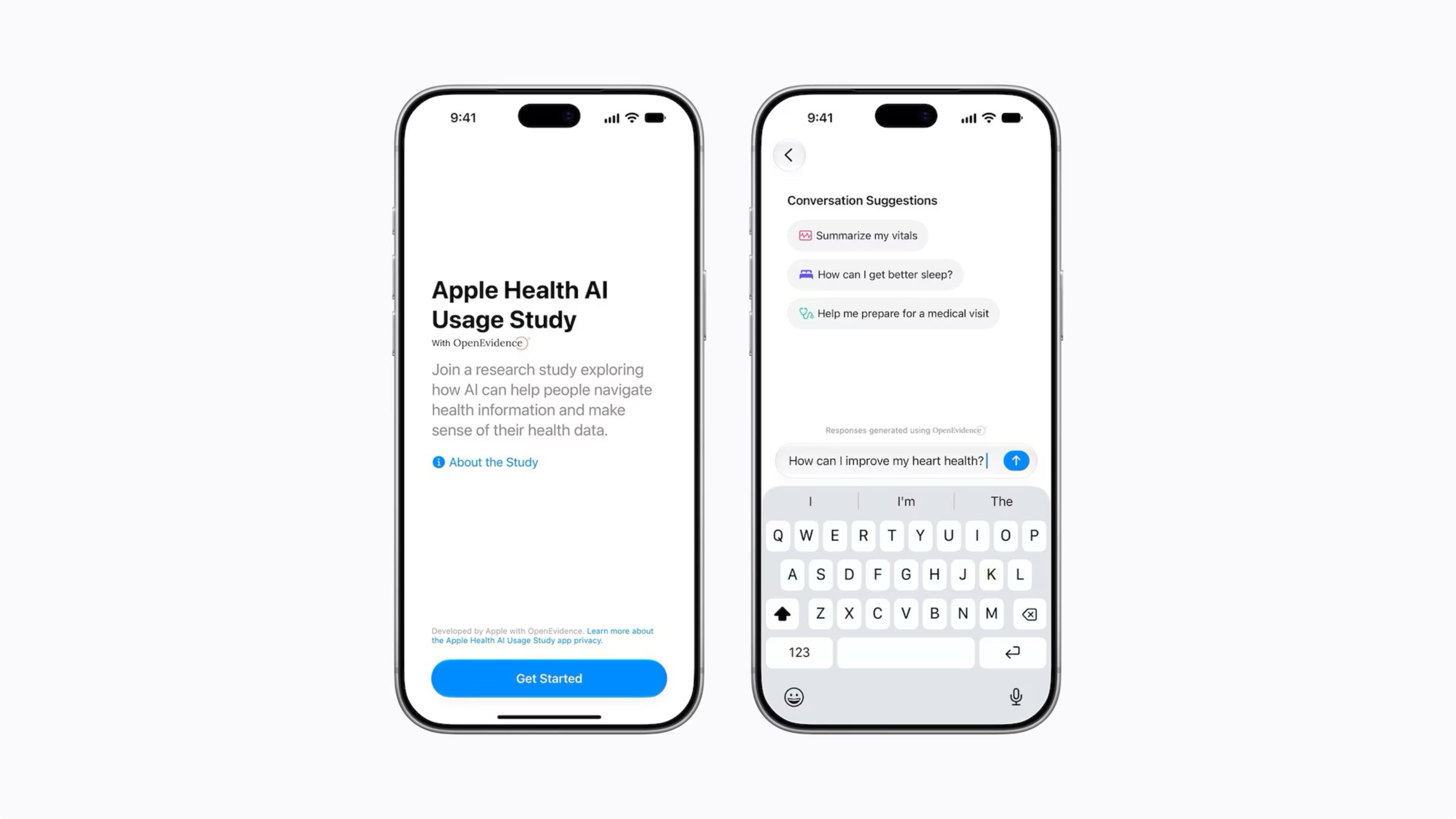
Apple on Sunday announced the launch of an Apple Health AI Usage Study that gives participants access to a dedicated iPhone app that answers everyday health questions using medical research and, optionally, their own Health app data. Conducted in collaboration with clinical AI company OpenEvidence, the U.S.-only study will examine how people understand and evaluate AI-generated health information, what makes them trust it, and whether it can help them prepare for appointments with their doctors. "At Apple, we believe responsible innovation starts with scientific rigor and clinical grounding. Health is deeply personal, and conducting a dedicated research study is the most thoughtful way to understand how people engage with, comprehend, and evaluate health AI in everyday life," said Sumbul Desai, M.D., Apple's vice president of Health and Fitness. "Insights from this study will help advance the broader scientific conversation and ensure that as technology evolves, we continue building trusted tools that genuinely support people wherever they are on their health journey." The app combines OpenEvidence's technology with an Apple-designed research experience, where responses include links to peer-reviewed clinical sources, with information drawn from publications like The New England Journal of Medicine, JAMA, and Nature. Apple says the app presents complex medical information in approachable language. Participants can choose to share data such as their resting heart rate, activity, sleep, and lab results through HealthKit. The idea is for it to allow researchers to explore whether incorporating personal health information makes answers more relevant and easier to understand. Apple says the app can also help users put Health data in context, understand symptoms or conditions, and build personalized exercise or meal plans. Users can rate responses and complete occasional surveys about their experience, and all questions undergo processing designed to remove identifying information before reaching OpenEvidence, which deletes question-and-response data within 24 hours. Apple says study data will not be used to train AI models, and participants control whether they share HealthKit metrics or survey responses. "Patients and clinicians are both turning to AI, but the tools they use are being built and tested in separate worlds," said Robert M. Wachter, M.D., UCSF's professor and chair of the Department of Medicine. "When patients and doctors draw on versions of the same trustworthy tools, patients arrive prepared, conversations improve, and next steps happen seamlessly. Connecting these tools, and rigorously studying what works, is how we'll get there." Apple is keen to stress that health tools powered by large language models can give incomplete or unclear answers, and the app includes safeguards that are meant to detect certain concerning questions and direct users toward a healthcare provider or other resources. The study isn't intended to diagnose or treat conditions, or replace advice from medical professionals. The study is open to up to 200,000 eligible U.S. residents aged 21 and older with an Apple Intelligence-enabled iPhone running iOS 26 or later. If you're eligible and interested, download the Apple Health AI Study App from the App Store to learn more. Popular StoriesApple Launches Two Products TodayFriday November 13, 2026 2:37 am PST by Tim HardwickApple is releasing two new products today, Friday, November 13: the all-new Apple HomeView and the fourth-generation Apple TV 4K, both of which have been available to pre-order since mid-October. Apple HomeView: Apple's new smart home display, powered by Apple Intelligence with Siri AI, for entertainment and managing the home. Available in tabletop and wall-mounted models, it can recognize up...Apple Aiming to Upgrade the iPhone Duo in Four WaysSunday November 15, 2026 8:42 am PST by Joe RossignolBloomberg's Mark Gurman today said Apple has four goals for future iPhone Duo models: Face ID, an Action button, a telephoto camera, and a thinner-and-lighter design. Gurman said Apple has already developed iPhone Duo 2 prototypes with Face ID on the outer display, but it is "running out of time" to finalize the feature for that model, so it might not arrive until the iPhone Duo...Apple Black Friday Starts Early: Save on Apple Watch, MacBook Air, and MoreBlack Friday is now less than two weeks away, taking place on Friday, November 27 in 2026. As always, this will be the best time of the year to shop for great deals, including popular Apple products like AirPods, iPad, Apple Watch, and more. Note: MacRumors is an affiliate partner with some of these vendors. When you click a link and make a purchase, we may receive a small payment, which helps ...
Apple Seeks 200,000 People for AI Health Study
Full Article
Original Source
Read the full article at Macrumors →KhanList aggregates and links to publicly available news content. We do not host full articles from third-party sources. Always verify important information with original sources.