
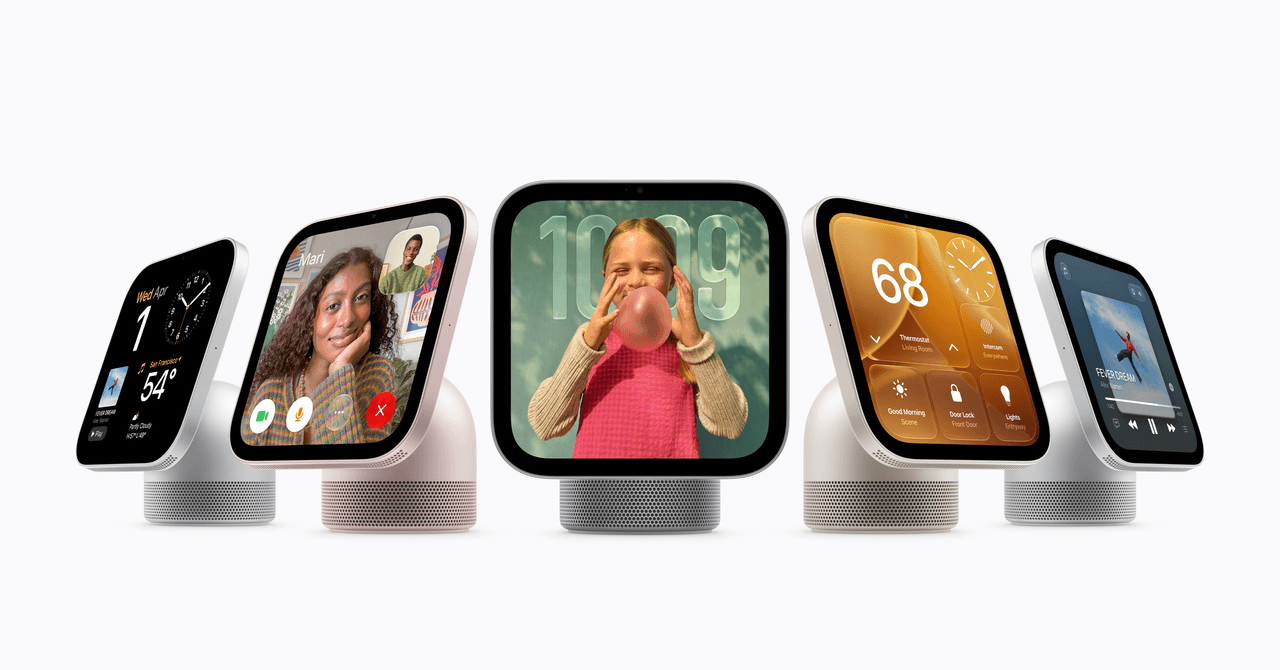
I got an early glimpse of Apple’s biggest push into the smart home in years.Apple has lagged in the smart home race, which Amazon and Google have dominated for a decade with Alexa and Google Assistant (now Gemini), respectively.But after finally revamping Siri AI this year and turning the butt-of-the-joke voice assistant into a more competitive companion—paired with a more mature Matter-supported ecosystem of smart home gadgets—Apple now has the brains to power the home system it has always envisioned.That starts with three new devices: the Apple HomeView, the company's first smart display; the HomePod Mini 2 smart speaker; and the fourth-generation Apple TV 4K.Apple announced the products at a media-only event in New York City, and it also revealed a slew of new smart-home gadgets made in collaboration with LG and Schneider Electric, including a video doorbell, thermostats, and security cameras.Here's everything you need to know.The Apple HomeViewThe cornerstone of Apple's latest smart-home push is the Apple HomeView, a countertop gadget made up of a 7-inch square display resting on a speaker base. It operates like smart displays we've seen from Amazon and Google, but it’s an entirely new device category for Apple.It runs what Apple calls “HomeView Software,” so while the interface may resemble an iPhone or iPad, the HomeView runs a stand-alone operating system and lacks access to the App Store. As an alternative, Apple has curated a selection of apps for the system, including Messages, Safari, and FaceTime, alongside select third-party media apps like Spotify. (If an app developer has made an app for the CarPlay standard and it's installed on your iPhone, that app can also populate on the HomeView.)Courtesy of AppleSiri AI powers the core experience, which Apple revamped this year in iOS 27. Now, Siri can answer broad questions like Gemini or ChatGPT, and it can provide personalized answers; the same personal context Siri has cataloged on your iPhone is accessible to the HomeView. Ask it to open the recipe your friend Alex messaged about, or add a dentist appointment to the family calendar, and it can handle it.Apple's HomeView supports up to six iCloud profiles, and each person can set up a custom view only visible to them once the device’s camera detects their face. Yes, there’s a camera on the HomeView. The computer vision trick where the HomeView displays a custom view for a specific individual when they approach it only works if the person’s iPhone is on the same Wi-Fi network and was recently unlocked. You need an iPhone with Apple Intelligence support (iPhone 15 Pro or newer) to get the most out of the device; you can't set it up with an iPad.We have a separate story with more details if you'd like to read more about the HomeView, which is available for preorder now and goes on sale November 13 in the US, UK, Australia, Canada, New Zealand, India, Singapore, and South Africa. It costs $299.The Apple Home CollectionOne of the biggest problems with Apple's smart-home presence is its relatively meager HomeKit device ecosystem, especially compared to the many smart home devices that can be controlled by Amazon and Google’s platforms. The Matter standard—which allows supported devices like smart bulbs, smart switches, and smart shades to interact with any connected home platform—has helped expand HomeKit support. But Apple is also nudging the ecosystem along with the “Apple Home Collection.”This new selection of smart-home hardware designed in collaboration with LG and Schneider Electric includes the LG Indoor Camera Plug-In ($200), LG Outdoor Cam Plug-In ($300), LG Video Doorbell ($250), LG Smart Deadbolt Lock ($350), LG Smart Thermostat ($200), LG Temperature Sensor ($40), Schneider Home Smart Thermostat ($200), and Schneider Home Room Sensor ($40).Courtesy of AppleThese devices connect to the Apple Home app automatically when you install them, and all of them are controllable through Apple’s products; you don't need separate LG or Schneider accounts or multiple apps.I got a brief look at some of them in action. The LG Indoor Camera tilts downward when it detects you're home to give you some added privacy, though there's no privacy shutter to block the camera itself. The LG Deadbolt can unlock automatically as you approach by sensing your iPhone or Apple Watch; there's a nice green LED animation that circles the lock to show you when it unlocks. The LG Video Doorbell has two cameras: one to see who is at the door, and one to monitor any packages left at your door.The LG Outdoor Camera has a floodlight upgrade ($400) that will automatically activate when it detects motion. With the right iCloud+ subscription, you can enable smart video descriptions that send alerts to tell you who is outside (it can recognize faces), that your pet has been spotted in the yard, or that a package has been dropped off.The products in the Apple Home Collection will be available in December, with the security cameras launching in the UK, US, and Canada. The thermostats and door lock meet North American standards, so Apple is only selling them in the US and Canada.The HomePod Mini 2Apple has decided not to launch a successor to the flagship 2023 HomePod 2 smart speaker—maybe it thinks the HomeView, which is essentially a speaker with a screen on it, would cannibalize sales. Instead, it has updated the smaller, cheaper sibling: Say hello to the HomePod Mini 2.The Mini 2 costs $149, with preorders open now and official sales kicking off October 30. That's a $50 price bump from the original HomePod Mini, though only $30 more if you factor in Apple's recent price hike due to the ongoing memory crisis.Courtesy of AppleOddly enough, the HomePod Mini 2 will not have the new Siri AI experience out of the box—that will arrive later on via a software update (and yes, you will need an Apple Intelligence-enabled iPhone to use Siri AI on the HomePod Mini 2). It's otherwise a minor hardware update, resembling the existing HomePod Mini but in new colors: green, white, midnight, pink, and black.One new feature is Sound Glow—the lights on top of the HomePod Mini 2 will match the album artwork colors of whatever song is playing. It also works with soundscapes, so if you ask Siri to play rain sounds, the lights will display a pitter-patter animation like raindrops falling on a surface.You can color-match the HomePod Mini 2 to the iMac; pair two of the devices and use them as the default speakers for Apple's all-in-one computer. Apple's S10 chip powers the speaker, the very same processor that debuted on the Apple Watch Series 10.The Apple TV 4KFour years since the last Apple TV 4K, Apple finally has a successor. But what may surprise you the most about the fourth-gen streaming box isn't the hardware or features; it's the price: $299.Apple raised prices on its products earlier this year, but this is a whopping $170 increase for the Apple TV, though this model has Wi-Fi and Ethernet and starts with 128 GB of storage instead of 64 GB on the last version. Preorders are live now, and it ships November 13.Once again, Siri AI is the star of the show, as Apple touts the ability to ask the assistant for recommendations or play “that show my friend Alinda recommended,” leveraging the personal context from your iPhone. The hardware has three far-field microphones, letting it pick up your voice easily when you're on the couch, even when the TV is playing content. The A19 chip sits inside, which Apple first introduced on the iPhone 17.If you have ever lost your TV remote, you might be more excited that the new Apple TV 4K remote has built-in Find My support. That means you can ping it in the Find My app or ask Siri for its location, and the familiar AirTag chime will play through the remote's speakers. (It supports ultra-wideband, so you can use Apple's precision-finding mode to locate it between the couch cushions.) The remote is backward compatible, so you don't need the fourth-gen Apple TV 4K if you buy the new remote as a replacement for an older Apple TV.Courtesy of AppleYou can also pair four second-gen HomePod speakers to the new Apple TV 4K, setting two in front of you and two behind you for a surround-sound home theater experience. I heard this in action with two HomePod 2 speakers by the TV and two HomePod Mini 2 models behind the couch—it really does make whatever you’re watching feel more immersive. The speakers calibrate automatically to give you the best sound for your room.Apple calls this one of the easiest ways to set up a home theater. That four-speaker arrangement would cost you $1,000, but that’s a decent price for a wireless surround-sound system that pairs with all of your Apple products. Just know the surround-sound capability is restricted to specific HomePod models. You're out of luck if you have the original 2017 HomePod or the first-gen HomePod Mini.The smart-home revamp comes as Amazon and Google both zhuzh their ecosystems by replacing their aging assistants with Alexa+ and Gemini, powered by large language models, which you can think of as a soft reboot. That timing might work in Apple's favor, according to Jitesh Ubrani, director of Consumer Devices Research at IDC.“Amazon and Google have both reset their platforms with Alexa+ and Gemini, but even their rollouts have been slow,” Ubrani writes in a statement to WIRED. “That means Apple is bringing Siri AI to the home at a point when the competition hasn’t pulled far ahead.”Apple may finally have the hardware in place, but Siri AI has to prove it belongs in the room.In your inbox: Go inside the world of digital security with Kernel PanicJulian Chokkattu is Senior Editor, Gear at WIRED, overseeing personal technology, gadgets, and gizmos. He has been reviewing consumer products for a decade, specializing in mobile—from smartphones, tablets, and smartwatches to smart glasses and virtual reality. This is his sixth year at WIRED. Previously, he was the mobile and wearables ... Read MoreWired Coupons
Apple Reboots Its Smart-Home Strategy With New Hardware and a ‘Home Collection’
Full Article
Original Source
Read the full article at Wired →KhanList aggregates and links to publicly available news content. We do not host full articles from third-party sources. Always verify important information with original sources.