
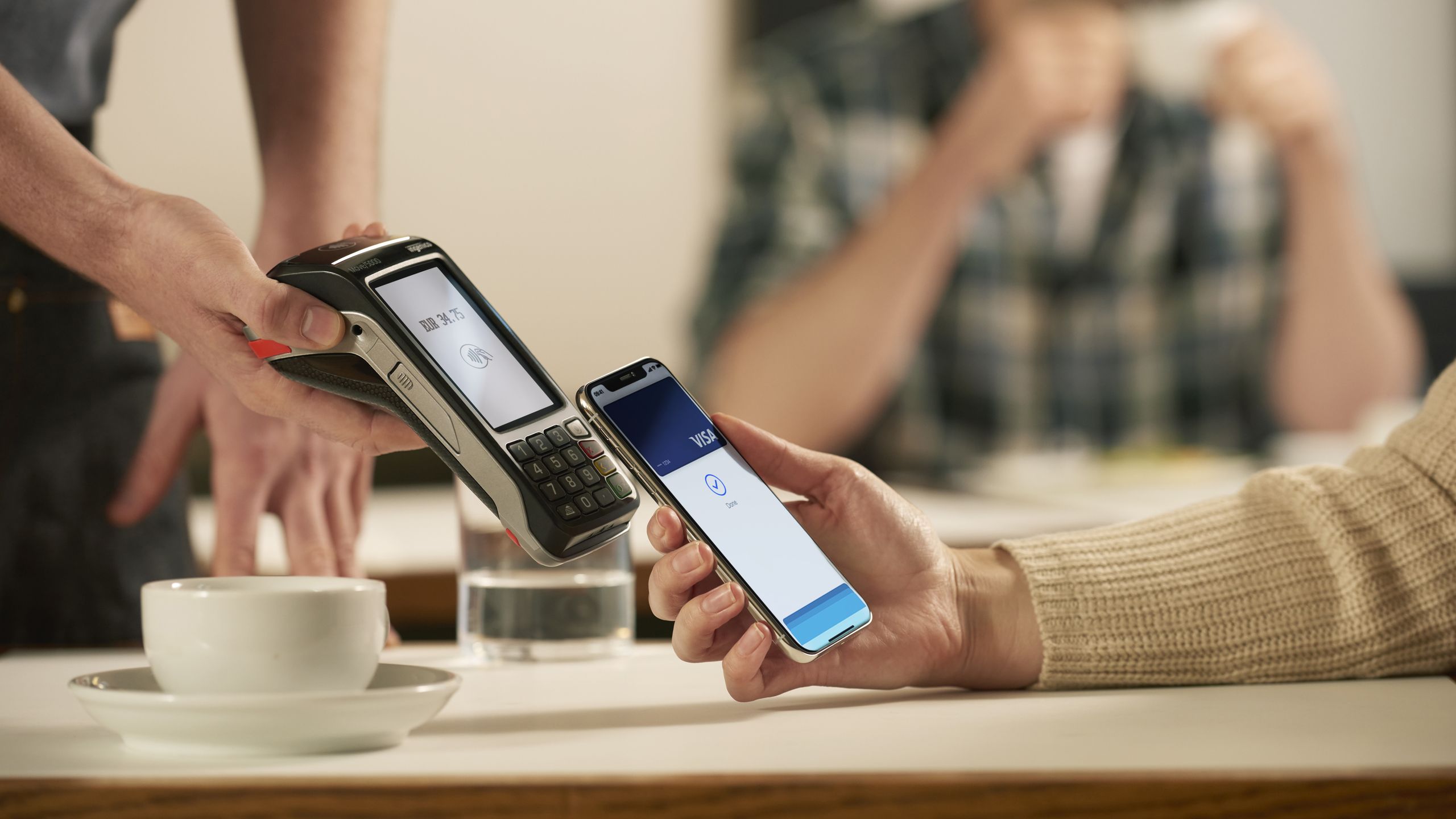
(Image credit: Visa) The UK government wants more Apple Pay alternatives for consumersIt’s proposing opening the technology up to other companiesIt also wants Apple to charge lower fees for accessIf you pay for an item using the contactless tech on any of the best iPhones, you’re locked into Apple’s way of doing things. But the UK government’s competition regulator — the Competition and Markets Authority (CMA) — is proposing new rules that could blast open the way you pay using your iPhone.According to a press release on the UK government website, the CMA believes that “Apple’s fees and rules are blocking UK fintechs and other businesses from innovating and growing” and that its proposed changes are “expected to result in substantially lower access fees, helping make it commercially viable for more businesses to innovate and compete.”The CMA pointed out that no rivals to Apple Pay exist in the UK, as opposed to in the EU, where several alternatives can be used. The CMA believes this is due to both high fees charged by Apple and restrictions placed on certain technology by the Cupertino giant.For instance, while Apple allowed third-party companies to offer Apple Pay alternatives in the UK back in 2024, one condition was that these firms had to use Apple’s Secure Element, which encrypts important payment card information during transactions.In the EU, however, European Union-wide rules mean that Apple must let companies use host card emulation (HCE) for free instead of the Secure Element, if they wish. The CMA wants that kind of technology to be available in the UK and says it does not believe that doing so would raise any “inherent security concerns.”Commenting on the CMA’s move, Mattias Eld, CEO & Co-founder at contactless firm Fidesmo, said: “Buying an iPhone should not mean handing Apple the keys to your wallet. Consumers should rightly choose how they pay, and banks should choose who they work with. But for over a decade Apple has honed its domination over tap-to-pay, through the careful and deliberate stifling of its competitors. This has allowed Apple to charge banks inflated transaction fees, with the threat of exclusion from such a vast market leaving them little choice but to pay.”Apple pushes back (Image credit: Apple)The CMA says that while it isn’t seeking to dictate the prices or terms that Apple must set, it wants to propose “principles for how this should be determined, with the expectation that charges would be substantially lower than Apple’s current fees while still fairly rewarding Apple for providing access.”Sign up for breaking news, reviews, opinion, top tech deals, and more.However, Apple has pushed back against the CMA’s proposals, telling Reuters that “We do not believe the CMA should require Apple to adopt an approach with lower privacy and security protections. We will continue to engage constructively to reach an outcome that is in the best interest of our users.”Why does Apple restrict access to contactless payment tech? One answer might simply lie in the almighty dollar: as with the App Store, Apple charges third-party firms for access and likely doesn’t want to give up that revenue stream.I’m not entirely convinced that that’s the main reason, however — after all, Apple is one of the wealthiest companies on the planet and makes huge profit margins on every product it sells. Is nickel and diming really such a core strategy when its iPhone revenue alone jumped 21% to $54.25 billion in the third quarter of 2026?Analysis: Apple fears it could pay the priceTo me, a stronger argument centers on something else: control. This has been an obsession for the company since the days of Steve Jobs, and Apple is acutely, painfully sensitive to how its products are perceived.If Apple loosened its grip on something so vital to the user experience as payments and financial services and a third-party contactless provider then got hacked or scammed customers, Apple fears that that will reflect badly on itself as a company. For the perfectionists at Apple, anything that lessens the user experience due to Apple’s actions is an absolute no-go. By taking payments entirely under its own aegis, Apple reassures itself that nothing will go wrong.There’s a degree of logic to that. Apple has proven its security credentials and works harder than many companies to keep its systems incredibly safe. Going with a third-party means trusting someone else whose track record might not be as strong. But that certainly doesn’t mean that only Apple can safeguard your payment information — or indeed that only Apple should be allowed to even try.If the CMA gets its way, Apple might be forced to change its ways. The company has already been forced to crack open its contactless walled garden in the EU, and the UK might soon follow. The way you pay using your phone might look very different as a result. Follow TechRadar on Google News and add us as a preferred source to get our expert news, reviews, and opinion in your feeds. Alex Blake has been fooling around with computers since the early 1990s, and since that time he's learned a thing or two about tech. No more than two things, though. That's all his brain can hold. As well as TechRadar, Alex writes for iMore, Digital Trends and Creative Bloq, among others. He was previously commissioning editor at MacFormat magazine. That means he mostly covers the world of Apple and its latest products, but also Windows, computer peripherals, mobile apps, and much more beyond. When not writing, you can find him hiking the English countryside and gaming on his PC.
Apple Pay faces UK crackdown that could change iPhone tap-to-pay
Full Article
Original Source
Read the full article at Techradar →KhanList aggregates and links to publicly available news content. We do not host full articles from third-party sources. Always verify important information with original sources.