
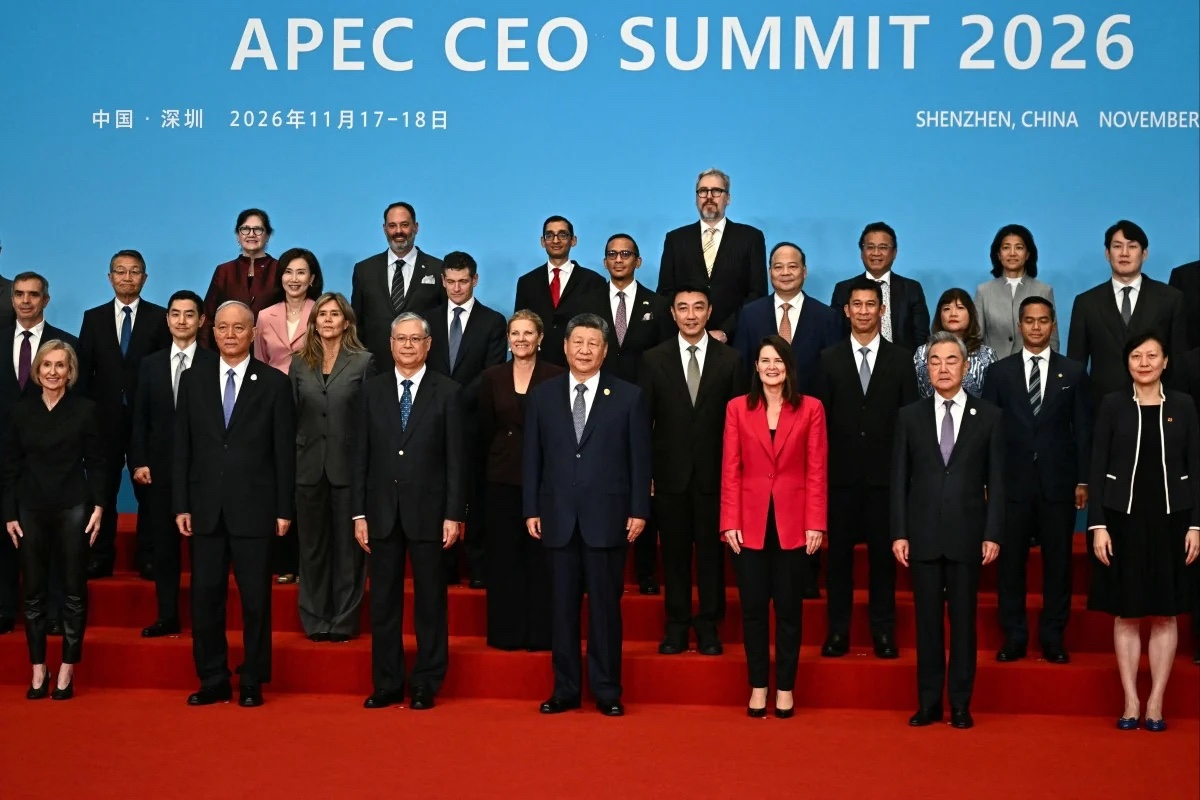
Hours after the 33rd APEC leaders’ meeting wrapped up in Shenzhen on November 19, the joint statement vanished from the forum’s website. At the time of writing, the page returns a 404. China’s state news agency Xinhua republished the text later that evening, but the episode was an apt metaphor for an institution whose substance has been thinning for years. The 2026 APEC Leaders’ Shenzhen Outlook contains no reference to the World Trade Organization or the multilateral trading system. It marks the second consecutive year the Asia-Pacific’s flagship free-trade forum has produced a leaders’ statement without mentioning the body that underpins global trade rules. The Free Trade Area of the Asia-Pacific, a concept now 20 years old, survives only as a line about building economies’ capacity to participate in high-standard and comprehensive regional undertakings. That is less a commitment to build a free trade area than an aspiration to attempt it one day. If APEC’s trade liberalization agenda is this thin, what is the forum actually for? The answer lies in what happened around the summit, not inside it. Every November, the Asia-Pacific’s diplomatic calendar compresses into a few crowded weeks. ASEAN, the East Asia Summit, APEC, the G20 and a constellation of minilateral groupings all convene in quick succession. The result is a cluster of rooms and states choose among them by membership list, depending on which audience they want for which message. For middle powers, which often lack the leverage to convene their own rooms, the choice matters more than the agenda inside any one of them. On 17 November, the Quad leaders met in Manila on the sidelines of the ASEAN summit. It was the grouping’s first leaders’ summit in over two years. The joint statement was notably pointed: “grave concerns about economic coercion, including through arbitrary export restrictions”, a commitment to “open, safe, and resilient maritime transit corridors”, and the announcement of a new Indo-Pacific Maritime Surveillance Collaboration. China was not named, as always. Two days later, Donald Trump met Xi Jinping and Vladimir Putin in Shenzhen for the first-ever trilateral meeting. The concise declaration they produced covered UN reform, energy supply, the International Criminal Court and nuclear risk. It said nothing about trade, the Indo-Pacific or APEC. The summit’s economic label brought the three leaders to the same city. What they did with the room had nothing to do with the forum’s agenda. That underscored what APEC has become: less a venue for economic liberalization than one node in a network of overlapping summits whose value lies in who is in the room at any given place and time. APEC’s particular niche is not that it is the only forum seating Washington, Beijing and Moscow; the G20 and the East Asia Summit do that too. It does so under a voluntary, non-binding, economic-only label, with no security mandate and no binding commitments to argue over. That keeps the bar low enough for leaders to show up without implying strategic alignment. It may be the only room where adversaries can sit at the same table under the banner of trade policy. A skeptic would counter that convening power alone does not set APEC apart. The Asia-Pacific calendar is so saturated with summits that none of them carries the weight it once did. Leaders skip forums, send deputies and reserve their political capital for the bilateral pull-asides that happen in the corridors. If every venue is losing relevance, APEC is just one more weakening institution in a crowded field. That is a fair objection, and the Shenzhen summit largely confirmed it. But saturation is precisely why summit membership lists and rules of engagement become key differentiators. When the rooms all look similar, the one that brings major rivals together under the lowest political bar stands out. Great powers can arrange bilateral meetings whenever required, and they use multilateral venues instrumentally to advance their own agendas. The Shenzhen trilateral is a case in point: APEC provided the calendar and the city, but the substance was entirely on Washington, Beijing and Moscow’s terms. Beyond those great-power optics, middle powers depend on these forums. They keep turning up and engaging in sideline diplomacy because the alternative is being shut out of the rooms where the signals are sent. Australia’s presence at Shenzhen illustrated this. Anthony Albanese attended the APEC summit before traveling on to Beijing for a bilateral meeting with Xi Jinping. The summit gave the Beijing leg diplomatic cover: a standalone trip to a strategic competitor reads differently from one stop on a multilateral itinerary. For Canberra, the week offered leader-level access to key regional powers without the appearance of choosing sides. That is a considerable benefit for a country managing simultaneous alliance obligations and trade dependencies. Vietnam takes over as APEC’s host for 2027, with the leaders’ meeting planned for Phu Quoc. Hanoi trades heavily with both the United States and China, and it has spent years cultivating upgraded partnerships with both. The chair gives Vietnam a year of agenda-setting power in a forum that, for all its institutional frailty, still convenes many of the powers that matter most to Vietnamese trade and security. The question is whether Hanoi can use the hosting to shape outcomes, or whether it will simply manage the logistics of another hollow communique. The Shenzhen Outlook’s own text offers an inadvertent answer to APEC’s relevance. Paragraph 3 of the statement asserts that “APEC has long been at the forefront of regional economic cooperation, and its enduring role remains relevant in the current economic context.” When an institution has to insist on its own relevance in its own communique, something is under strain. But the room was still filled in Shenzhen. For the middle powers that depend on such fora, that may still be enough. Lam Duc Vu is a Southeast Asia-based risk analyst writing on Indo-Pacific security and regional affairs.
APEC’s free trade promise fades, but its relevance endures
Full Article
Original Source
Read the full article at Asiatimes →KhanList aggregates and links to publicly available news content. We do not host full articles from third-party sources. Always verify important information with original sources.