
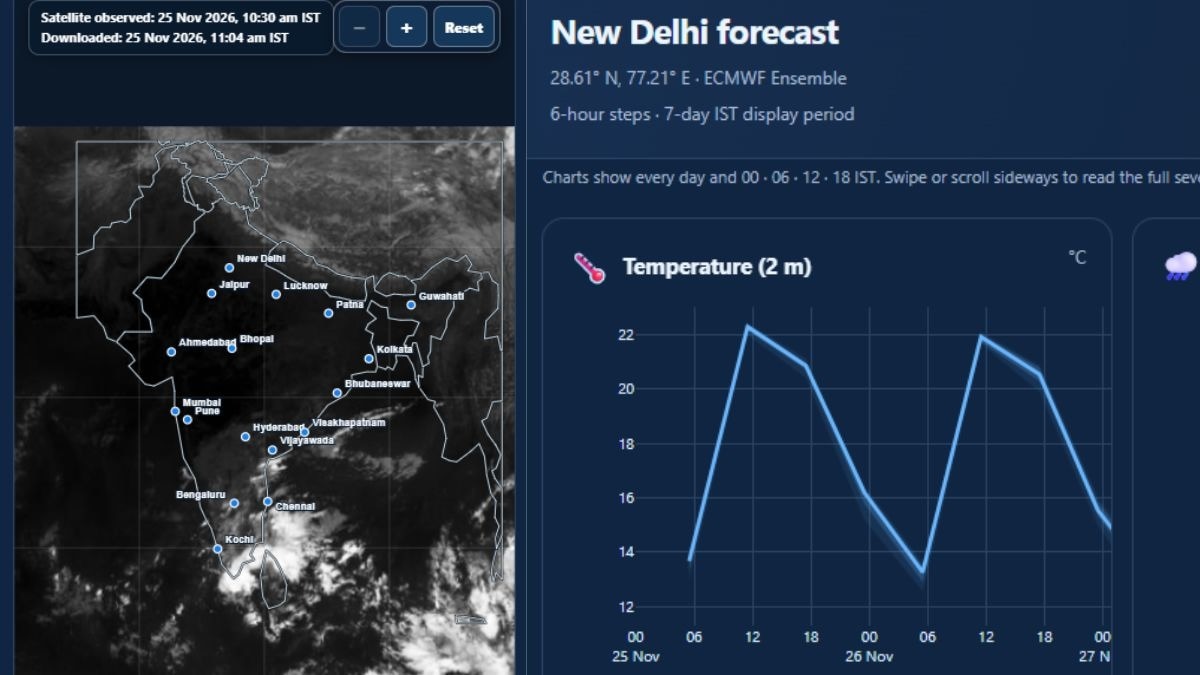
Every monsoon, India conducts the same small, quarrelsome ritual. A cloud darkens the edge of the sky, the washing comes in off the lines, and somebody on a balcony sniffs the wind and declares that it will pour by evening. Somebody else swears it will not. The sky has always been a conversation, and the forecast, the one expert voice in it, has mostly been spoken in a language the rest of us cannot read.On a desktop screen at IIT Madras, that language has been turned into something anyone can follow. A belt of rain settles along the west coast and stays, hour after hour, as if the monsoon had decided to linger. Further south, over Chennai, it thins to a few doubtful millimetres, a drizzle that may or may not come, and then to nothing at all. Three days of weather drift past in a few quiet seconds, as unhurried as the clouds themselves.It has the appearance of something made in a national weather centre, in the cold hum of a supercomputer. It was drawn by an ordinary desktop computer, in the quiet hours after its owner had gone home.That owner builds cooling systems for a living. He made the forecast system as a passion project and gave it away to the public for free. It lives on the weather page of his laboratory's website, which links to a platform called India Ensemble Weather. Anyone with a laptop can open it, see the rain expected over the next 72 hours and check it against the sky outside. The public, in other words, can now play weathermen. Once every three days, after work, he types a single command and walks out. By the time he returns, the machine has fetched the world's weather data, simulated the rain, drawn the animations and published them. "This is done out of passion," Professor Arvind Pattamatta, of the Department of Mechanical Engineering, told India Today Digital in an exclusive interview at the IIT Madras campus.WHY WOULD A COOLING EXPERT WATCH THE SKY?His day job explains it better than he does. Heat is his working life. His labs test spray cooling, vapour chambers and immersion cooling for phones, EV batteries and spacecraft electronics, with projects for ISRO and DRDO. The weather, to him, is the same subject at a planetary scale. "The atmosphere is the biggest engine," he said, driven by the warm ocean beneath it and powering the entire rainfall cycle. Heat and fluids are his craft. The sky is simply the largest example he could find.HOW CAN ONE DESKTOP FORECAST THE RAIN?By borrowing the hard part.Large agencies already run global weather models on supercomputers, but only coarsely, the way a world map shows a country as a smudge. His desktop takes that output and zooms into one region. The tool is the Weather Research and Forecasting model, called WRF, an open-source code developed mainly at the US National Center for Atmospheric Research and free for anyone to download. An IIT Madras professor runs a 72-hour rain forecast on an ordinary desktop and publishes it free, so anyone with a laptop can play weatherman. (Photo: IIT Madras) WRF divides the atmosphere into a three-dimensional grid of boxes of air. Pattamatta's boxes are 8 km wide, and the grid rises about 11 km into the sky. A finer view is possible by nesting a smaller grid inside a bigger one, a trick forecasters use for cyclones to see where a storm will make landfall. "I can do one pixel for the entire IIT campus," he said, at roughly 2 to 3 km. A run for South India takes about four hours on his machine. All of India takes about eight.WHAT HAPPENS WHEN HE TYPES THE COMMAND?Very little that he has to do himself.The script pulls free global forecast data from the European Centre for Medium-Range Weather Forecasts (ECMWF), the US Global Forecast System, or both, so he can compare them during cyclone season. It tries a cloud mirror first because the download is faster, and falls back to ECMWF or the US agency NOAA if needed. Then it runs WRF, draws the maps and uploads them to GitHub, a code repository linked to his website."If I want it for 48 hours, I just change it to 48," he said. The default is 72. The data itself is getting easier to reach. In October, ECMWF made a subset of its 9 km forecasts free and open, released two hours after real time. He had expected that move by the end of the year.HOW DOES HE KNOW IT IS NOT GARBAGE?He checks it, and he admits when it fails.He calls his tests sanity checks. During the interview, his model gave Chennai 33 degrees Celsius at 11.30 am, and a weather station website read 32.6. Bengaluru has to be cooler than Chennai, and the west coast cooler still under monsoon cloud. If Bengaluru came out hotter, he said, some input in the model would be wrong.He also reads rain as a probability. A forecast of heavy rain with only 10 to 20 per cent probability is unreliable, he said. He looks for at least 70 to 80 per cent. Along the west coast, all 60 members of an ensemble, repeated runs from slightly altered starting conditions, showed rain. That told him the southwest monsoon was active. A dry forecast there would have made him suspect the model.He is plain about misses, too. The day before, his system gave Chennai 89 per cent probability and about 7 mm of rain. Only a light drizzle came.WHAT CAN IT NOT DO?Quite a lot, and he says so himself.At 8 km, the model cannot see individual clouds. The rain-bearing cumulus clouds are smaller than one box of air, so it estimates their effect, a method called parameterisation. At 1 km, he said, such clouds can be resolved. Beyond about 72 hours, accuracy falls, and seasonal monsoon prediction is a far harder problem. He also holds the sea surface temperature fixed during a run. The Bay of Bengal is warm and changes little in three days, so that is acceptable there, though not over a cold ocean.WHY DOES HE GIVE IT AWAY FREE?Because the best forecasts are hard to read.The India Meteorological Department (IMD) has supercomputers and publishes its products online, he said, but "it is not user-friendly. It's not public-friendly." He points to the app Windy, which runs no model of its own and simply draws open data beautifully. "Like I am also getting the same data and I am doing it in my way," he said.That is why his platform is built for the public rather than for researchers. "Anybody can access it," he said, and it works on a phone too. His main intention is to make the forecast user-friendly, so that any common person can look at it, understand it and judge for themselves whether to trust it.He does not mean it as a rival to the weather office. His wish is a simple, authoritative IMD app that farmers and villagers could read. "I am not an official IMD person. This is my personal," he said, and his site carries a disclaimer to say so.Asked whether this deserved a story, he was modest. "You can write, but I don't think this is something great," he said. A forecast anyone can read, on a machine anyone could own, may be exactly that.- Ends
Anyone can play weatherman with an IIT Madras professor's home-PC rain forecast
Full Article
Original Source
Read the full article at Indiatoday →KhanList aggregates and links to publicly available news content. We do not host full articles from third-party sources. Always verify important information with original sources.