
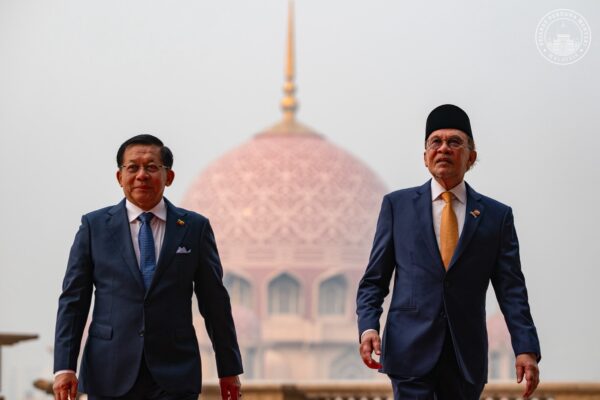
This week, Malaysian Prime Minister Anwar Ibrahim received Min Aung Hlaing, Myanmar’s junta chief, who led the 2017 genocide against the Rohingya, to arrange the transfer of 200,000 refugees, including Rohingya, back to Myanmar. The first deportations have already begun. The plan is not just morally bankrupt. It makes no practical sense. It appears driven by months of coordinated online hate speech against Rohingya refugees in Malaysia and the targeting of community leaders by authorities, including the recent arrest of Zafar Ahmad Abdul Ghani. In case anyone needs reminding, Min Aung Hlaing is the subject of an arrest warrant from the Argentine Federal Court for commissioning the atrocities against Rohingya as commander-in-chief. Prosecutors at the International Criminal Court have also requested an arrest warrant for him on similar grounds. He is yet to face justice, and the military remains as brutal as ever. He led the coup in 2021 and has razed half the country in the years since in his desperate bid for power. He still represents the Myanmar military, an institution whose sole purpose is to exploit the population through force, as it has for more than 50 years, and is the root cause of all Myanmar’s suffering. Deporting refugees to Myanmar under an agreement with Min Aung Hlaing is a violation of international law and the fundamental principle of non-refoulement. And it will not ease the burden of the Myanmar crisis on Malaysia or the wider region; indeed, it will worsen it. Time and time again, Min Aung Hlaing has proven that he can’t be trusted, not only by the people of Myanmar, but also by our neighbors. He has treated ASEAN with contempt since the coup, ignoring the basic requirements of the Five-Point Consensus, which called for an immediate cessation of violence, inclusive dialogue, and humanitarian access to the country. This is the precise reason why the refugee numbers continue to grow. Min Aung Hlaing is also not the sole arbiter of power in Myanmar. He controls less than half of the country. He does not even control northern Rakhine State, the Rohingya homeland. That region, and most of Rakhine, is now largely held by the Arakan Army, which is committing its own grave abuses against Rohingya. Just last week, the military bombed a market in Kyauktaw township in Rakhine State, killing nearly 50 civilians, including Rohingya. Where then will these refugees be returned to? To the killing field? Or will they be housed in internment camps outside Sittwe alongside 120,000 other Rohingya who have been confined there for 14 years? Or will they be left to face the exploitation of trafficking networks and armed groups, including the military, that will forcibly recruit them and send them to die on the front lines? The plan will fail, while emboldening Min Aung Hlaing and fueling instability, making a lasting solution harder to reach. Malaysia has offered safety to Myanmar refugees, and those refugees have in turn contributed to Malaysia’s economy. But this is not a permanent solution. Of course, Anwar has an obligation to address the issue, and he is right to pursue diplomatic efforts in that regard. But if he genuinely wanted to improve the situation and resolve the crisis, rather than reacting to populist pressure, these are a number of diplomatic steps he would take. The first is to work through ASEAN and the U.N. to secure a nationwide ceasefire in Myanmar and uninhibited humanitarian access to all parts of the country, including by defining concrete benchmarks to measure Min Aung Hlaing’s implementation of the Five-Point Consensus. Second, he should support efforts to hold Min Aung Hlaing and leaders of the military and other armed actors to account for the genocide and decades of grave violations against Rohingya and other civilians across Myanmar. The same principles that Anwar applies to Palestine apply in Myanmar: without an end to impunity, the devastating cycles of violence will not end. Third, Anwar should develop a diplomatic strategy that responds to the reality of Myanmar’s multiple centers of authority, engages Myanmar’s legitimate authorities and stakeholders, and works toward inclusive dialogue for a genuine political solution. Fourth, he should lead a coordinated international effort to dismantle the regional human trafficking networks that are flourishing in the conflict, exploiting the most vulnerable and fueling the refugee crisis. Finally, he needs to consider how a mission of independent international monitors could be stationed in Rakhine State, with a mandate to monitor and report on the protection of civilians, as a means of building confidence towards the eventual sustainable, voluntary, and dignified return of Rohingya and other refugees from Myanmar. Rohingya and other Myanmar refugees want nothing more than to return safely to our homes. We are not objecting to Anwar’s plans because we want to live the rest of our lives in insecurity and exile; we are objecting because we know it will only make things worse. And deep down, I believe Anwar knows this too. These are not the actions of the wise and principled leader whose release many human rights activists and I supported. These actions are a dangerous betrayal that bargains away our lives, in the vain hope of short-term political gain.
Anwar is Bargaining Myanmar Lives For Political Gain – And He Will Lose
Full Article
Original Source
Read the full article at Thediplomat →KhanList aggregates and links to publicly available news content. We do not host full articles from third-party sources. Always verify important information with original sources.