
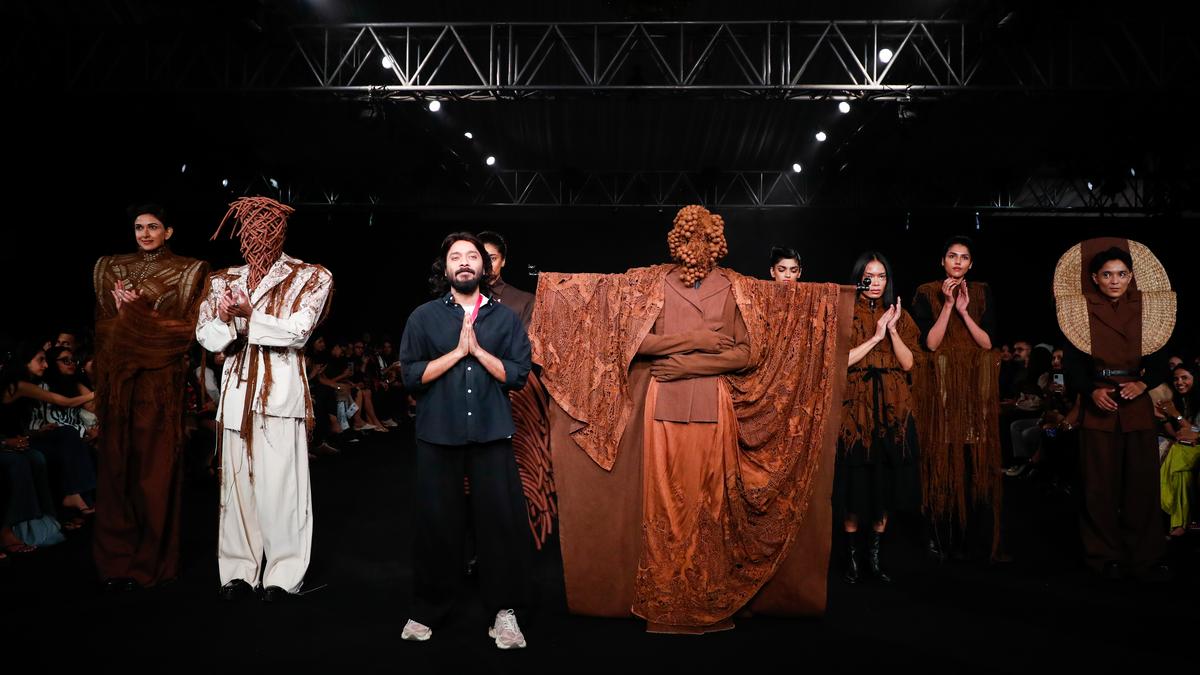
A weed pulled from village ponds in eastern Uttar Pradesh is an unlikely candidate for the fashion spotlight. Yet on October 16, at Lakmé Fashion Week 2026 in New Delhi, water hyacinth made an extraordinary journey from clogged waterways to the runway.Woven into textiles and transformed into sculptural garments, the invasive aquatic plant became the centerpiece of ‘Artisanal’, designer Anurag Gupta’s collection celebrating handcrafted materials and the women whose labor could give them a new lease of life.The collection’s significance extended beyond its earthy textures, oversized silhouettes and experimental constructions. It was rooted in Biskohar, Anurag’s hometown in Siddharthnagar district, where generations of women in the western neighbourhood known as Pacchu Tola or Pachhim Tola have lived with the constraints of hereditary sex work.For many, alternative livelihoods have remained elusive because opportunities have been scarce and trust repeatedly betrayed. Anurag wants to change that equation, using fashion to connect an overlooked community with an industry that thrives on creativity and skilled hands.“With Artisanal, we wanted to dedicate this collection to women who have had very few opportunities to choose a different livelihood,” he says. “The idea is to recognise their strength and skills without defining them by their circumstances.”The hard work behind the weave An outfit from the show | Photo Credit: special arrangement Anurag says his engagement with water hyacinth began through a collaboration with Earthomadic Foundation. Founded by social entrepreneur Nagmani Roy, it focuses on eco-friendly craft innovation and creating livelihoods for marginalised and rural women. It demonstrates how the plant could be transformed into functional, aesthetically considered products. Witnessing the process firsthand encouraged Anurag to explore its potential in his fashion practice and, subsequently, in Biskohar.Water hyacinth is an unconventional raw material, even by the standards of experimental fashion. The fast-growing aquatic plant spreads across ponds and waterways, impeding navigation and disrupting aquatic ecosystems. Yet its fibrous structure offers possibilities beyond the challenges it raises in its natural habitat. An outfit from the Anurag Gupta show | Photo Credit: special arrangement The plants must be harvested, sorted, dried, and processed before they can be worked into textiles. Moisture, inconsistent material quality and the labour involved in preparing the fibers for weaving present practical challenges. Turning a tangled plant into a workable resource requires patience, skill and considerable manual effort.For the women learning the process, the challenge is twofold: mastering an unfamiliar material while developing the skills needed to enter a livelihood they have had little opportunity to explore.Beyond the runway An outfit from the Anurag Gupta show | Photo Credit: SPECIAL ARRANGEMENT Project Biskohar, Anurag’s initiative to create livelihood opportunities for local women, is being developed as a longer-term endeavour. With support from the Earthomadic Foundation, it aims to connect water-hyacinth harvesting and processing with weaving, product development and market access.An initial 30-day training programme is planned for 30 women, covering harvesting, processing, weaving, and product development, with stipends during training. The broader vision includes fair compensation and home-based earning opportunities, enabling women to work without necessarily leaving their village.The women involved are current or former sex workers. Their participation raises a fundamental question: what does it take to make an alternative livelihood genuinely accessible to people whose economic choices have been constrained for generations? Anurag acknowledges that building trust remains a significant challenge. Consistent work, transparent payment and a dependable route from training to income will be essential if the initiative is to succeed.For the women, the stakes are intensely personal. “We want to continue learning this craft and build a better future for ourselves and our children,” says Saleema (the women wanted to share only first names). Subiya adds, “We hope this work will give us the opportunity to step outside our neighbourhood, meet new people, and explore a world we have rarely had the chance to experience.”Fashion as a beginning A model walks the ramp during the Anurag Gupta show at the Lakmé Fashion Week 2026, held on October 16 at Taj Palace, New Delhi, India | Photo Credit: SPECIAL ARRANGEMENT Project Biskohar brings a social dimension to fashion’s sustainability conversation: can an unconventional material create an entry point into the formal economy for women historically excluded from it? Water hyacinth is a compelling symbol of this ambition, although its environmental benefits will depend on responsible harvesting and production. The real test is whether the craft can become commercially viable while sustaining livelihoods.On the Lakmé Fashion Week runway, water hyacinth acquired a new identity. In Biskohar, the harder transformation is still unfolding: turning an experimental material into dependable work, and a fashion initiative into a genuine expansion of choice.
Anurag Gupta takes water hyacinth from pond to runway
Full Article
Original Source
Read the full article at Thehindu →KhanList aggregates and links to publicly available news content. We do not host full articles from third-party sources. Always verify important information with original sources.