
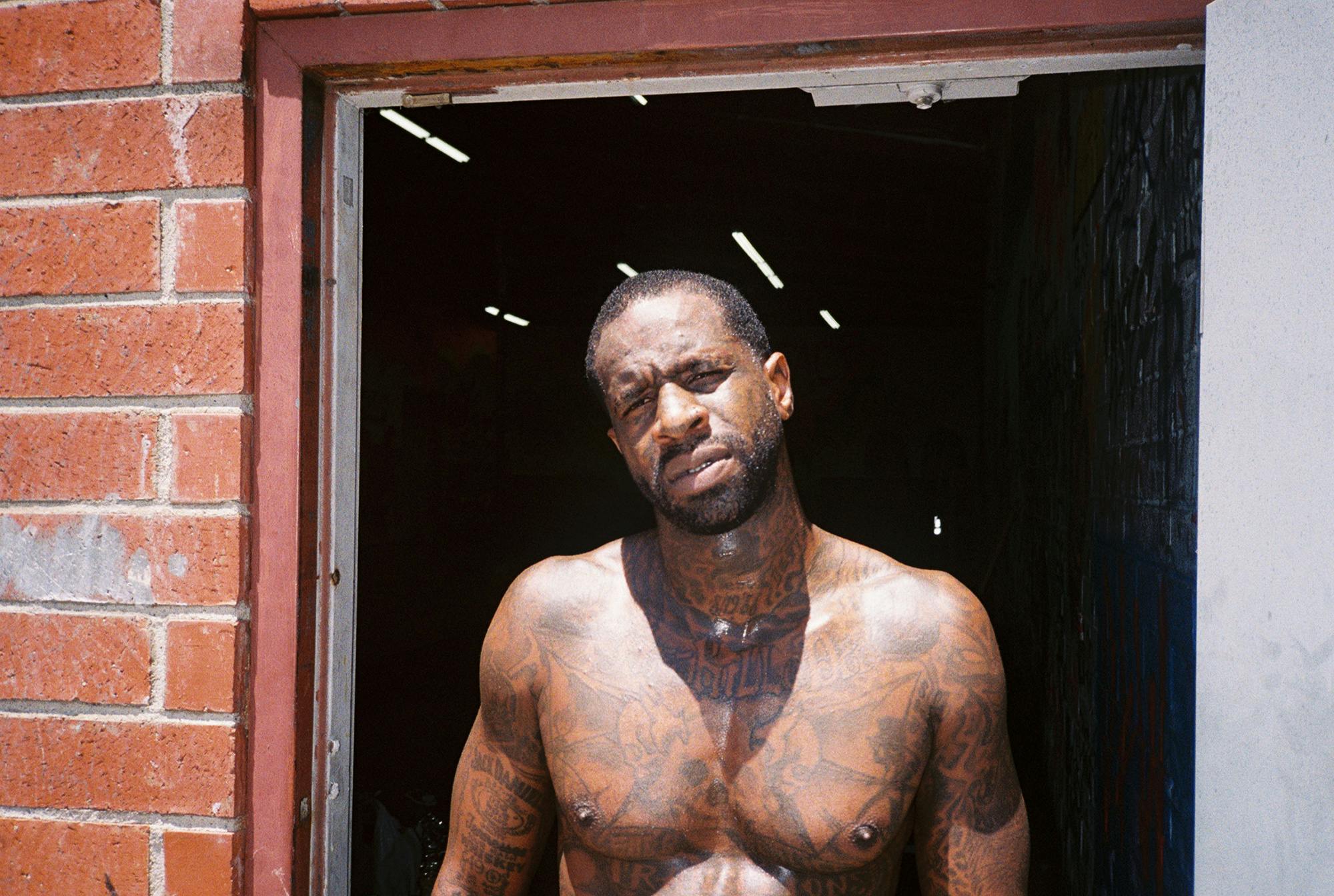
On an overcast morning in early July, Antwuan Dixon leans against a table inside Starbucks taking swigs of hot green tea. The 38-year-old skateboarding legend seems to know practically everyone in this coffee shop, tucked into a blocky mixed-use development in California’s San Fernando Valley: he greets the barista who made his drink, then a man with a low-slung baseball hat reading “too old to squabble.” Dixon nods his head, throws up prayer hands, and chats with them. He recognizes these regulars — and they recognize him — from the gym down the way where Dixon often hits the weight room and does plyometric exercises. Also nearby is the wellness center where he does hyperbaric chamber and cryotherapy regimens, in between skateboarding at local spots. Dixon has created a new kind of community in America’s most famous suburb, and he likes it that way. “I thrive off of routine,” he tells me. Dixon’s wholesome day-to-day might seem like an unrecognizable turn for someone who, for decades, led a debauched lifestyle while consistently lapping his peers. He was “just a character, man,” says pro skateboarder Paul Rodriguez, a friend of Dixon’s. “Always the life of the party.” Rodriguez remembers first meeting Dixon at the X Games; while riding a golf cart, Rodriguez suddenly felt a weight at the back of the vehicle — it was Dixon, gripping the cart while riding a skateboard. A preternaturally talented skateboarder who charged onto the Southern California scene as a teenager in the early 2000s, Dixon could nail thorny tricks with finesse and ease — a rare quality even among seasoned pros. “He was just so effortless and so smooth,” says Erik Ellington, who rode with Dixon for Baker Skateboards. “How does he do it like that?” Within a few years, Dixon was starring in cult videos like Baker 3, releasing his own shoe and board, and being anointed as the most gifted skater of his generation. Then, things took a turn. He struggled with substance abuse and went to jail several times. Sponsors dropped him. He stopped appearing in skate videos, then ceased skating at all. “I went from a professional skater to a professional partier,” he says. Now five years sober, Dixon has emerged once again as a skateboarding force, notching new milestones like a part in FTP’s recent video — his first in a major video since 2008 — and gracing the cover of Thrasher. As Dixon tells it, his last time in jail was “the best thing that could have happened to me, because now I’m able to live a second life, but just do it a whole different way. Everybody can give up on you, but I’ve never given up on myself.”Dixon grew up in Carson, California, a South Los Angeles city flecked by oil refineries and the Goodyear Blimp. As a child, he hung out with friends at the mall, trying his luck at Street Fighter and Pac-Man at the arcade, and played youth basketball and football. He briefly joined the choir at South Vermont Avenue Baptist Church — where his uncle was a pastor — and did plays there. Although timid by nature, he had a knack for making people laugh. When Dixon was 11, his older brother, who was involved in a local gang and was in jail from time to time, brought home a skateboard and handed it to him. Not long after that, a friend from the neighborhood was showing off the kickflip he’d been practicing. Dixon, who could do ollies by that point, “thought it was sick.” He asked to see his friend’s board — and nailed a kickflip on his first try. He was soon skating 10 hours a day and dropping in at skate parks like Long Beach’s El Dorado.At 14, Dixon put together a “sponsor me” video to see if Transitions, a longtime Carson skate shop, would back him. But when the time came to drop off the tape, he was too afraid to deliver it himself. A fellow skateboarder brought it inside. “You can skate like this? You come in here and buy stickers!” he remembers the shop’s owner, Buddy, telling him. Transitions became Dixon’s first sponsor. Buddy is “the one that told me, ‘You have a raw talent; you could actually be something,’” Dixon says. Through videographer Ryan “Beagle” Ewing, Dixon began meeting skaters who rode for Baker Skateboards, known for its roster of stylish characters. “Everybody liked him,” says Ellington, noting that Dixon’s nickname back then was “Big Candy” because of his proclivity for eating sweets. Dixon was a “ripped, quiet, humble kid and, at that time, as talented as you could ever imagine,” Ellington adds. In 2005, a 16-year-old Dixon spent several months filming a part — his first — for a skate video called Baker 3. The video sees Dixon landing tricks with such grace that he appeared practically “asleep on the board,” as Rodriguez describes. He could pull off something like an ollie heel-flip without ever moving his arms. “Not only was he doing, like, really dangerous, hard tricks down big sets of stairs, but the way he did it so effortlessly? I definitely knew he was one of a kind,” says Ewing.Ahead of Baker 3’s packed premiere in Hollywood, someone told Dixon that his life was about to change. He shrugged and took his seat inside. When Dixon appeared onscreen, skating to Biggie’s “Let’s Get It On” (Dirty Harry Blend), the audience “didn’t really know who I was, so it got quiet,” he says. Then, the “fucking theater went crazy.”“Everybody will remember the line where he does a Switch 180 over the rail, goes around the handicap, like, little path, and then the Tre Flip on flat ground before he heel-flips,” Rodriguez says. Dixon’s part in Baker 3 “really lit a fire under me,” he adds. “[It] really motivated me to be like, ‘Alright, this is where the bar is at. Let’s keep adding to it.’”The now-mythical video made Dixon “one of everybody’s favorite skateboarders,” Ellington says. Sponsorship offers and endorsements flooded in. “I went from nobody to somebody in one night,” Dixon says. The sudden fame, and money, startled him. “I was just like, ‘Whoa,’” he says. “It was hectic.”After Baker 3, Dixon and the crew kept skating around LA, often going to Hollywood High then partying at Ellington’s house in the Hills afterward. “I’d be able to drink a beer and stop,” says Dixon. “It was mellow at first.” But the Baker team had a penchant for carousing, which compounded within a subculture that was, by definition, rebellious. On tour, the team would be received in new cities not unlike ’80s rock stars. “People would have alcohol for us…someone would have drugs,” Ellington says.Dixon, still a teenager, was trying to hold on as best he could as his career kept progressing. He landed another acclaimed part in the video Baker Has a Deathwish and began riding with the cult company Deathwish. His board for Deathwish became a top seller. But as Dixon’s fame grew, “trouble followed him around,” Rodriguez says. In 2008, a 19-year-old Dixon was arrested in Tampa, Florida, for battery and marijuana possession. His father died a year later, and “that’s what took it up a notch,” Dixon says.The graphics on Dixon’s Deathwish boards immortalized his hardscrabble partying: One had a “get out of jail free” card; another showed him being arrested. When I ask Dixon if he felt he had to continue feeding this persona, he chews on the question for a beat. Back then, he offers, his mentality was as follows: “‘Fuck it, maybe I’ll just be wild and fucking crazy, man. Just drinking and not caring about what the fuck happened.’” On the road, “you didn’t know what was going to happen” with Dixon, Ewing says, adding that he simultaneously radiated positive energy and got into trouble. “At one point, he punched this tattoo artist right after he got tattooed,” Ewing remembers.Ellington, who is now sober, says the maelstrom made it hard to see clearly if someone was spiraling. The warning signs might not have been obvious with Dixon, given his skating prowess. “Not to promote the, I guess, debauchery of the era, but the fact that he was as out of it as he was at that time, and still making everybody look silly on a skateboard compared to him, is pretty crazy,” Rodriguez says. But around 2013, the same year Dixon went to jail for violating his probation, Deathwish’s founders opted to discontinue Dixon’s top-selling board. “It was like, do we as a company want to enable the behavior by continuing to give him a pro board, even though he’s killing himself?” Ellington says. He hoped it would be a wake-up call for Dixon. It wasn’t.Dixon grappled with a series of tragedies soon afterward. In 2015, his mother died. One of his childhood friends suddenly passed away, and his nephew took his own life. “That was a bad one,” he says of that stretch. To escape his grief, Dixon drank.In 2019, Dixon found himself behind the wheel of a stolen car. He’d driven around a refinery in Carson, and the parking lot gate wouldn’t open. The police arrived and drew their weapons. “I ain’t stepping out of nowhere when you got that gun on my face,” Dixon recalls saying. When they got closer, Dixon hit the gas, smashing through the gate. A chase ensued. Dixon was taken in later that day and went back to jail for the fourth time. While inside, Dixon felt a bone-deep exhaustion. “‘What am I doing?’” he remembers thinking. “Something fucking clicked. I was just tired of the cycle that I was putting myself through.” After his release in 2021, Dixon enrolled at a rehab program in Pasadena where he stayed for several months. In the five and a half years since his last drink, Dixon has drawn on lessons from his time in jail and treatment programs alike to comprise the routine that now grounds him — including reading the Bible, “daily bread” reflections, and journaling every morning. Once he’s done filling out a journal, he chucks it in the trash. He likes the finality of the act, but he’s also “trying to be less of a, what do you call it, a hoarder?” he smiles.Dixon didn’t skate much while he was trying to get healthy. But as the fog lifted, he “was able to fall back into the things that I love to do,” he says.Ellington saw Dixon skateboarding around LA again after Dixon had been sober for a year. “It wasn’t on the level of when he was 18 because he was still climbing the hill of relearning things,” Ellington says. “But you could see that he was in tune.” Then, in late 2024, Dixon was skating a staircase when he felt something very wrong in his body, as though his knee had been wrenched from its socket. He’d torn his ACL. He got reconstructive surgery and was laid up for a while — doing physical therapy, watching movies, and keeping his usual routine to steady him. About six months later, he got back on the board. Rodriguez, who skates with Dixon more now than when they first met in the mid-aughts, is awed by how he’s come back with longevity in mind. “He’s got the bands around his knees, he’s doing his warm-up routine before the session starts,” Rodriguez says. “We’re treating ourselves like athletes.” Dixon, he says, is still Dixon. “He’s smoother than ever, he’s still got a funny-ass personality, and his essence is still there. That goes to prove that, like, the partying, the drugs, the crazy antics wasn’t what did it. It was him who did it.”Dixon is looking ahead to big travels coming up, including a trip to China and several cities throughout the US to skate. He now collects magnets from his adventures, which he sticks to his fridge to savor the hard-won memories. “Nowadays I do things, and I remember the whole experience,” he says. As far as future aspirations go, Dixon wouldn’t mind being Skater of the Year. But to skate at all — and to continue challenging himself on the board — is its own gift. “Because of the things that I’ve been through, I was able to bounce back,” he says. “Skating at whatever age you’re at, it’s never easy. And even as you get a little bit older, it’s not any easier, right? That concrete is still that fucking concrete.”CreditsBy: Paula MejíaPhotographed by: Alexis GrossPhotography Assistant: Ashley Olah
Antwuan Dixon Has Always Been This Good
Full Article
Original Source
Read the full article at Highsnobiety →KhanList aggregates and links to publicly available news content. We do not host full articles from third-party sources. Always verify important information with original sources.