
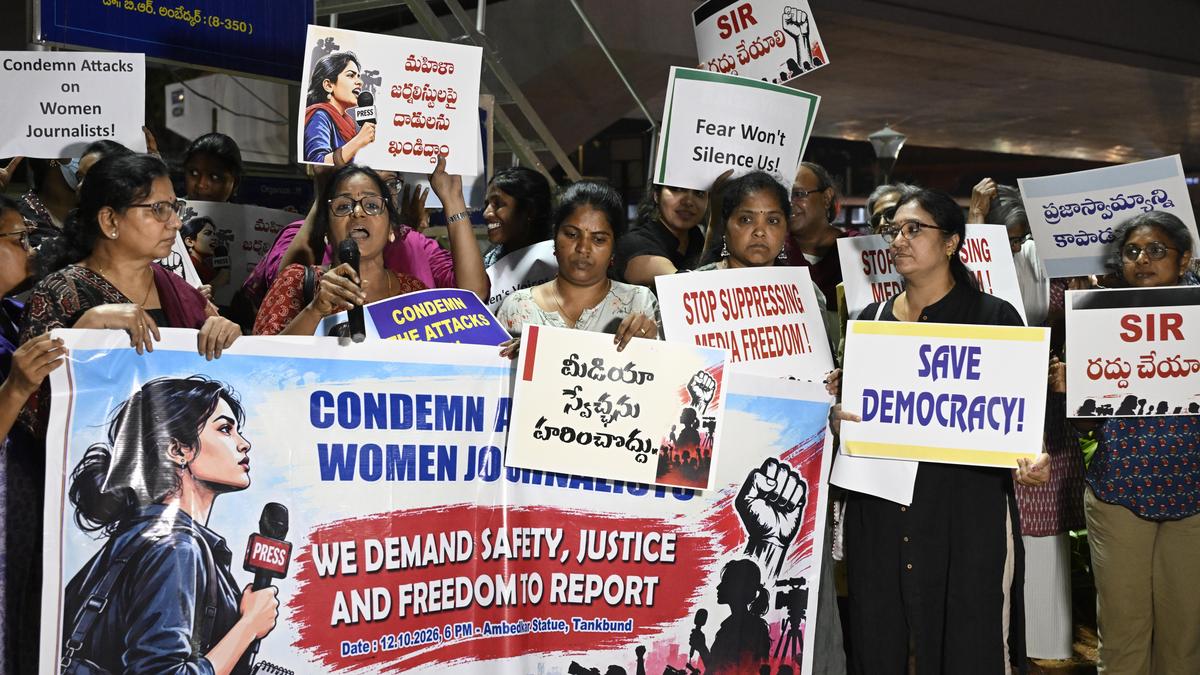
The Supreme Court on Thursday said it would test whether law enforcement agencies should grant journalists any “special privilege” at protest sites.A three-judge Bench headed by Chief Justice of India Surya Kant said journalistic freedom must be balanced with the administration of public order.“Whether a journalist has a special privilege in a situation of an assemblage, demonstration, or other exercise of democratic rights in relation to law enforcement agencies... Or is the law enforcement agencies’ purpose only the maintenance of law and order, and there cannot be any additional journalistic privilege…” observed Justice Joymalya Bagchi, laying out the debate.Also Read | 43 journalists detained, several assaulted, while covering protests against CEC: CPJ‘Allow us to do our work’The court’s remarks came during the hearing of multiple petitions alleging the abuse and illegal removal of journalists — including women media professionals — from demonstration sites during the widespread protests demanding the resignation of Chief Election Commissioner (CEC) Gyanesh Kumar in October.The Kerala Union of Working Journalists, represented by senior advocate P.V. Dinesh, said journalists were not claiming any “privilege” whatsoever.“We are only saying that we are just journalists. Allow us to do our work,” Mr. Dinesh clarified.He referred to the specific cases of seven journalists who have alleged that they faced abuse at the hands of the police. The court directed the journalists’ body to approach its High-Powered Enquiry Committee (HPEC), which has been set up to hear individual grievances against the police using excessive force disproportionate to the maintenance of public order.Also Read | Delhi Police considered reporter jackets, press IDs to distinguish journalists from ‘reel-makers’ during anti-SIR protests‘Superior treatment’Justice Bagchi went on to voice a larger question bothering the court, that is, whether journalists require a “superior or a different species” of treatment at places of democratic processes like a protest, demonstration, or public assembly.Mr. Dinesh said the rights of journalists were already crystallised by law and judicial precedents. He said the core issue here was whether “established journalists covering an event can be taken into custody”.The court said journalists canvassing wrongful detention or alleging that they were stopped from performing their professional duties during the protests were free to demonstrate their cases before the HPEC. Justice Bagchi said the top court would focus on addressing or further clarifying the law.Explained | Police ‘handling’ of women protesters: What law says about crowd control, use of forceWhat is ‘custody’?One of the questions raised by Justice Bagchi, which he said the court would determine, was whether “picking up someone and removing them from a spot amounts to ‘custody’.”“If so, what are the consequences if we hold it as ‘custody’? We could examine this,” the judge said.Justice Bagchi, at one point, said a journalist’s status was not a “self-confirmed” one, noting that there was a realm of atomised individuals who self-identify as ‘journalists’.The Delhi Police, in its affidavit in the case, had assured the court that it “respected the role of the press”. The police had denied removing or detaining anyone who had not hindered their work.Also Read | Website selling ‘lifetime press cards’ for ₹1,799 raises concerns; Delhi Police, journalist bodies flag verification challenge‘Reel-makers are not journalists’However, the police claimed that the protests against the NEET-UG 2026 paper leak in July and against the CEC in October were swarmed by individuals masquerading as journalists by using a camera and a microphone. The affidavit blamed “reel-makers” and “content-creators” interfering with their operational space. The police said current laws, guidelines, and rules did not consider reel-makers and content-creators as ‘working journalists’.The affidavit had urged the court to determine if “reel-makers can be elevated to the status of journalists or reporters”.Justice Bagchi asked whether a person could be considered a professional journalist only if she was accredited or registered under the law or employed with an established print or electronic media house. The judge questioned whether a person, who seemed to be a spokesperson of the people, or a citizen journalist, could be recognised as engaged in the profession of journalism.The petitioners said nomenclatures like ‘reel-makers’ and ‘content-creators’ used by the police in its affidavit seemed to be an afterthought, and cannot be applied to restrict, restrain, or remove the people covering protests.
Anti-CEC protests: Supreme Court to examine if police must grant journalists ‘special privilege’ at protests
Full Article
Original Source
Read the full article at Thehindu →KhanList aggregates and links to publicly available news content. We do not host full articles from third-party sources. Always verify important information with original sources.