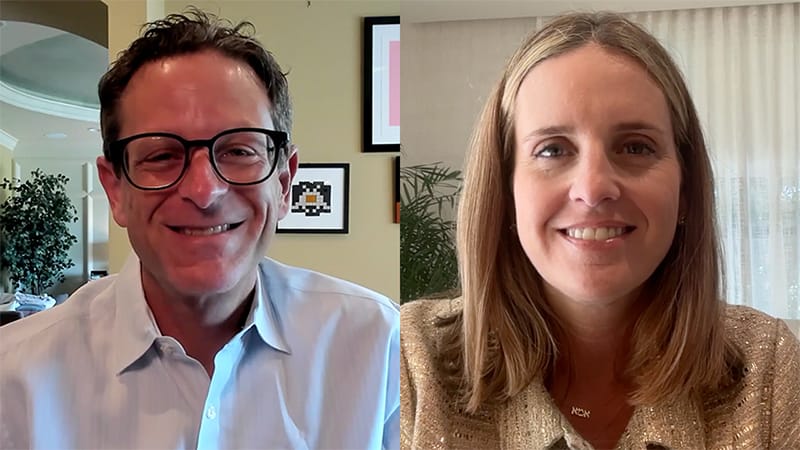
This transcript has been edited for clarity. Richard Isaacson, MD: Hi, I'm Dr Richard Isaacson. I'm a preventive neurologist at the Institute for Neurodegenerative Diseases in South Florida. I'm here with my close colleague, Dr Jennifer Buczyner. Jen, introduce yourself.Jennifer Buczyner, MD: I'm Jennifer Buczyner. I'm glad to be here with all of you. I'm also a neurologist, and I work at the Atria Research Institute with a focus on preventive neurology.Isaacson: Today, we're going to talk about anti-amyloid drugs. This has been in the news lately, and there has been a large amount of interest in these new FDA-approved disease-modifying drugs. There's a recent Cochrane review that said maybe these drugs aren't all they're cracked up to be, and maybe they don't do too much.Dr Buczyner, what do you think about this? Sometimes I say: In the right patient, at the right dose, for the right duration of time. I think anti-amyloid drugs are a critical part of our ecosystem of multimodal interventions. What are your thoughts?Buczyner: When we talk about anti-amyloids, it's all about how we present it to the patient. What is a meaningful change? For me, when I'm treating patients with Alzheimer's disease, a meaningful change is that somebody's independent, that someone may delay a nursing home visit, and that they can do their activities of daily living longer. To me, that's a meaningful change. The other side of the coin, I think we're intervening too late. If we think about it, changes in amyloid happen 15 to 20 years before some people get dementia. What meaningful change are we really making?Isaacson: There are many ongoing studies that'll give us more randomized, controlled trial data to say whether implementing these drugs very early at the cusp of symptoms or even presymptomatic — could that move the needle? And could that be a potential presymptomatic intervention? We'll see how the data shake out. We can't think of anti-amyloid drugs as a panacea. They're an important component of, as I said earlier, a multimodal, comprehensive approach to fighting Alzheimer's disease. If a person is otherwise not healthy, not doing the right things, not exercising, has diabetes, is eating unhealthy food, and not staying socially engaged, in some ways, it's a drop in the ocean. You can use an anti-amyloid drug, but what kind of upside are you going to see?Considering the people who do the best on these drugs, you have the randomized, controlled trials, which is a heterogeneous group of people. In my clinical practice, we have people who are trying to do everything they can, as long as it's evidence-based and safe. When people are optimizing their overall health, their brain health, using an anti-amyloid drug in the right person, at the right dose, and for the right duration of time — that's when I think these drugs can have the most benefit. There are a couple now that are on the market.Do you have any suggestions for the listeners about why to use one over the other? Is this agent better than that agent, or is it just the twice-a-month or once-a-month drug? What do you have to say on that?Which Anti-Amyloid for Which Patient?Buczyner: Let me start by saying I use both. I'm an equal opportunist. In the right patient, I believe there are choices and things that we decide. For example, if you're thinking about lecanemab, you're committing someone to a long-term therapy. You're discussing the potential that protofibrils play a role in their disease course and that you need the benefit of being on a longer-term therapy — but they're going to be more frequently dosed. If we're talking about the right patient for donanemab, we're talking about someone who's like, "I want to treat this amyloid, I want to get off this drug, and my life is such that I can do once a month, if it's for a finite time."I think both choices are right for the right patient and the right reasons we discussed. Lecanemab was the first on the market, so some practitioners probably have a little higher comfort level with that drug because it's been around longer. I think they both serve their role.Isaacson: I've used all of the various drugs. There was one on the market, aducanumab, which is no longer on the market. I've experimented with them all. I even have several patients who have been on all three. First on aducanumab, and then switched to lecanemab, and now on donanemab maintenance or now pausing for a little bit and in surveillance mode. Every patient is a little different. We can use blood tests, PET scans, and spinal fluid to understand whether that anti-amyloid drug works for that person. We can use cognitive assessments to understand their cognitive trajectory. We can use our clinical gestalt to understand if this is working for them. Then we use MRIs to understand whether this is potentially causing a side effect like vasogenic edema, swelling, or bleeding. I think in each person, especially with one or two copies of APOE4, there's some nuance here. I'll ask you a controversial question.Buczyner: We like controversy. Mild MCI Centiloid Score in the Low 20sIsaacson: Let’s say you refer someone to our clinical research study and our blood biomarker panel. This is a very smart guy — professional, working — who has mild changes, but when you talk to him, you have no idea anything's going on. He is highly intellectual, really smart. His Centiloid score is in the low 20s. When you have someone who has some symptoms and is right at the borderline, is this mild cognitive impairment (MCI) or something else? He's really smart, so he tests well, but his Centiloids are around 20. How do you make a decision in clinical practice? Would you use an anti-amyloid drug in a person like that? Would you choose one or the other? Would you modify the dose? Would we think about something off-label? A controversial question. What do you think?Buczyner: If we're going to stay on-label, let me start by saying these drugs are approved for phases 3 and 4 of Alzheimer's disease, so this would not be the right patient. Where the trends of all these therapies and studies, as you mentioned, are going is that person who's earlier in their disease course. Not only do they have a positive or negative Centiloid value, but what is that value? Is there some threshold level of toxic amyloid where we know that if we don't intervene, someone's going to progress on that cascade?As long as they understood what they were getting into and the why, if we felt this person had some sort of clinical change, and I knew where things were headed, why not? You could also make that argument, as you said, that maybe as you trend their PET amyloid, you would see that number rising and feel you needed to be more aggressive.Isaacson: Yes. There was a recent paper: “Beyond Binary — the Case for Amyloid Centiloid Quantification.” I think amyloid scans are really helpful. They've been FDA-approved since 2012 or so.In our clinical practice, we have a lab where we do testing frequently, and we track all these metrics from amyloid ratio to tau to GFAP (glial fibrillary acidic protein) , NFL (neurofilament light chain), and other things. Whatever metric we're going to eventually use, I believe we should use definitive, evidence-based ways to approach this. We take the clinical data, but then we can also use the signals. You can't do a PET scan every few months. There's radiation, it's expensive. But maybe one day we'll use blood testing to try to understand this. I agree that if you see the amyloid going in the wrong direction — the more amyloid in the blood the better because that's lower amyloid in the brain — but if the amyloid is going in the wrong direction and the taus are increasing, then maybe that biases you to use an anti-amyloid drug. One day, we're going to probably flip the script and use these longitudinal tests to understand the trajectory of change rather than a binary: "Oh, we checked it. Okay, it's fine. Check it in a year." Patients don't follow that exactly. People age, and as we age, our brains age, too. I think that's the direction we're going. What do you think about using blood tests to assess the efficacy of anti-amyloid drugs? Do you think we're there yet or not?Buczyner: I've been doing this in my own practice. I know that you're doing this in your practice. I think it's extremely valuable. For me, the addition of the amyloid PET with a Centiloid, a blood-based biomarker, gives me the whole picture because I can assess the patient over time.Let's say in that patient I'm using donanemab and they complete the drug, I can then track them and figure out, well, wait, is their p-tau rising again? Is their Centiloid value rising? Do I need to think about re-treating somebody like this? Those two things together are really helping me make clinical decisions. I can't say I'm there with just a blood-based biomarker.Not There Yet With a Blood Biomarker AloneIsaacson: Yes, I agree. I'm not ready to prescribe an anti-amyloid drug based on a blood biomarker alone. I need something more definitive, and that's an amyloid PET scan or a spinal fluid — also for tracking disease progression over time and response to therapy. While I love the blood-based biomarkers in our panels because I'm so used to them, I think we have to be cautious and use more definitive tests when we can.Final question. Anti-amyloid drugs are FDA-approved, but again, this whole drop-in-the-ocean thing. Have you seen in your clinical practice that when you use these anti-amyloid drugs and people are doing everything right — they're healthy and they're doing the right things, such as exercise, healthy nutrition, and stuff like that — do you think they do better?Buczyner: I definitely do. As you said, if you're approaching every single angle, all of the risk factors, the medical risk factors, and then I'm reducing or impacting amyloid, I think we're making a difference. The other thing I'll tell you, even just from the studies and my own clinical experience, is the person with MCI who we probably would have put on the back burner until the next year in clinical practice, before I worked at Atria, that is the person who does better on these drugs.We know their response is more robust. I think this makes the case for prevention. The impact these drugs can have is so much more impressive if you treat that patient who's way earlier in the cascade, has not developed any tau accumulation, vascular problems, inflammation, or anything like that. You can really augment a change in that patient by addressing the risk factors as well.Isaacson: I couldn't agree with you more. Our lab is working very hard to create what we colloquially call the cholesterol test for the brain so we can use these blood panels in real time to evaluate these things. What we see is when you use an anti-amyloid drug plus multimodal, evidence-based lifestyle interventions, that's when those blood biomarkers look even better in real time. I agree with you. Dr Buczyner, thank you so much. That was a great conversation. It’s always a pleasure to chat.Buczyner: Thank you, Dr Isaacson.
Anti-Amyloids and Meaningful Change
Full Article
Original Source
Read the full article at Medscape →KhanList aggregates and links to publicly available news content. We do not host full articles from third-party sources. Always verify important information with original sources.