
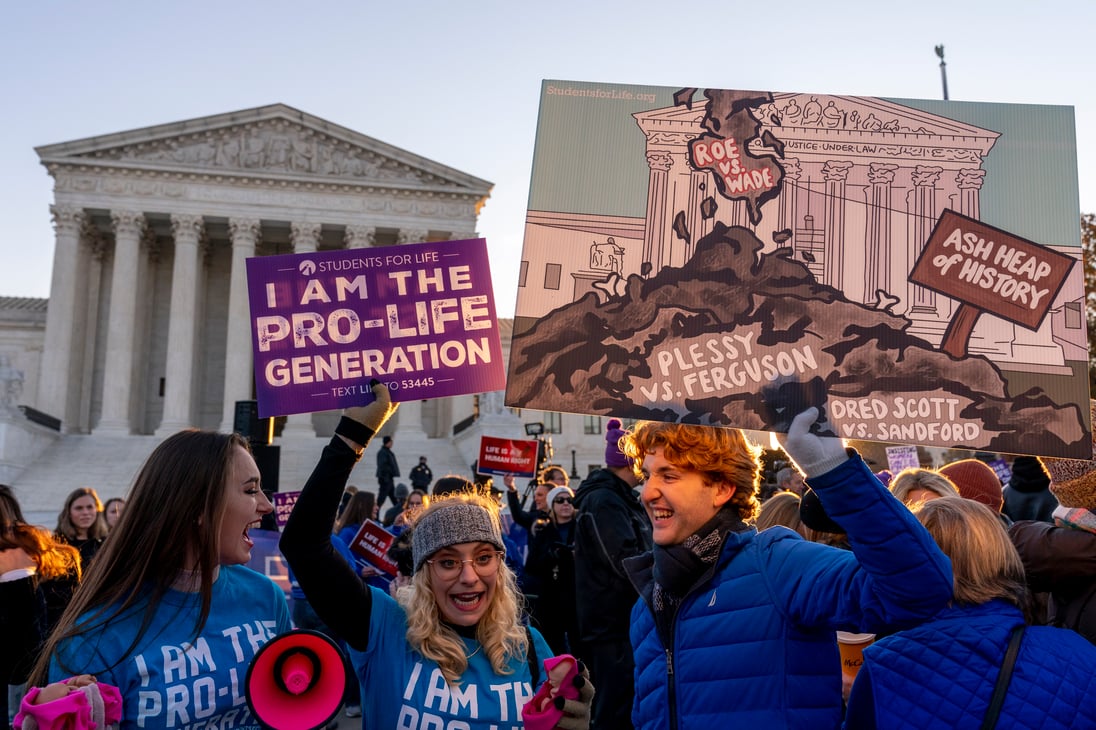
The state says a requirement for organizations to list their top five donors on ads doesn't even apply to Students for Life Action.(CN) — A student-led anti-abortion nonprofit asked an Eighth Circuit panel on Wednesday to revive its challenge to what it calls an unconstitutional South Dakota law requiring the disclosure of donors on political communications.Students for Life Action is a nonprofit that trains and mobilizes anti-abortion leaders to influence public policy and elections. The group sends text messages to voters about lawmakers’ voting records on abortion legislation and mailers urging citizens to contact their state leaders.In 2023, the group sued South Dakota over its law requiring any person or group spending more than $100 on an independent political communication about a candidate or ballot measure to include an on-ad disclaimer listing their five largest donors. The group appealed after a district judge denied its motion for summary judgment due to lack of standing.At the heart of the 30-minute hearing was the lack of an opt-out clause for donors.The nonprofit argues the law has no time limit, no minimum donor threshold and no mechanism for donors to opt out of on-ad listing by earmarking their contributions away from election-related spending.“These structural defects render the statute incapable of satisfying exacting scrutiny — let alone strict scrutiny — because it forces organizations to disclose donors who never intended to fund the communication at issue, for communications bearing no nexus to any election, at spending levels that capture routine civic discourse,” Students for Life Action in its brief.“No federal court has upheld a disclosure statute with its combination of features, requiring organizations to list their five top largest general donor on every covered message, with no off-ramp for donors, a negligible $100 trigger, no temporal time limit to any election, and criminal penalties,” Jeffrey M. Schwab told the panel on behalf of the group. “To uphold it, this court would have to go further than every circuit that has reviewed a comparable disclosure law, splitting with the reasoning of those decisions.”Schwab, from Liberty Justice Center based in Austin, Texas, pointed to rulings in the First and Tenth circuits upholding similar laws because they contained opt-out provisions.South Dakota Assistant Attorney General Grant M. Flynn pushed back.“While they make the point that no court has ever upheld a statute with this particular constellation of symptoms, they really don’t point to any cases where the court has struck down any of these statutes because it’s been missing one of those particular components,” Flynn said.Students for Life Action claims its communications do not tell recipients whom to vote for or against. Instead, they encourage recipients to sign petitions, urge candidates to keep pro-life pledges or contact politicians about pending legislation.Each of the messages cost more than $100 and the group expects future messages to carry a similar price tag.South Dakota argues the lower court correctly determined the student group lacked standing because the law in question does not apply to it.“Appellant’s overbreadth and vagueness claims are based on faulty interpretations of the statute that conclude that its reach extends to issue advocacy rather than only express advocacy,” the state wrote in its brief.Flynn expanded on that point.“The court certainly found that they don’t have standing to challenge the on-ad disclosure or the on-ad donor disclosure portions of the statute, and that’s where that ‘issue’ versus ’express’ advocacy question comes into play,” Flynn said. “Because they don’t engage in any express advocacy and have disavowed any intent to do so, they’re under no obligation to do the on-ad donor disclosure because they don’t receive any ‘contribution.’”But Schwab countered the emphasis on that word was problematic.“Here, the government and the district court are attaching the word ‘contribution’ to the donation, which means that we have to figure out what the intent of the donor is in order to comply with the statute,” Schwab said. “So maybe the donor intended to fund to influence an election. Maybe he didn’t. We don’t know, and there’s no way that Students for Life Action is going to generally know that, but they’re subject to the disclosure requirement and criminal penalties.”U.S. Circuit Judges Steven M. Colloton and Bobby E. Shepherd, both George W. Bush appointees, and Jane Kelly, a Barack Obama appointee, made up the three-judge panel, which took the case under advisement. There is no timetable for a ruling.Subscribe to our free newslettersOur weekly newsletter Closing Arguments offers the latest about ongoing trials, major litigation and rulings in courthouses around the U.S. and the world, while the monthly Under the Lights dishes the legal dirt from Hollywood, sports, Big Tech and the arts.Additional Reads
Anti-abortion student group pushes for overhaul of South Dakota donor disclosure law
Full Article
Original Source
Read the full article at Courthousenews →KhanList aggregates and links to publicly available news content. We do not host full articles from third-party sources. Always verify important information with original sources.