
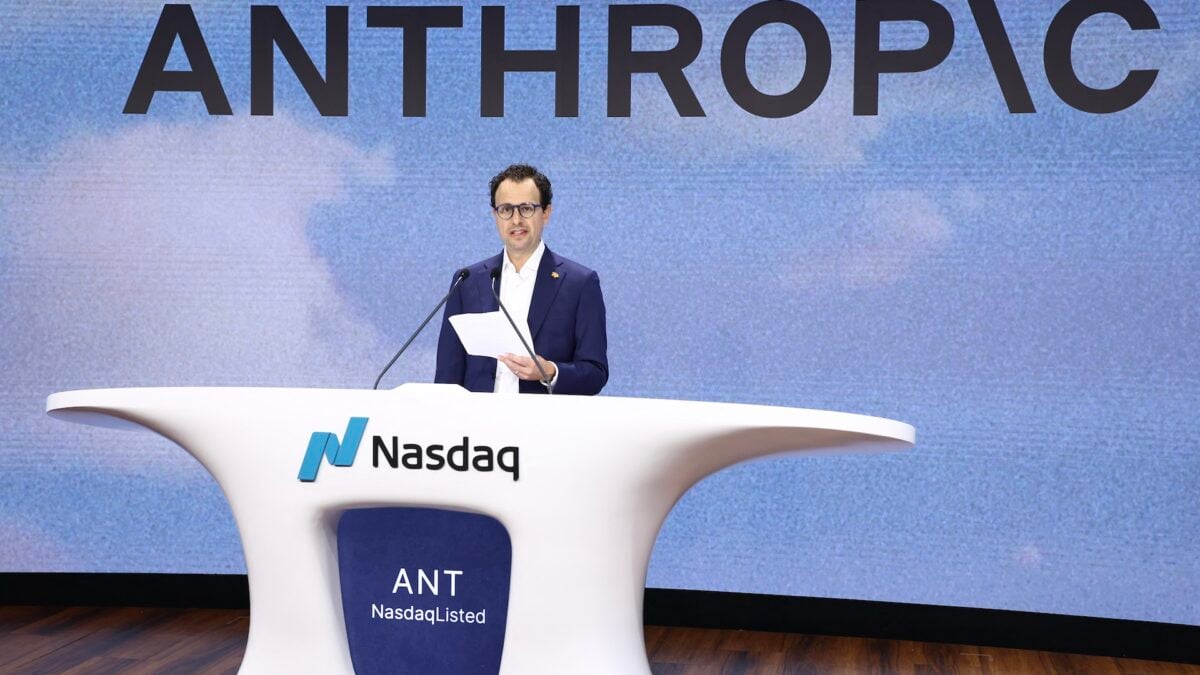
On Friday morning, less than twenty-four hours after the company made Wall Street history with a record-breaking IPO, Anthropic mathematician Levent Alpöge claimed to have used Claude to prove the Riemann hypothesis—a problem that’s plagued mathematics for 167 years. His proof was confirmed the following day by two mathematical organizations, the Lean Focused Research Organization and the Mathlib Initiative, who wrote in a joint statement: “We have full confidence that Alpöge’s proof of the Riemann Hypothesis is correct, and we congratulate him on this achievement.” The confirmation that math’s most infamous puzzle had finally been cracked with the help of AI was taken by some as proof of the technology’s transformational potential. “As someone who has spent much of my life in math and science, I see the proof of the Riemann Hypothesis as clearly marking the beginning of a significant change.” Meta chief AI officer Alexandr Wang wrote on in a lengthy X post on Sunday, titled Superintelligence is Arriving. “It is hard to overstate the magnitude of discovery that we have just witnessed—completed with the help of an alien mind that we don’t understand.” Longevity expert Bryan Johnson was even more enthusiastic in his prediction for what would come next: “riemann hypothesis is solved,” he wrote in a Monday X post, “death is next.” There’s no reason to believe, however, that an AI-assisted mathematical breakthrough will directly lead to immortality, the elimination of deadly diseases, the end of poverty, or any of the other grand visions AI boosters promise. And as the AI critic Gary Marcus noted in a Sunday edition of his newsletter, it probably won’t even have a significant impact on Anthropic’s bottom line. Despite the exuberance on social media around Alpöge’s proof—which consisted of over 250,000 pages in the programming language Lean—the company’s stock price at market close yesterday was around 24% lower than the price it first started trading at Thursday morning. That’s probably because for the vast majority of people who are currently using AI on a day-to-day basis, the Riemann hypothesis, like most of what happens in the world of PhD-level math, is almost completely irrelevant. Alpöge’s proof is undoubtedly a historic achievement. But Anthropic’s historic IPO—and before that, its eclipsing of OpenAI as the world’s most valuable startup—was largely made possible by the popularity of its AI tools among software developers and businesses. Those customers, and now by extension Anthropic’s shareholders, care more about pragmatic, user-friendly forms of automation than they do about solutions to esoteric problems with no known real-world applications. “Solving an old pure math problem does not immediately widen Anthropic’s operating margins,” as Google DeepMind AI researcher Seb Krier put it in a Saturday X post. Anthropic could take a warning from its competitor OpenAI, which made headlines in September after solving the Navier-Stokes smoothness and existence problem—which, like the Riemann hypothesis, is one of the Clay Mathematics Institute’s $1 million-dollar Millennium Prize Problems. In addition to stirring controversy around how the solution was published, the company has, according to some of its users, become hyperfixated on headline-grabbing, computationally expensive accomplishments (like the Navier-Stokes solution), while sidelining the use-cases that people actually care about. As one user wrote on Monday: “People don’t need models that are brilliant at math; they need models that are good at life.”
Anthropic Can Solve Math’s Greatest Mysteries. It Still Has to Make Money.
Full Article
Original Source
Read the full article at Gizmodo →KhanList aggregates and links to publicly available news content. We do not host full articles from third-party sources. Always verify important information with original sources.