
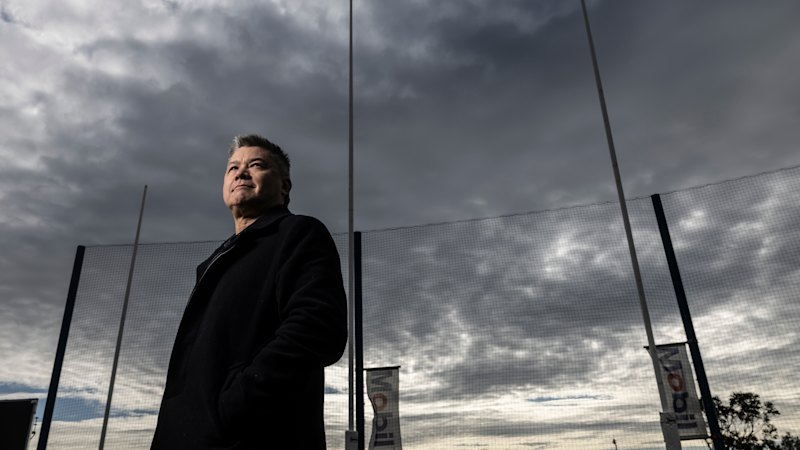
As the AFL drags its heels on head trauma research, and launches yet another review of its safety protocols – the timeline for which is unclear – a startling new study of late NFL players’ brains has sent a shiver down the spines of Australian neuroscientists.Published this week in medical journal The BMJ, the research shows that, at an absolute minimum, one in four of NFL players who died between 2016 and 2021 had chronic traumatic encephalopathy (CTE).A new study out of the US has revealed a worrying rate of CTE among former NFL players.APAbout a quarter of players who died in that six years donated their brains to science. More than 90 per cent of those 235 brains were posthumously diagnosed with CTE, meaning that, at a minimum, 24.5 per cent of all players who died during that period had CTE. The number could be as high as 97.7 per cent.The data presents a stark comparison to the roughly 1 per cent of the general population posthumously diagnosed with CTE in community brain bank studies.The study also found a high rate of dementia among NFL players posthumously diagnosed with CTE, particularly those with more severe diagnoses.The NFL did not respond to The Age’s request for comment, but a spokesperson told Reuters it was continuously striving to make the game of football safer, and had implemented several strategies to reduce concussions and head impacts. It also released a joint statement with the NFL Players Association outlining new sanctions for players found guilty of repeated on-field health and safety violations, like dangerous tackles.Thousands of kilometres away, Australian neuroscientists have been taking note.While the Boston Brain Bank started around two decades ago, the Australian Sports Brain Bank (ASBB) opened only in 2018. The bank’s Victorian manager Dr Alan Pearce said the US study provided the clearest picture yet of the prevalence of CTE among athletes exposed to repeated head knocks.His team has analysed around 150 sportspeople’s brains, about half of which were found to have CTE, though Pearce said this was skewed by the fact that people suffering CTE-like symptoms were more likely to donate their brains.Pearce said this dataset likely could have been much more complete by now if the AFL had been more cooperative. Instead, he said, the AFL has consistently hidden behind research gaps as an excuse for inaction, focusing brain health discussions on concussions, which are easier to prevent, and largely ignoring CTE, which is associated with repeated head knocks over an extended period.“It’s a dirty word,” Pearce said. “If you look at Spud’s Game from a couple of weeks ago, they talk about mental health, but they never mention CTE at all, even though Danny Frawley died with stage two CTE.”Danny Frawley died in 2019.Getty ImagesLooking through the archives of media releases and articles on the AFL website, CTE has been mentioned in connection to Spud’s Game only twice – once in 2013, and once in 2021.During his tenure as a lead brain health adviser to the AFL, Dr Paul McCrory was accused of downplaying the link between head trauma in sports and CTE, giving a speech in 2016 in which he argued that the dangers of concussion in the NFL were not nearly as serious as some reports suggested.Study timeline remains unclearIn early 2023, the AFL announced a $25 million longitudinal study into the brain health of current and former players. Its stated aim was to answer questions about the prevention, diagnosis and management of sport-related concussion and repetitive head impacts, and potentially help identify at-risk players sooner.The league submitted the study for ethics approval in November 2024. The first participant was enrolled eight months later and, to date, the study has recruited just 102 of its sample size target of 3000 players, according to the Australian New Zealand Clinical Trials Registry. The study methodology spans at least 40 years.The Age has repeatedly asked the AFL in recent weeks for an update on the study, including when results would be published. The league did not answer specific questions, other than to say that two teams were involved with more to come.The AFL Players Association said it had a representative on the study’s steering committee, but that its role was purely advisory. It was not sure which players were participating, or even how many.Pearce has called on the AFL to commit to a timeline for publishing interim results.The Australian Sports Brain Bank’s Victorian manager Alan Pearce.Jason South“They say they’re doing ongoing research, particularly in the long-term retired athlete space, and they’ve been doing that apparently since 2009 or 2010, but we’ve never actually seen any data at all,” Pearce said.Ideally, though, he said he would like to see the AFL fund fully independent studies to eliminate any possible perception of bias or obfuscation.Pearce has long been at loggerheads with the AFL. He first fell out with them in 2017 after an unfruitful two-year research project, which the league had contracted him to lead. Pearce said he felt the AFL purposely frustrated his efforts by failing to provide him with enough former players to test.He said subsequent AFL-funded research appeared to have been similarly stalled, including into the use of instrumented mouthguards such as those made by Australian technology company HITIQ, which contain sensors designed to detect both concussive and sub-concussive impacts. This information can be fed live to medical staff on the sidelines during a game.The company’s technology is widely used in rugby union after being accredited by World Rugby. HITIQ was also recently selected by a US military research centre to help measure head impact in military and tactical training environments.Despite significant research pointing to the efficacy of the technology – which the AFL is using as a tool to gather metrics in its own brain health study – the league has not yet sought to roll it out more widely. Several years ago it commissioned Monash University to conduct research into the efficacy and viability of HITIQ’s mouthguards, which have since been tested on hundreds of players. The results are yet to be fully published.Monash University associate professor Stuart McDonald, who is leading the research, said they had already published one paper in collaboration with the AFL that showed HITIQ mouthguards provide accurate, biologically meaningful head impact data.McDonald said the further study that was yet to be published was looking at how they could be used to flag impacts of clinical or neurobiological concern during games. He said the league had signed off on it and a final version had been submitted to a journal for peer review.While there is still a long way to go, McDonald said it was important to acknowledge that a lot of other good research was underway, including exploring the use of blood biomarkers to assess head impacts.Players’ loved ones demand answers, not condolencesDespite a 2023 federal parliamentary inquiry into concussions and repeated head trauma in contact sports, the national discourse has remained scattered, largely reactive, and often narrowly focused on concussion.But after the persistence of a few headstrong individuals undaunted by the prospect of AFL exile, momentum has shifted this year. The number of impassioned dissidents is growing – among them, the friends and family of loved ones posthumously diagnosed with CTE.A deep-dive by the ABC’s Four Corners and revelations in the Herald Sun about Geelong’s Jake Kolodjashnij signing a waiver assuming responsibility for future on-field head injuries have fuelled the snowball effect.The AFL appears to have taken note of this temperature change. The Age has spoken to three people, whose loved ones have been posthumously diagnosed with CTE, who have been contacted by the league for the first time in recent months.Premiership Eagle Adam Hunter’s close friend Dave Andrews – a strident advocate for current and former players – has received calls from both the league’s football operations executive general manager Laura Kane and chief executive Andrew Dillon.Adam Hunter with the 2006 premiership cup.Getty ImagesDillon also wrote back to a letter sent by Andrews to the AFL. In this response, seen by The Age, the AFL boss said the league was “ramping up” its Brain Health Initiative, which would run over at least the next decade and involve all clubs, and committed to putting in place contact training limits.“The AFL has been subject to much scrutiny with respect to the way in which it deals with concussion and head trauma ... The AFL welcomes that scrutiny and fully cooperates with such inquiries and has actioned all such recommendations directed to it,” he said.Dillon conveyed the league’s sympathies for Andrews’ loss and said it had done the same for Hunter’s parents, responding to “concerns as were raised by them in the recent ABC Four Corners program”.Hunter died in February 2025. His parents first spoke publicly about his CTE diagnosis the following August.Adam Hunter’s mum Jo Brown, who received a call from Kane about a month ago, said it was too little, too late.“I said, ‘it happened nearly 18 months ago. Where were you then? … They played for you. Where were you?’” Brown recalled.She said the call lasted about five minutes. She said she did not want condolences, she wanted answers, and to receive her son’s medical records from his time playing in the league, which she was unsure how to secure.On Thursday, the AFL and AFLPA issued a joint statement committing to strengthening the game’s concussion framework through a review of existing safety nets. Dillon said the Geelong matter had highlighted the challenges faced by clubs, boards, doctors, and players navigating the complex legal and risk management issues around head trauma and concussion.The review will consider the challenges of insurance protections for players and officials, increasing the scope of the player association’s injury and support fund, and reviewing data collection practices.Next month, representatives of sports codes and research institutions from around the world will meet in Melbourne for the inaugural International Sports Concussion Conference, co-hosted by the AFL and NFL. Neither Pearce nor his Australian Sports Brain Bank colleague Michael Buckland have been invited to speak.Get the best of Good Weekend delivered to your inbox every Saturday morning. Sign up for our newsletter.From our partners
Answers, not condolences: Inside the fight for AFL action on head trauma
Full Article
Original Source
Read the full article at Smh →KhanList aggregates and links to publicly available news content. We do not host full articles from third-party sources. Always verify important information with original sources.