
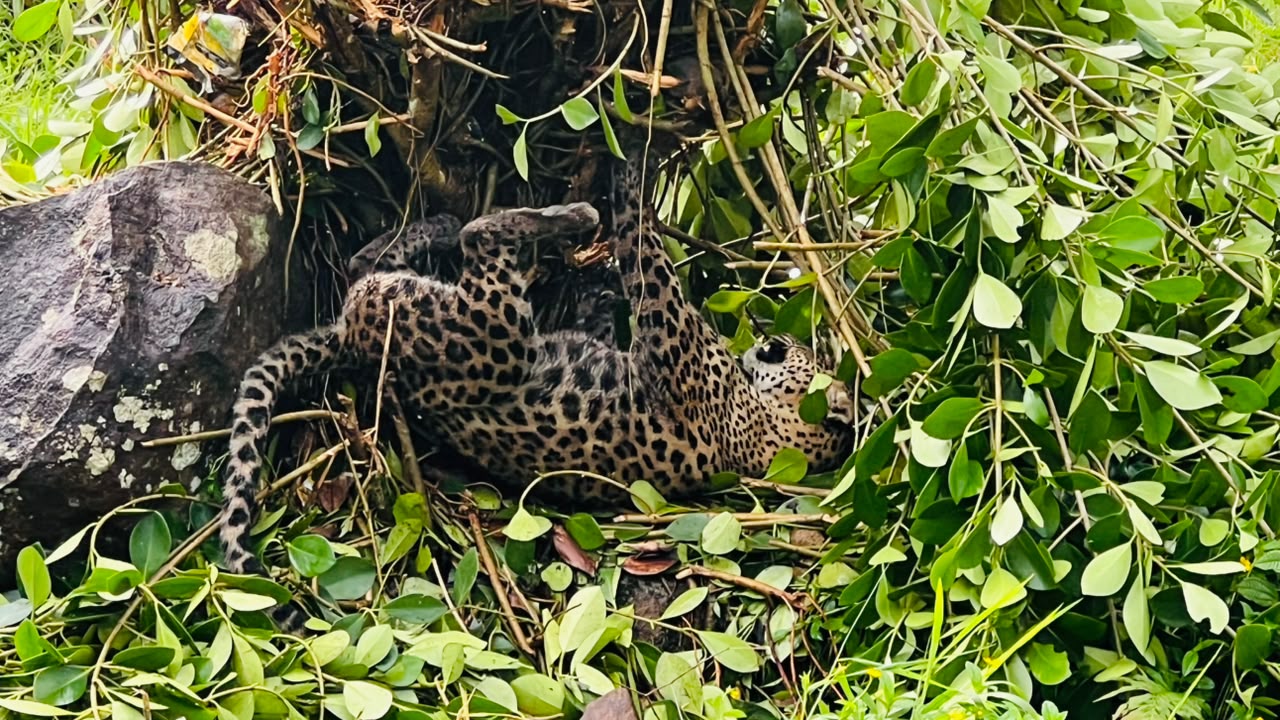
A young female leopard rescued after being caught in a wire snare in Sri Lanka’s Central Highlands spotlights the continuing threat posed by indiscriminate traps often setup for game animals like wild boar.A study analyzing deaths of hill country leopards for 17 years (2008–2024) shows that wire snares accounted for 62.3% of human-induced leopard deaths with known causes in Sri Lanka, with tea plantation landscapes emerging as major mortality hotspots.While improvements in veterinary response have strengthened leopard rescue efforts, conservationists point to shortages of wildlife veterinarians and the need for a separate unit for Sri Lanka’s highlands.Conservationists say that snare-removal efforts must extend beyond elephant habitats, arguing that Sri Lanka needs a broader approach to protect all wildlife from illegal killings. COLOMBO — The stillness of a cold November night at Athad Tea Estate in Norwood in Sri Lanka’s Central Highlands was suddenly shattered by agonizing growls. Awakened by the cries echoing through the darkness, estate workers rushed to check, only to find the horrifying sight of a leopard (Panthera pardus kotiya) caught in a wire snare, writhing desperately to break free from the tightening trap. The trapped animal was a female, approximately 3.5 years old. The wire had severely compressed her flank as she relentlessly struggled to free herself. Officers from the Department of Wildlife Conservation’s (DWC), accompanied by a veterinarian from the veterinary unit at Randenigala, reached the location early morning and anesthetized the agitated animal. Although the compression was severe, she had fortunately escaped major external cut wounds which is common in snared victims, said Akalanka Pinidiya, the veterinarian in charge of the Central Region. Even when the leopard appears to be calm, wildlife officers do not release snared leopards immediately. “When a leopard gets caught in a snare, its struggle to escape can cause serious internal injuries, particularly to organs such as the kidneys, which can prove fatal even though not visible,” said Pinidiya, who has treated a number of such snared leopards. According to the wildlife vet, this leopard is passing feces and urine, and she has even eaten a small portion of meat provided. “These are encouraging signs that there are no serious internal damages, but the leopard will remain under observation for a few more days before the release,” Pinidiya told Mongabay. This GPS-collared leopard rescued from a snare was released about 20 kilometers (12 miles) away from its original range, but on three occasions swam over a kilometer to return to its original range, demonstrating the challenges associated with rescued leopards being translocated. Image courtesy of Wilderness & Wildlife Conservation Trust. Her fortunate rescue, however, highlights a much wider conservation problem of wire snares continuing to threaten Sri Lanka’s hill-country leopards, often killing animals that are not even the intended targets. Deadly traps in leopard country The Sri Lankan leopard (Panthera pardus kotiya) is the country’s apex terrestrial predator. In the Central Highlands, leopards inhabit a mosaic of tea plantations, forest patches, grasslands and estate settlements. These human-dominated landscapes provide important habitat and prey, but also expose the charismatic cats to traps set by people aiming to hunt wild animals for meat. Wire snares are usually made from strong metal cables arranged in a loop along animal trails. When an animal passes through, the loop tightens around its body or limb. Although commonly set to catch wild boar (Sus scrofa) and sambar deer (Rusa unicolor) for bushmeat, these indiscriminate traps can ensnare leopards and other wildlife. Even elephants can prove unintended victims. A study examining 17 years of human-caused leopard mortality records (2008–2024), documented 164 deaths in Sri Lanka. Of the 138 cases with known causes, wire snares accounted for 62.3%, while poisoning, gunshots and roadkill collectively contributed 31.9%. The study also noted that nearly half of the recorded deaths occurred in plantations, highlighting the dangers facing leopards living in the tea-estate landscape. Floating snares and difficulty of removal The trap involved in the latest rescue was what Pinidiya described as a floating snare. Instead of being fixed to a tree or permanent structure, the wire is attached to a heavy movable pole. A wildlife officer displays snares recovered during an operation in the habitat of an iconic tusker, conducted with armed forces support following the death of Kavantissa. Environmentalists call for such anti-poaching efforts to be extended beyond elephants to protect all wildlife. Image courtesy of the Ministry of Environment. When an animal becomes entangled, it initially drags the pole while attempting to escape. The pole may eventually become lodged against vegetation or rocks, leaving the animal trapped. This method is believed to make it harder to associate a trap with a particular property, for which the owner of property could be penaliszed. Palinda Perera, a naturalist who work in Sri Lanka’s central highlands and has been involved in removing snares voluntarily, says locating these traps are difficult. Perera has personally tested the strength of one such trap by attempting to pull himself free and said he could hardly move. Perera, who removes these logs with wires, said that combinations of these are too heavy to carry away. Perera believes regular patrols could help prevent illegal trapping and protect wildlife. Releasing rescued leopards Treating a snared leopard medically is only part of the challenge as deciding where to release it after treatment can be equally complicated, says Anjali Watson, managing trustee at The Wilderness and Wildlife Conservation Trust (WWCT), an organization that focuses on studying leopards. Returning an animal to the exact location where it was caught could expose it to the same threats, particularly if snares remain in the area. However, relocating it to a distant protected area may not necessarily be the safest solution either, she added. Palinda Perera, a naturalist in Sri Lanka’s Central Highlands, demonstrates the strength of a floating wire snare by placing it around his waist and attempting to escape. He could hardly move, highlighting the plight of animals caught in these traps. Image courtesy of Palinda Perera. A 2025 scientific paper on the rescue, treatment, release and monitoring of an injured Sri Lankan leopard, co-authored by leopard conservationists and wildlife veterinarians including Watson offers important insights. The researchers documented the rescue of a young male leopard caught in a snare at another tea estate in central Sri Lanka in December 2022. After surgery and four months of veterinary treatment, the leopard was fitted with a GPS collar and released in a protected area around 20 kilometers (12.4 miles) from where it had been caught. The release site was selected partly to avoid returning the animal to a human-dominated landscape where it could be caught in another snare, Watson said. But the leopard had other plans. GPS tracking revealed that the leopard made immediate, clear and rapid directional movements toward its original range. Remarkably, it swam across three stretches of open water in the Randenigala Reservoir, swimming more than a kilometer (0.62 mi) before reaching an agricultural landscape approximately 10 kilometers (6.2 mi) from its original capture site within three weeks. Based on these observations, Watson cautions against translocating rescued leopards unless there is little alternative. Rather than releasing them in distant, unfamiliar habitats, the researchers recommend a relatively secure location closer to the original capture area, provided threats can be adequately addressed. In recent years, treatment procedures for snare victims have improved considerably, and the photograph shows an injured leopard being scanned for internal injuries. Image courtesy of Department of Wildlife Conservation. Improving rescue response The latest rescue also highlights logistical challenges. The veterinary team for the central wildlife region is stationed at Randenigala, which is more than 100 km (62 mi) from where leopard snaring incidents are being reported frequently. Pinidiya agreed that a dedicated rapid-response capacity in the hill country would help reduce delays, but the shortage of wildlife veterinarians remains a major obstacle. Watson, a leopard conservationist who has worked closely with the DWC veterinary team, said rescue, treatment and release procedures had improved compared to the past. Pinidiya provides data to back this claim. He says that in 2025 alone, he dealt with 30 snared leopards and 22 of them have been successfully rescued and released back to the wild. Watson says that the Randenigala facility has the necessary space and enclosures for rescued animals, but the bigger problem, according to her, is the continued fixing of snares. Rescue operations themselves can be dangerous. Pinidiya recalls an incident a few months ago when a leopard overpowered him while attempting to dart a fully grown male leopard, resulting in scratches and minor injuries. Another wildlife veterinary surgeon, Malaka Abeywardana, too was attacked while trying to release a snared leopard in 2023. Protecting wildlife beyond elephants In the aftermath of iconic tusker Kavantissa’s death, the Sri Lankan Government has initiated a collaborative program involving the armed forces to protect high-risk elephants. Snare-removal programs too had been conducted in areas frequented by these tuskers. Rajika Gamage, a conservation activist in the hill country, welcomed these efforts but said similar initiatives should extend to other wildlife habitats across the country. “We cannot discriminate and try to protect only the elephants. All creatures are part of nature, and measures have to be taken to protect wildlife as a whole,” Gamage told Mongabay. Snares are setup along animal trails, primarily targeting game species such as wild boar, and are not easy to detect. Image courtesy of Palinda Perera. Following tusker Kavantissa’s death, the government pledged to establish an Elephant Transit Home (ETH) with facilities to treat injured elephants in close proximity to the habitats of several iconic tuskers. The nearest existing facility is more than 200 km (125 mi) away from where the majority of snare incidents are recorded. A similar gap exists in leopard rescue services. “Snared leopards need urgent attention. Every passing minute increases their struggle to escape, tightening the wire loop further and reducing its chance of survival, so a facility closer to the hill country is a dire need,” Gamage told Mongabay. While Sri Lanka steps up efforts to protect its iconic elephants, leopards and numerous other wild animals continue to fall victim to illegal snares and poaching efforts, conservationists say. The rescued female may soon return to the tea-covered slopes of the Central Highlands. But without sustained snare-removal programs, regular patrols, strong enforcement and community involvement, her fortunate escape may remain the exception rather than the rule, Gamage added. Banner Image: This young female leopard was caught in a wire snare on Nov. 12 inside a tea estate in Sri Lanka central region. Its desperate attempts to escape only tightened the metal wire around its flanks. Image courtesy of Romesh Abeywickrema. Citations: Weerakkody, S., Gunasekara, V., Muhandiram, S., Harapan, T. S., Gunasekara, K. R., Jayasena, B., … & Kudavidanage, E. P. (2026). Human-caused leopard deaths in Sri Lanka are concentrated in Central Highlands’ estate mosaics: Evidence from 17 years of mortality records. Wildlife Letters, 4(3), 107–117. doi: 10.1002/wll2.70040 Kittle, A. M., Watson, A. C., Prasad, T., Pinidiya, M. A., Kumarasiri, A. M. K. N., Kumara, M. A. P. R., …& Hewapathirana, H. D. S. (2025). From snared to swimming: Some observations on the rescue, treatment, release and monitoring of an injured Sri Lankan leopard (Panthera pardus kotiya). Ecological Solutions and Evidence, 6(2), e70029. doi: 10.1002/2688-8319.70029 Credits Topics
Another Sri Lankan leopard caught in a snare. These big cats need protecting, experts say
Full Article
Original Source
Read the full article at News →KhanList aggregates and links to publicly available news content. We do not host full articles from third-party sources. Always verify important information with original sources.