
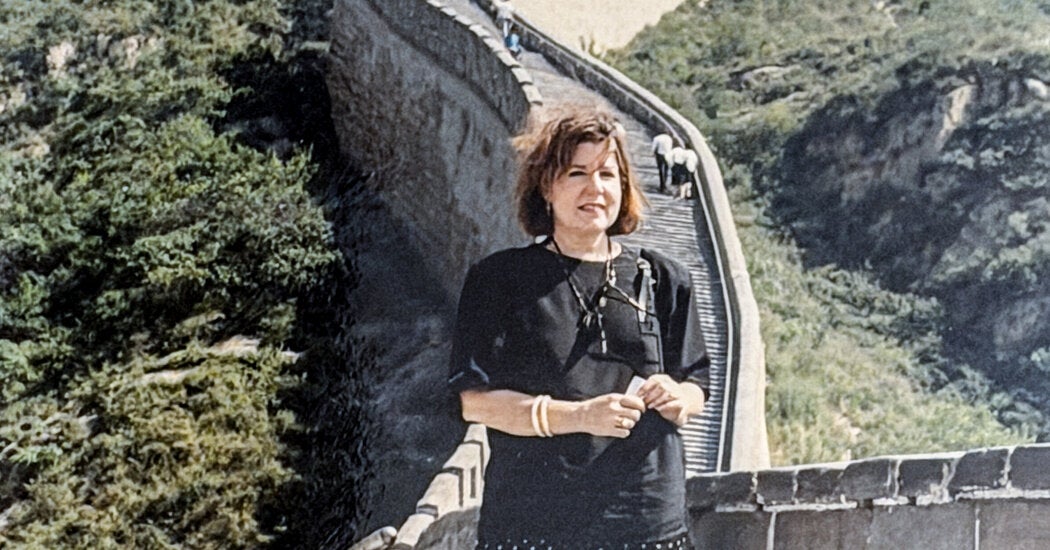
AdvertisementSKIP ADVERTISEMENTDr. Thurston’s works documented Mao Zedong’s personal life and the traumas of the Cultural Revolution, earning scholarly accolades — and scorn from Beijing.Anne Thurston at the Great Wall of China in the 1990s.Credit...via Thurston EstateNov. 17, 2026, 10:34 a.m. ETAnne F. Thurston, an American political scientist and expert on China who co-wrote a best-selling book with Mao Zedong’s longtime personal physician that revealed intimate — and often bawdy — details about the dictator’s personal life, died on Oct. 2 in Alexandria, Va. She was 83.The death, at a senior-care facility, was from complications of dementia, said Adam Nelson, a longtime friend and colleague.“The Private Life of Chairman Mao,” published in 1994 and co-written with Dr. Li Zhisui, was Dr. Thurston’s sole best seller, but she wrote, co-wrote or edited numerous books that, despite being academic in tone, were acclaimed studies of the individual experiences of Chinese people.She often focused on dissidents of one kind or another and how their lives were upended during the transformations of Chinese society in the latter half of the 20th century, beginning with Mao’s decade-long campaign of persecution known as the Cultural Revolution.Image“Anne was one of the greatest and most credible contributors to our understanding of China,” said David Lampton, the former director of the China program at the Johns Hopkins School of Advanced International Studies.Credit...Random HouseDavid Lampton, the former director of the China program at the Johns Hopkins School of Advanced International Studies in Washington, remembered choosing Dr. Thurston in 1999 as one of his first hires.“Anne was one of the greatest and most credible contributors to our understanding of China,” he said. “Hers was a unique mixture of empathy and understanding about why China behaved the way it did, but it never slid into being an apologist. Her sympathy was with people on China’s periphery.”Dr. Thurston was one of the first American political scientists to be granted research access to China during the thaw in U.S.-China relations after Mao’s death in 1976. After an initial visit three years later, Dr. Thurston spent much of her career going back and forth to China.In a personal statement she wrote while working as a researcher at the Wilson Center in Washington, one of the think tanks, universities and other institutions with which she was affiliated over the decades, she said her mission was “to listen to Chinese people tell their stories — and then to relate those stories here in the West in a way that makes sense to both us and the storytellers themselves.”Her trip to China in 1979 was a “turning point,” she wrote. The accounts of the Cultural Revolution relayed to her by Chinese counterparts in political science programs were “at such odds with the official, printed accounts,” she recalled, that she resolved to center her first published book on extensive field work with Chinese intellectuals.ImageMs. Thurston in China in the 1980s, standing in front of a sign indicating a dormitory for foreign students.Credit...via Thurston EstateDozens of interviews, with private citizens and Chinese officials, resulted in what she considered her favorite of all her books, “Enemies of the People: The Ordeal of the Intellectuals in China’s Great Cultural Revolution” (1987).Writing in The New York Times, the Sinologist Merle Goldman called the work “an important book because the victims believe that the more the outside world (as well as the Chinese) knows about what happened in the Cultural Revolution, the less likely it is that such a phenomenon may reoccur.” The Times included the volume on its list of the year’s notable books.But it was Dr. Thurston’s third book, “The Private Life of Chairman Mao,” that received worldwide attention. It was a collaboration with Mao’s personal physician, Dr. Li, who kept journals while he cared for Mao for more than two decades, burned them because he feared retribution during the Cultural Revolution, and then recreated them from memory for the book.She conducted extensive interviews with Dr. Li, who began living in the United States in 1988, followed by separate research to confirm details, and she basically wrote the book.“The Private Life of Chairman Mao” was deemed so newsworthy that, soon before its official publication day, it merited a front-page article in The Times, although the reporter credited Dr. Thurston only once, in passing, as Dr. Li’s “editorial assistant.”The Times review that followed, by the historian Marilyn B. Young of New York University, credited her correctly as the co-author and recounted the book’s descriptions of “Mao’s appetite for young women and fatty pork, his addiction to sleeping pills, his adherence to esoteric Taoist sexual practices, his reluctance to bathe or brush his teeth.”The most intimate portrait of Mao ever released, it became an international best seller and was denounced by the Chinese government as slander. The authorities took issue with Dr. Li’s characterizations of how Mao’s tyrannical attitude led to disastrous policy choices, but the salacious details garnered much of the public’s attention.Mao's sprawling sex life had been alluded to in other works, but the stories Dr. Li recounted in his book with Dr. Thurston spoke to a closeness to the man that others simply didn’t have.ImageMs. Thurston with the Dalai Lama in about 2015 as he held a copy of her book “The Noodle Maker of Kalimpong: the Dalai Lama’s Brother and His Struggle For Tibet.” Credit...via Thurston EstateDr. Li recalled, for instance, how Mao had repeatedly sent him young women with symptoms of the protozoan parasite Trichomonas vaginalis, which is sexually transmitted. “The young women were proud to be infected,” he and Dr. Thurston wrote. “The illness, transmitted by Mao, was a badge of honor, testimony to their close relations with the Chairman.”Anne Elizabeth Fritter, the older of two sisters, was born on July 16, 1943, in Manhattan. Her father was Lee W. Fritter, an Army colonel, and her mother was Aileene (O’Dea) Fritter.She graduated in 1965 from Tufts University with a bachelor’s degree in government and received a master’s degree (1966) and a doctorate (1974), both in political science from the University of California, Berkeley.Her marriages to Thom B. Thurston and Patrick G. Maddox ended in divorce. She is survived by a sister, Mary Fritter of Germantown, Md.Later in her career, Dr. Thurston’s attention shifted to Tibet. For years, she directed the Grassroots China Initiative at the School of Advanced International Studies, often taking groups of researchers and students to Tibet. Beginning in 2012, Beijing refused her a visa, and she never returned to China.In a tribute to her, Yawei Liu, the senior adviser on China to the Carter Center, another Washington think tank Dr. Thurston was affiliated with, said she was a “bridge between scholars and the public long before the concept of the public intellectual was coined.”Moreover, he wrote, she exuded a sense of style and “no matter where she was or where she was going, she always dressed elegantly,” even in rural areas of Tibet.Her final book, “The Noodle Maker of Kalimpong: the Dalai Lama’s Brother and His Struggle For Tibet” (2015), was co-written with Gyalo Thondup, the 14th Dalai Lama’s elder brother. It documented the story of Mr. Thondup’s decades as his family’s secret diplomatic middleman between officials in China, India and the United States.Noel Millea contributed reporting.Max Bearak is a correspondent for The Times focusing on breaking and international news.Related ContentAdvertisementSKIP ADVERTISEMENT
Anne Thurston Has Died. She Revealed Salacious Details of Mao’s Life.
Full Article
Original Source
Read the full article at Nytimes →KhanList aggregates and links to publicly available news content. We do not host full articles from third-party sources. Always verify important information with original sources.